The short answer: split it, stay consistent, and pick the clock that matches your reason
One real rule, one small trial, one honest gap.
If your daily magnesium dose is on the larger side, split it into two or more portions through the day. That advice traces to an actual regulatory document. It exists for your stomach, not for a bigger effect.
Pick a clock time that matches your reason for taking it. Morning, for a routine anchor. Evening, if sleep is the point. Then keep that same time every day. Consistency, not the hour on the clock, is the part every trial below actually measured.
Food or no food comes down to your own stomach. The one label we checked argues both sides, on the very same day.
The three numbers on one card: 2+ portions (EFSA/SCF 2001), Cohen's d 0.2 (2025 trial), certainty low to very low (2026 review)
The only timing advice with a primary source behind it, and it is about avoiding stomach upset, not raising your magnesium level.
EFSA/SCF opinion, 2001
A small effect on self-reported sleep quality, from 250 mg dosed once daily for weeks, never split by time of day.
How a 2026 systematic review of 12 randomized trials rates the certainty of the sleep evidence.
All three figures are read and cited section by section below, with the date we read each one.
Splitting the dose is the timing rule with a document behind it, and it is about tolerance
The document is the Scientific Committee on Food's Tolerable Upper Intake Level opinion for magnesium, expressed in 2001.
"A given daily dose of Mg is better tolerated when it is divided into several portions."
EFSA / SCF, Tolerable Upper Intake Level of Magnesium, 2001That sentence sits inside a bigger finding. The opinion sets a ceiling of 250 mg a day for magnesium from supplements, water and fortified food, separate from whatever you get from a normal diet. Go past that ceiling without a split, and mild diarrhoea starts showing up. It hits a small share of adults, at daily doses around 360 to 365 mg.
It is a comfort rule, written by people studying gut tolerance, not a rule about when your body absorbs more magnesium.
The opinion's own scope note: the 250 mg ceiling was built from split doses, and the source line
Search "best time to take magnesium" and most pages guess. One European regulatory opinion actually says something, and it says it about splitting, not about the clock.
The ceiling itself assumes a split dose. Read the opinion's own scope note.
"While the UL is expressed as a daily intake it should be noted that most of the studies used in its derivation involved daily intake obtained from two or more doses. Therefore the UL should apply to daily intake of Mg consumed on two or more occasions."
EFSA / SCF, same opinion, 2001So the 250 mg figure was not built from people swallowing one large dose at once. Most of the underlying studies split it.
EFSA / Scientific Committee on Food, "Opinion on the Tolerable Upper Intake Level of Magnesium," expressed 26 September 2001. Read from the EFSA compendium PDF, September 3, 2026.
Does splitting raise your magnesium levels? An animal study says be careful with that claim
A 2019 study in mice tested exactly that question. Researchers gave one group a single higher dose, and gave a matched group the same total dose split into two portions twelve hours apart. This is an animal study, not a human trial, and the doses were scaled to a mouse's body weight. Keep that label on it every time it comes up.
"We showed that dividing high doses of daily administered magnesium compounds did not sufficiently increase tissue magnesium levels."
Ates et al, Biol Trace Elem Res, 2019So the honest split of the evidence looks like this. Splitting for a calmer stomach: one real human-relevant document says yes. Splitting to push your magnesium level higher: the only study we found says no, and it was run in mice.
Tolerance versus absorption, the exact mouse doses (405 mg-equivalent versus two 202.5 mg portions), and the citation
Tolerance and absorption are two different rails, and it is easy to slide a claim from one onto the other. The rail above is about comfort. This one is about whether splitting a dose puts more magnesium into your body, and here the evidence runs the other way.
Splitting a 405 mg-equivalent dose into two 202.5 mg portions did not push more magnesium into tissue than the single larger dose did.
Ates M, Kizildag S, Yuksel O, et al. "Dose-Dependent Absorption Profile of Different Magnesium Compounds." Biol Trace Elem Res 2019 Dec;192(2):244-251. PMID 30761462, read September 3, 2026.
Morning or night: what the evening trials measured, and how small it was
No trial in our file compared the two clock times. The closest evidence is a 2025 trial that dosed magnesium once a day and tracked sleep over weeks. 155 adults who reported poor sleep took 250 mg of elemental magnesium, as bisglycinate, once daily. A matched group took a placebo.
Both numbers matter here. The result cleared statistical significance by a thin margin, at p = 0.049. The size of the benefit was small by the authors' own label. One more line belongs next to those numbers. The paper itself discloses a conflict. One author runs a contract research firm. It gets some funding from nutraceutical companies.
Nowhere in that trial does a clock time get tested against another. The dose was daily, and the outcome was a questionnaire score, not a same-night measurement.
The trial's own numbers (-3.9 vs -2.3 on the insomnia scale, p = 0.049, Cohen's d = 0.2) and the citation
The trial measured change on a standard insomnia scale over the trial period.
"-3.9 [95% CI: -5.8 to -2.0] vs -2.3 [95% CI: -4.1 to -0.4], respectively; p = 0.049... The effect size was small (Cohen's d = 0.2), indicating a modest benefit. No significant differences were observed in other psychological outcomes."
Schuster, Cycelskij, Lopresti, Hahn, Nat Sci Sleep, 2025That does not make the result false. It is worth knowing, before you read 250 mg a day as a settled answer.
Schuster J, Cycelskij I, Lopresti A, Hahn A. "Magnesium Bisglycinate Supplementation in Healthy Adults Reporting Poor Sleep: A Randomized, Placebo-Controlled Trial." Nat Sci Sleep 2025 Aug 30;17:2027-2040. Read via PubMed record, September 3, 2026.
The freshest synthesis is the least excited one
Published online 28 August 2026, a systematic review pooled twelve randomized controlled trials of oral magnesium for sleep.
"Certainty of evidence was low to very low. Current evidence does not support oral magnesium as a routine treatment for insomnia. It may provide modest benefits for selected subjective outcomes in some adults, but the findings are inconsistent, and the certainty of the evidence is low or very low."
Lopresti, Smith, Drummond, J Diet Suppl, 2026An earlier review, covering 7,582 people across nine studies, found the same split by study design.
"Observational studies suggested an association between Mg statuses and sleep quality, while the RCTs reported contradictory findings."
Arab, Rafie, Amani, Shirani, Biol Trace Elem Res, 2023What that split between observational studies and trials means, and both citations
One small trial is not the whole picture. The most recent review of the whole field is, and it landed only days before this page.
Put plainly: the papers that just watch people over time see a pattern. The trials that actually test magnesium against a placebo do not agree with each other. That gap, not a single trial's result, is where the evidence actually sits right now.
Lopresti AL, Smith SJ, Drummond PD. "Magnesium Supplementation for Sleep in Adults: A Systematic Review of Randomized Controlled Trials." J Diet Suppl 2026 Aug 28 (online ahead of print). Arab A, Rafie N, Amani R, Shirani F. "The Role of Magnesium in Sleep Health." Biol Trace Elem Res 2023;201(1):121-128, PMID 35184264. Both read September 3, 2026.
With food or on an empty stomach: one company, two instructions, same day
We read two documents from the same company, BiOptimizers, for our Magnesium Breakthrough review, both on September 3, 2026.
"Take 2 capsules daily, preferably with a meal or as directed by a healthcare professional."
"Because Magnesium Breakthrough is taken on an empty stomach... Taking it without food in your stomach allows for maximum absorption."
We did not find a study that tested magnesium with food against magnesium without food. Not for absorption. Not for sleep. Both instructions above are marketing and labeling copy, not trial results.
Why the honest fallback is your own stomach, and where each instruction was read
Here the question is not what the trials say. It is what one manufacturer's own documents say, and they do not agree with each other.
Same capsules. Same company. One document tells you to eat first. The other tells you not to.
When a label and a sales page disagree like this, the honest fallback is your own stomach. Some people tolerate magnesium better with a meal. If yours does not react either way, the choice is genuinely yours to make.
Label directions from BiOptimizers' own Supplement Facts panel; sales-letter wording from the company's own sleep sales page. Both read September 3, 2026 for our Magnesium Breakthrough review.
"30 to 60 minutes before bed": where that instruction comes from, and what it is not
The side panel of the same product's label reads, in full:
"For sleep support, take 30-60 minutes before bed."
Magnesium Breakthrough's own label, read September 3, 2026That sentence is a manufacturer direction, printed on packaging. It is not a finding from any of the three trials named on this page.
Which windows the three trials did not test, and why a number on a label reads like data
One more specific number shows up on a real label: a window before bedtime.
None of the three trials on this page tested one bedtime window against another. Not the 2025 trial. Not the 2026 review. Not the 2023 review of 7,582 people. None tested 30 minutes against 60, or either against no fixed window at all.
A specific number on a label reads like data. Here it is a direction a company chose to print, and it is fine as a habit to build, as long as it is not mistaken for a tested result.
Label read from the seller's own product image, September 3, 2026, for our Magnesium Breakthrough review.
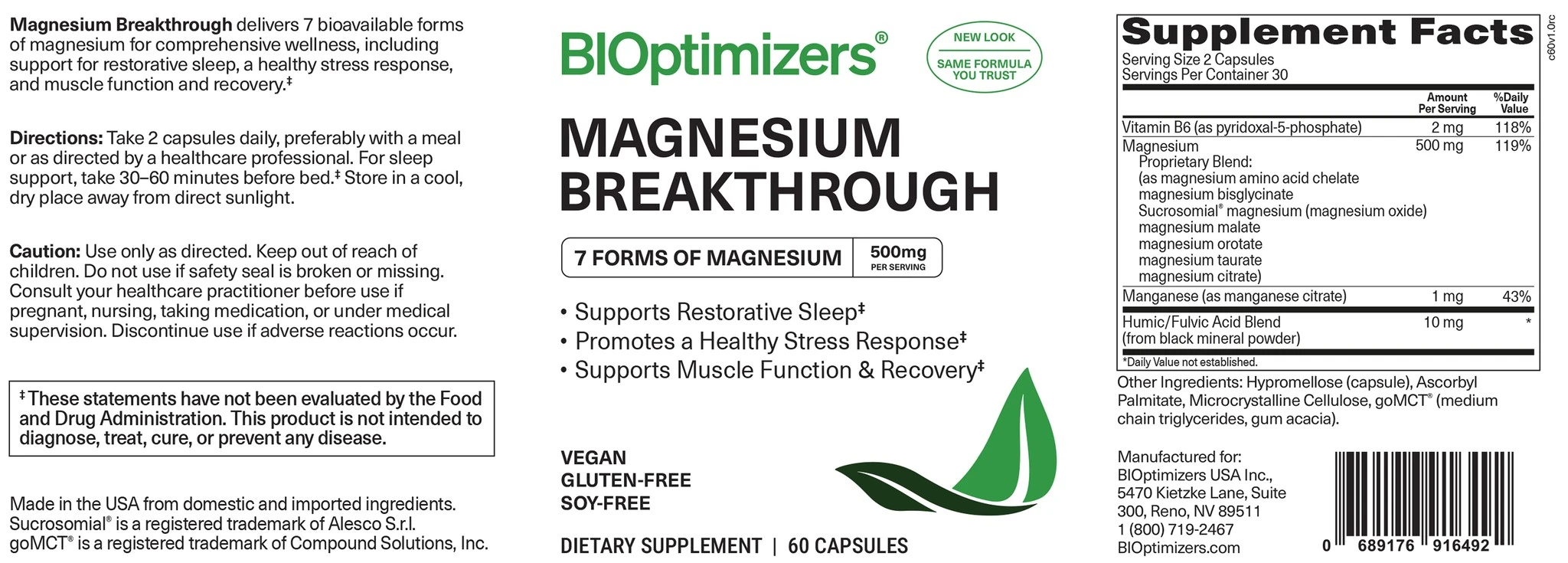
The full label wrap we read for our Magnesium Breakthrough review, September 3, 2026. The Directions line carries both the food instruction and the bedtime window discussed above.
Consistency is the part the trials actually tested
Both sleep studies on this page dosed magnesium every day. Both measured the result weeks later, not the morning after one dose.
No trial in our file crowned a clock time
- Neither sleep trial compared taking magnesium in the morning against taking it at night.
- Neither trial compared taking it with food against taking it on an empty stomach.
- Both measured a daily habit sustained over weeks, never a single dose timed to a single night.
- No source in our file supports one clock time working better than another, for anyone.
What this means for you: the habit the trials rewarded was showing up every day, at whatever time you actually keep.
A timing plan you can hold to
Three steps (split, pick a clock, let your stomach decide), what a fixed routine gives you and does not, and three generic alternatives
Split a bigger dose
If your daily total is on the higher side, take it in two sittings rather than one. This is for stomach comfort, per the EFSA opinion above, not a bigger effect.
Pick a clock and keep it
Morning if you want a routine anchor. Evening if sleep is your reason. Every trial above dosed daily and measured weeks later. The clock time was never the tested variable; showing up every day was.
Let your stomach decide on food
One label argued both sides in the same day. If magnesium alone upsets your stomach, take it with a meal. If it does not, an empty stomach is not documented as worse.
What a fixed routine gives you
- A habit you will actually keep for the weeks a trial ran, not just the first few days.
- Fewer stomach complaints, if you split a bigger dose the way the tolerance rule describes.
- One less daily decision to make.
What it still does not give you
- Proof that one clock time beats another for sleep, absorption, or anything else.
- A guarantee that the small effect in one 2025 trial applies to you.
- Certainty about food timing: the same company's own two documents disagree.
A fixed schedule alone will not fix a sleep problem that keeps going. If that is where you are, three generic alternatives are worth naming, none of them a specific brand.
A smaller, single dose taken with dinner, for a stomach that reacts to magnesium alone.
A single-form product, such as a citrate or a glycinate, with the milligram amount printed per capsule. That is a dose you can actually check against a trial.
Or working on the timing habit itself, such as a fixed wind-down routine, before adding another supplement on top of it.
Questions people also ask
Should magnesium be taken in the morning or at night?
The trials we have dosed daily and measured over weeks, without comparing one clock time against another. The most recent systematic review, from August 2026, rates the certainty of the sleep evidence as low to very low.
Does a meal change how magnesium is absorbed?
It depends which of the manufacturer's documents you read, and in the case we audited the two disagree on the same day: the printed label says "preferably with a meal", the sales letter says the product is taken on an empty stomach.
Is it better to split a magnesium dose across the day?
For tolerance, yes, and that is the only timing rule with a document behind it: the European opinion says a daily dose is better tolerated when divided into several portions, and that the 250 mg/day ceiling itself applies to intake taken on two or more occasions. For raising levels, a mouse study found no gain from splitting high doses.
How long before bed should magnesium be taken?
One label we transcribed prints "For sleep support, take 30-60 minutes before bed". That is a manufacturer direction: none of the trials we read tested that window against another.
How long does magnesium take to make a difference to sleep?
The 2025 bisglycinate trial measured a small effect over the trial period (Cohen's d 0.2). The 2026 synthesis of twelve randomised trials rates the certainty of the evidence low to very low and calls the findings inconsistent across subjective outcomes.
How we built this page
Every source, the date we read it, and what this page is not
This is a source-reading page. It is not a lab test, and it is not medical advice.
- The split-dose tolerance rule and the 250 mg/day ceiling come from EFSA / SCF, "Opinion on the Tolerable Upper Intake Level of Magnesium," expressed 26 September 2001, read from the EFSA compendium PDF on September 3, 2026.
- The mouse study on splitting and tissue magnesium is Ates et al, Biol Trace Elem Res 2019, PMID 30761462, read September 3, 2026.
- The 2025 evening-dosed sleep trial is Schuster, Cycelskij, Lopresti and Hahn, Nat Sci Sleep 2025, read via its PubMed record on September 3, 2026.
- The 2026 systematic review is Lopresti, Smith and Drummond, J Diet Suppl, published online 28 August 2026, read September 3, 2026.
- The 2023 review of 7,582 people is Arab, Rafie, Amani and Shirani, Biol Trace Elem Res 2023, PMID 35184264, read September 3, 2026.
- The label directions and the sales-letter wording were read from BiOptimizers' own materials on September 3, 2026, for our Magnesium Breakthrough review.
- A new supplement, or a change in how much you take, is worth a conversation with a doctor first, especially if you are pregnant, nursing, or on medication.
The label whose own two documents disagree
A timing question gets strange when the same company answers it twice, differently, on the same day.
What the full review lays out, and two tips for reading any Directions line
We read both documents, the printed panel and the sales letter behind the buy button, and then read the checkout too.
The full review lays out the label line by line, the food-timing contradiction above in its original context, and six order forms we actually rendered, with the totals that came back.
Read the Directions line before you read anything else on a panel. It is where a food instruction and a bedtime window both live, in the manufacturer's own words.
When a label and a sales page disagree, hold neither one as settled science. Check what a trial actually tested before you follow either one.
The full label panel, the food-timing contradiction, and the six checkout totals, each dated.