The short answer: one number is a total, the other is a supplement ceiling
The first number is how much magnesium you should get in a day, in total.
That total counts every source: food, water, and any supplement you take.
The American RDA table puts that total at 310 to 420 milligrams a day, depending on age and sex.
The second number is a ceiling, not a target.
It applies only to supplements, and it sits much lower: 250 milligrams a day.
A supplement serving of 500 milligrams sits above that ceiling before you eat anything else that day.
The RDA range across adult ages and sexes, per the American table the EFSA opinion reproduces.
EFSA's Tolerable Upper Intake Level for supplemental magnesium. Food magnesium is not counted.
Magnesium Breakthrough's own Supplement Facts panel, per two-capsule serving.
The intake targets, in milligrams, by age and sex
The intake target is not one number. It changes by age and by sex.
| Group | EAR | RDA |
|---|---|---|
| Men, 19–30 years | 330 mg | 400 mg |
| Women, 19–30 years | 255 mg | 310 mg |
| Men, 31–70 years | 350 mg | 420 mg |
| Women, 31–70 years | 265 mg | 320 mg |
| Pregnancy | +35 mg | not set |
Table 2 of the SCF/EFSA opinion on the tolerable upper intake level of magnesium, headed "EAR and RDA for magnesium (FNB, 1997)". Read via efsa.europa.eu on September 3, 2026.
This is the American RDA. The EFSA opinion simply reprints it for reference; it is not a European recommendation.
The supplement ceiling: 250 mg a day, and exactly what it does not count
First, it is a supplement-only number. Magnesium bound inside food does not count toward it, by the opinion's own words.
Second, it sits well below the RDA total: 250 mg against an RDA of 310 to 420 mg.
EFSA's own sentence, quoted: a UL of 250 mg for readily dissociable salts and compounds like MgO, not including magnesium normally present in food
This is a different number from the RDA above, and it covers a narrower thing: supplements only.
"...an UL of 250 mg Mg per day can be established for readily dissociable magnesium salts... and compounds like MgO in nutritional supplements, water, or added to food and beverages. This UL does not include Mg normally present in foods and beverages."
SCF/EFSA opinion on the tolerable upper intake level of magnesium (2001)So a person can eat an RDA-level diet and still stay under the supplement ceiling. The two numbers are counting different things.
Where that ceiling came from: mild diarrhoea as the most sensitive effect
Regulators work back from the point where a real effect starts to show up: no laxative effect up to 250 mg a day (the NOAEL), mild diarrhoea in a small percentage of adults at about 360/365 mg a day (the LOAEL).
Both EFSA sentences, quoted: the 250 mg NOAEL and the 360/365 mg LOAEL, with mild diarrhoea as the most sensitive effect
"No laxative effects have been observed in adult men and women, also during pregnancy and lactation, at doses up to 250 mg Mg per day. Therefore, this dose is considered as being the no-observed-adverse-effect level (NOAEL)."
SCF/EFSA opinion on the tolerable upper intake level of magnesium (2001)One step above that dose, a small share of adults start to notice something.
"mild diarrhoea occurs in a small percentage of adult subjects at oral doses of about 360/365 mg Mg per day, hence presenting the LOAEL... mild diarrhoea can be taken as the most sensitive non-desirable effect if Mg supplements are taken for nutritional purposes."
SCF/EFSA opinion on the tolerable upper intake level of magnesium (2001)A few rows from the same opinion's own diarrhoea table show how uneven that effect is, by dose and by salt.
| Dose (elemental Mg) | Salt | Diarrhoea |
|---|---|---|
| 250 mg/day | Hydroxide | 0 of 31 |
| 365 mg/day | Aspartate HCl | 1 of 278 |
| 365 mg/day | Lactate/Citrate | 4 of 17 |
| 476 mg/day | Oxide, capsules | 18 of 50 |
Table 2 and Table 3 of the SCF/EFSA opinion on the tolerable upper intake level of magnesium (2001), read via efsa.europa.eu, September 3, 2026. Table 3's own footnote: doses are "referred to elemental Mg".
Absorption is not linear: 65% at the bottom of the range, 11% at the top
Doubling the milligrams on a label does not double what the body actually takes in.
"Although absorption increased with each increment in intake, fractional magnesium absorption fell progressively (from 65% at the lowest to 11% at the highest intake)."
Fine et al., 1991 · PMID 1864954Two more findings from Fine 1991: almonds absorbed as well as magnesium acetate, and enteric-coated chloride absorbed far worse (PMID 1864954)
The same trial made two other findings worth keeping.
Almonds, a food source, were just as absorbable as soluble magnesium acetate, a supplement salt.
And enteric-coated magnesium chloride was absorbed far worse than plain magnesium acetate, a sign that coating itself can get in the way.
Fine KD, Santa Ana CA, Porter JL, Fordtran JS. J Clin Invest 1991 Aug;88(2):396-402. PMID 1864954, PMC295344, read September 3, 2026.
None of this sets a personal dose for you
Every document behind this page describes a population, or a controlled trial. None of them describes you specifically.
- The RDA table gives population averages by age and sex, not an individual prescription.
- The 250 mg ceiling describes tolerance in most adults. It says nothing about a benefit above 250 mg.
- The absorption trial measured single, closely controlled doses in a research setting, not everyday supplement habits.
- No source in our file says a bigger serving works better than a smaller one, for a given person.
What this means for you: these are real numbers from real documents. None of them replaces a conversation with a clinician about your own diet and health history.
"119% Daily Value" is a third number again, and it is a labelling reference
Magnesium · 500 mg · 119%
Magnesium Breakthrough's own panel, read September 3, 2026That 119% is not 119% of your own personal requirement.
What the %DV is (a labelling reference), the one distinction it does not make, and where that 500 mg sits against the 250 mg ceiling and the 360/365 mg threshold
That 500 mg is supplemental magnesium, the exact category the 250 mg supplement ceiling covers. It also sits above the 360/365 mg mild-diarrhoea threshold from the section above.
The %DV is a labelling reference. It does not tell you whether a milligram came from food or from a capsule. That is the one distinction the 250 mg ceiling actually makes.
What a 500 mg per serving label reads like against all three numbers
Line up the label against the three numbers above, and the gap gets easy to see.
Total target, food and supplement combined.
EFSA's UL, supplements only.
Where the sentinel effect starts to show.
Two capsules, per the panel we read.
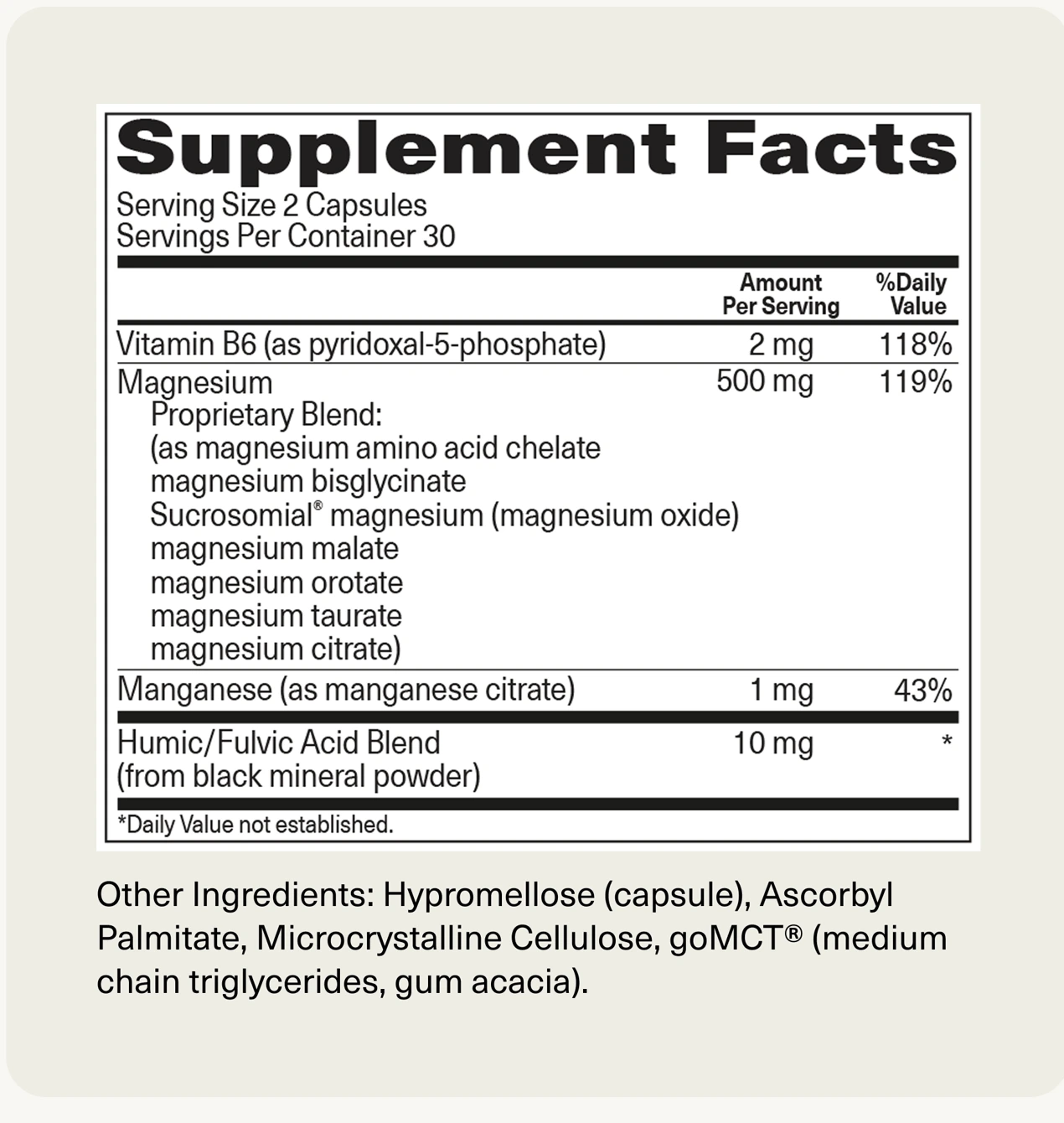
This is the panel we transcribed on September 3, 2026: one elemental magnesium line, 500 mg, 119% DV.
Below that line sits a Proprietary Blend naming seven forms of magnesium, with no split published for any single one.
The 500 mg is above the supplement ceiling, above the mild-diarrhoea threshold, and above every RDA row in the table further up this page.
What a printed elemental line gives you (a number to compare against the RDA, the ceiling and the LOAEL) and what it still does not (no accounting for food, no per-form split, no reason to assume more works better)
What a printed elemental line gives you
- A single number you can compare directly against the RDA, the ceiling and the LOAEL above.
- A figure the maker has committed to in print, on the panel itself.
- A way to see, in one glance, whether a serving sits above or below the 250 mg ceiling.
What it still does not give you
- Any accounting for magnesium you already get from food or another supplement that day.
- A published split of how much of the 500 mg comes from each of the seven named forms.
- A reason to assume a bigger serving works better than a smaller one that stays under the ceiling.
Three alternatives when a serving sits above the ceiling: a lower-dose single form, a split dose, or food
When a serving sits above the ceiling, three honest alternatives exist.
A lower-dose, single-form product that stays under 250 mg of supplemental magnesium on its own.
Splitting a higher-dose serving across two times of day. A divided dose is generally better tolerated than the same total taken at once.
Or leaning more on food, where the 250 mg ceiling does not apply at all.
When a sales page prescribes more than the label does
The label we read says to take two capsules a day: 500 mg elemental.
A sales letter reached from an link on this page for the same product says something else.
"...it may disrupt your digestive system because magnesium draws water. Reduce the dosage by 1 capsule if that happens."
The seller's own sales letter, read for our Magnesium Breakthrough reviewThe six-week loading protocol on that page (up to 5 capsules, about 1,250 mg a day, then 4 capsules, about 1,000 mg), EFSA's 2,500 mg hypermagnesaemia line, and what we are not doing
That caution sits inside a six-week "Magnesium Loading Protocol" printed on the same page.
It rises to 5 capsules a day in weeks 3 to 6, about 1,250 mg elemental. It then holds at 4 capsules a day, about 1,000 mg.
Both figures are well above the label's own 2-capsule, 500 mg serving.
One piece of context only the primary source supplies: EFSA places toxic hypermagnesaemia "only... at oral Mg doses greater than 2,500 mg", so the practical risk in that protocol is digestive tolerance, not poisoning.
Even so, it is the seller's own page telling you to cut back if your digestion reacts. We print both documents here. We are not prescribing a dose.
Two things worth doing before you raise your own dose
Add up what you already take
Compare your total, food plus every supplement, against the RDA range above (310 to 420 mg). Do not compare it only against the number on one new bottle.
Split the dose, and ask first
A given daily dose is generally better tolerated when divided into two or more portions, per the same EFSA opinion cited above. A new supplement is worth a doctor's input first, especially with kidney issues or on medication.
Questions people also ask
How much magnesium should an adult get per day in total?
By the 1997 Food and Nutrition Board table reproduced in the EFSA opinion: an RDA of 400 mg (men 19-30), 420 mg (men 31-70), 310 mg (women 19-30) and 320 mg (women 31-70). The table's pregnancy row adds 35 mg to the EAR and sets no RDA.
Is there a separate limit for magnesium that comes from supplements?
Yes. EFSA set a Tolerable Upper Intake Level of 250 mg per day for readily dissociable salts and compounds like MgO in supplements, water and fortified food, and the opinion states explicitly that this ceiling does not include magnesium normally present in foods and beverages.
Is 500 mg of magnesium in one serving too much?
That is not a yes-or-no question and it does not replace a clinician. What the documents say: 500 mg of supplemental magnesium sits above the European 250 mg/day ceiling and above the 360/365 mg/day LOAEL, the sentinel effect being mild diarrhoea; EFSA places toxic hypermagnesaemia only above 2,500 mg taken orally.
Does taking more magnesium mean absorbing more of it?
Not proportionally. Fine and colleagues (1991) measured fractional absorption falling from 65% at the lowest intake to 11% at the highest. Total absorption still rose, but curvilinearly rather than linearly.
What does 119% Daily Value on a magnesium label mean?
That the serving delivers 119% of the reference value used in US labelling. It is not 119% of the reader's requirement: the FNB RDAs vary by age and sex, and %DV does not distinguish magnesium from food from magnesium from a supplement, which is exactly the distinction the 250 mg/day ceiling makes.
How we built this page
This is a source-reading page. It is not a lab test, and it is not medical advice.
Every source with the date we read it, the NIH ODS access error, what we did not estimate, and the doctor-first note
- The RDA table, the 250 mg ceiling and the NOAEL/LOAEL figures come from the SCF/EFSA opinion on the tolerable upper intake level of magnesium (2001). Read via efsa.europa.eu on September 3, 2026.
- The absorption figures (65% and 11%) come from Fine et al., 1991, PMID 1864954, read September 3, 2026.
- The 500 mg, 119% DV line and the seven-form Proprietary Blend come from Magnesium Breakthrough's own label panel. Read September 3, 2026, for our Magnesium Breakthrough review.
- The loading-protocol quote comes from the seller's own sales letter, read the same day for the same review.
- We did not cite a US supplement ceiling from the NIH ODS fact sheet. Its page returned an access error on the date we checked. The ceiling in this piece comes from the EFSA opinion instead.
- We did not test any product. We did not estimate the milligrams inside any single named form of a blend that does not publish that split.
- Nothing here is medical advice. A new supplement, at any dose named on this page, is worth a conversation with your doctor first. This matters most if you are pregnant, nursing, or on medication.
The 500 mg label we read line by line
A number this specific only means something next to a real label. We transcribed one, panel line by panel line, and then priced the six checkouts that sell it.
Add your food and every other supplement to the label's own number before you judge it. The ceiling and the RDA are measuring different totals.
Read the serving size line first. A panel written for two capsules, next to advice to take four or five, changes every number on it.
The full label panel, all seven forms, and the six checkout totals, each dated.