The short answer: one atom, seven partners, two rulebooks
Every form on a magnesium label carries the same mineral; the second word is the partner molecule, and it is what a regulator, a trial, or your gut actually reacts to. A food-bound form "has not been demonstrated to induce diarrhoea nor other adverse effects in healthy persons, probably as Mg is bound to matrices," per a European regulator's own words; supplement salts sit on the other side of that line.
Seven of those partner molecules show up on one widely sold label: an amino acid chelate, bisglycinate, a branded Sucrosomial oxide, malate, orotate, taurate and citrate, adding up to a single 500 mg elemental line, 119% of the Daily Value, per Magnesium Breakthrough's own Supplement Facts panel, read September 3, 2026. Two of the seven have a regulatory paper trail worth reading; one form does not even make the list.
Sources for the framing and the label figures
Physiological framing per the SCF/EFSA opinion on the tolerable upper intake level of magnesium (2001), full text read September 3, 2026. Label figures per Magnesium Breakthrough's own Supplement Facts panel, read September 3, 2026.
The dividing line a regulator drew: food matrix against dissociable capsule
One split predicts a side effect better than any other, and it is not "natural versus synthetic": it is whether the magnesium still sits in food, or breaks apart freely once you swallow it. All seven forms on the label above are supplement salts, on the dissociable side of the line to different degrees. The SCF/EFSA opinion sets 250 mg/day of elemental magnesium as the upper limit for these salts as a supplement; mild diarrhoea showed up at 360-365 mg/day in several trials it reviewed. The US RDA it reproduces runs 310 to 420 mg/day by age and sex, a total-diet target, not a supplement dose.
The regulator's wording verbatim, what magnesium does once absorbed, the EAR and RDA table by group, and the link to the full dose page
"Magnesium in foods derived from plant or animal sources has not been demonstrated to induce diarrhoea nor other adverse effects in healthy persons, probably as Mg is bound to matrices and hence is mostly not easily dissociable... On the other hand, easily dissociable magnesium salts (e.g. chloride or sulphate; included are compounds like MgO becoming readily dissociable after the reaction with gastric hydrochloric acid) which are present in water, many supplements and drugs, exert dose-dependent laxative effects."
SCF/EFSA opinion on the tolerable upper intake level of magnesium, 2001, read September 3, 2026The same source states the mineral's job once absorbed: "Mg is a cofactor in hundreds of enzymatic reactions, many of which involve energy metabolism. It also plays an important role in protein and nucleic acid synthesis and has a stabilizing and protecting effect on membranes."
A US reader knows a different table. Here is the 1997 target from the Food and Nutrition Board, as reproduced in the same EFSA opinion.
| Group | EAR (mg/day) | RDA (mg/day) |
|---|---|---|
| Men, 19-30 years | 330 | 400 |
| Women, 19-30 years | 255 | 310 |
| Men, 31-70 years | 350 | 420 |
| Women, 31-70 years | 265 | 320 |
Table and quotations per the SCF/EFSA opinion on the tolerable upper intake level of magnesium (expressed 2001), read September 3, 2026, at efsa.europa.eu. This is a total-diet target, not a supplement dose. It is a different number from the 250 mg/day upper level above it.
The full RDA-by-age table and the 250 mg supplement ceiling, worked through side by side, are on our how much magnesium per day page.
Form by form, with the trial or the opinion attached
Seven names, seven very different amounts of evidence. Amino acid chelate: in 12 patients with prior ileal resection, whole-group absorption matched oxide (23.5% vs 22.8%), won only among the four worst absorbers, and was better tolerated by all. Bisglycinate: 250 mg elemental daily improved a sleep score slightly more than placebo in 155 adults (p=0.049, d=0.2); a 12-trial review does not support magnesium as a routine insomnia treatment. Sucrosomial: oxide inside a branded shell, ahead of bisglycinate on red-blood-cell magnesium in a 350 mg trial. Malate: the thinnest individually studied of the seven. Orotate: a 2025 EFSA opinion could not establish its safety. Taurate: raised brain magnesium in mice. Citrate: the highest serum magnesium in the one 60-day trial that held dose at 300 mg across forms.
The seven cards with the trial or opinion attached to each, the two form-comparison pages, and the PubMed records
The category name a 2003 head-to-head trial uses, without naming the amino acid. A different paper, on the chelate it calls "diglycinate," ran a trial of 12 patients with prior bowel (ileal) resection: whole-group absorption matched oxide (23.5% vs 22.8%). The chelate won only among the four worst absorbers (23.5% vs 11.8%, p<0.05), and it "was better tolerated by all patients."
Full comparison: magnesium bisglycinate vs glycinate.
The everyday name for magnesium bound to glycine; whether it is the same chelate as the "amino acid chelate" above is not stated in either trial. A 2025 trial gave 155 adults with self-reported poor sleep 250 mg elemental daily. Sleep score improved slightly more than placebo (p=0.049, Cohen's d=0.2, "a modest benefit").
Sleep, not insomnia: a separate review of 12 trials found "current evidence does not support oral magnesium as a routine treatment for insomnia."
A branded delivery technology, trademarked by Alesco S.r.l., whose core on this label is the oxide the panel names in its own parentheses. In a 350 mg trial it beat bisglycinate on red-blood-cell magnesium. The authors add their own caveat: more study is needed on clinical benefit.
More below, including who funded the trial.
The malic-acid salt, and the thinnest individually studied of the seven on this label. It sits in the same absorption literature as the other organic salts, but without a brain- or muscle-specific number we can quote on its own.
A 2025 EFSA opinion could not establish the safety of magnesium orotate dihydrate as a novel food, at the applicant's proposed maximum dose.
Full detail below: the math behind that finding, and what the label does not let a buyer calculate.
The taurine salt, and the source of most "magnesium for the brain" citations. In mice, magnesium acetyl taurate raised brain magnesium at every dose tested. More below, species included.
In the one trial that held dose constant across forms (300 mg/day, 46 healthy adults, 60 days), citrate produced the highest serum magnesium. It beat an amino acid chelate and oxide by day 60.
Full comparison: magnesium glycinate vs citrate.
Chelate and ileal-resection trial: Schuette SA et al., JPEN 1994;18(5):430-5, PMID 7815675. Bisglycinate sleep trial: Schuster J et al., Nat Sci Sleep 2025;17:2027-2040. Insomnia review: Lopresti AL et al., J Diet Suppl 2026.
Sucrosomial trial: Brilli E et al., Eur Rev Med Pharmacol Sci 2018;22(6):1843-51, PMID 29630135. Orotate opinion: EFSA Journal 2025;23(7):e9528. Taurate mouse data: Ates M et al., Biol Trace Elem Res 2019;192(2):244-251, PMID 30761462. Citrate head-to-head: Walker AF et al., Magnes Res 2003;16(3):183-91, PMID 14596323. All records confirmed against PubMed or Europe PMC on September 3, 2026.
The form a European panel could not clear: magnesium orotate, July 2025
Orotate is orotic acid, salted with magnesium, and the acid is what a regulator weighed. EFSA's July 2025 opinion concludes that the safety of magnesium orotate dihydrate "cannot be established under the proposed conditions of use," and records that it has not been authorised for use in EU food supplements. That is a finding about one novel-food application at one proposed dose, not a verdict on any product's blend; but this label lists orotate inside a proprietary blend with no per-form amount published anywhere we found, so a buyer cannot calculate an orotic acid number for the bottle at all.
Both Panel conclusions verbatim, the dose arithmetic (around 5000 mg/day orotic acid, 400 mg/day magnesium, safety margin 0.7), and the sources
"The Panel concludes that the safety of the NF, magnesium orotate dihydrate, cannot be established under the proposed conditions of use."
"As of the date of this scientific opinion, magnesium orotate dihydrate has not been authorised for use in food supplements in the EU under Directive 2002/46/EC."
EFSA Journal 2025;23(7):e9528, PMID 40642284, adopted 25 June 2025, published 10 July 2025, full text read September 3, 2026The math behind it, at the applicant's own proposed maximum: "This intake level corresponds to around 5000 mg/day orotic acid and 400 mg/day magnesium." The safety margin for orotic acid came out at 0.7, below what the Panel treats as adequate.
The gap, not the verdict, is the finding here: the regulator asked a question this kind of label makes impossible to answer.
Opinion text and dose arithmetic: EFSA Journal 2025;23(7):e9528, doi 10.2903/j.efsa.2025.9528, PMID 40642284, full text read via Europe PMC on September 3, 2026. Blend composition per Magnesium Breakthrough's own label panel, read September 3, 2026: seven forms named, no per-form split published.
The form that is missing from most seven-form labels: L-threonate, cleared in March 2024
L-threonate is the newest of the common named forms, built for one pitch: crossing into the brain. EFSA's March 2024 opinion concludes that Mg l-threonate "is safe under the proposed conditions of use" and is a bioavailable source of magnesium, at a maximum corresponding to 250 mg magnesium per day; it says nothing about the brain, memory or cognition. Our transcribed seven-form panel lists no threonate.
The Panel's conclusion verbatim, the 3000 mg per day arithmetic, and the sources
"The Panel concludes that the NF, Mg l-threonate, is safe under the proposed conditions of use. The Panel concludes that the NF is a source from which magnesium is bioavailable."
EFSA Journal 2024;22(3):e8656, PMID 38481468, published 13 March 2024, full text read September 3, 2026At the applicant's proposed maximum: "3000 mg per day... corresponds to ~2730 mg l-threonate and 250 mg magnesium, which also corresponds to the UL for supplemental magnesium from readily dissociable magnesium salts."
What it confirms: a cleared, bioavailable form exists, and a label advertising "all the main forms" can still leave it out.
EFSA Journal 2024;22(3):e8656, doi 10.2903/j.efsa.2024.8656, PMID 38481468, full text read via Europe PMC on September 3, 2026. Seven-form roster per Magnesium Breakthrough's own label panel, read September 3, 2026.
Sucrosomial magnesium: oxide inside a delivery shell, and who paid for the study
The label's own parenthesis: "Sucrosomial® magnesium (magnesium oxide)." Sucrosomial is a branded delivery technology, trademarked by Alesco S.r.l., around the oxide other trials put at 4% fractional absorption on its own (PMID 11794633, Firoz & Graber 2001). In a 350 mg crossover trial it had a statistically significant advantage over bisglycinate in red blood cells, and the authors write that further studies are needed for clinical efficacy; the corresponding author's partenariat on the paper is PharmaNutra S.p.A., Pisa, Italy, a fact a reader deserves before trusting it too far.
The trial's three sentences verbatim, and the PubMed record
"Each subject was administered 350 mg magnesium in different formulations (Sucrosomial magnesium, magnesium citrate, magnesium oxide or magnesium bisglycinate) after 1 week of washout."
"in red blood cells Sucrosomial magnesium had a statistically significant advantage compared to magnesium bisglycinate."
"Further studies are needed to investigate if this advantage turns into more evident clinical efficacy."
Brilli E et al., Eur Rev Med Pharmacol Sci 2018;22(6):1843-51, PMID 29630135, confirmed on PubMed September 3, 2026PMID 29630135, confirmed on PubMed September 3, 2026. Trademark and "magnesium oxide" parenthetical per Magnesium Breakthrough's own label panel, read September 3, 2026.
Taurate, malate and the animal data behind the "brain" claims
Taurate carries the headline "reaches the brain" evidence, and it is animal data: in Balb/c mice dosed at 45, 135 and 405 mg per 70 kg equivalent, magnesium acetyl taurate raised brain magnesium in every group and citrate raised muscle and brain levels dose-independently. Nothing there says what the compound does in a human brain, and no source in our file bridges that gap for any form. Malate is where the evidence runs thinnest: no brain- or muscle-tissue trial we can attribute to it by name. None of this evidence tested the finished seven-form blend; every number describes one compound, at one dose, alone.
The mouse study's wording verbatim, the PubMed record, and the four limits of the evidence
"Brain magnesium levels were found increased in all magnesium acetyl taurate administered subjects. Magnesium citrate increased muscle and brain magnesium levels in a dose-independent manner."
Ates M et al., Biol Trace Elem Res 2019;192(2):244-251, PMID 30761462, confirmed on PubMed September 3, 2026Malate sits in the same organic-acid-salt family as citrate and orotate. That gap, not a hidden risk, is the honest state of the evidence here.
PMID 30761462, confirmed on PubMed September 3, 2026.
None of this evidence tested the finished seven-form blend
Every trial and opinion on this page measured one compound, at one dose, on its own.
- The mouse brain data is animal data. No source here tests any form on a human brain.
- The EFSA opinions on orotate and L-threonate are safety and bioavailability findings. Neither one rules on sleep, stress, or cognition.
- The Sucrosomial red-blood-cell result came from a trial whose corresponding author works for the company that owns the technology. It has not been repeated independently in our file.
- No trial here dosed a seven-form, 500 mg blend as one product. Every number above describes a single form, alone.
What this means for you: one form's trial record does not carry over to a blend that lists it beside six others, at an undisclosed amount.
Reading a multi-form label: itemised is not the same as disclosed
A seven-form label can be entirely honest about its ingredient list. It can still leave one question unanswered.
| What the label prints | Status |
|---|---|
| Total elemental magnesium per serving (500 mg, 119% DV) | Printed |
| All seven form names, listed | Printed |
| Milligrams of any single form inside the blend | Not published |
| Magnesium L-threonate as one of the seven | Absent |
| An orotic-acid exposure a buyer could calculate | Not possible |
The amount of any single form is not published anywhere we found: not the label, the product page, the sales letter, or the FAQ. That one missing line turns the orotate opinion above from an abstract regulatory fact into a real disclosure gap.
The seven names as the label prints them, what an itemised label gives you and does not, and the plain alternatives if the split matters
The label names magnesium amino acid chelate, magnesium bisglycinate, Sucrosomial magnesium (as magnesium oxide), magnesium malate, magnesium orotate, magnesium taurate and magnesium citrate. Together they add up to 500 mg elemental. It is also what "seven forms" means once you know what itemised leaves out.
Panel transcribed from Magnesium Breakthrough's own label, read September 3, 2026.
What a seven-form, itemised label gives you
- A published elemental total you can compare, form-blindly, to another label's total.
- Named forms you can look up individually, form by form, against the trials on this page.
- A public record: if a form later gets flagged by a regulator, you know it is on the ingredient list.
What it still does not give you
- Any way to compute an exposure number for a single form inside the blend, orotate included.
- Evidence that the finished multi-form blend itself was tested in people, at that ratio.
- A guarantee that a form with animal-only brain data will behave the same way in a person.
If the split matters to you, the honest alternatives are plain ones
- A single-form product whose dose you can match, milligram for milligram, to a trial you can read for yourself.
- A multi-form product that publishes the milligrams of each form, not just the names.
- Magnesium from food, where the mineral sits bound to a matrix rather than as a free supplement salt, per the regulatory framing above.
None of these is automatically a better result for you. They are the options that let you check the number yourself instead of taking a label's word for it.
Questions people also ask
How many types of magnesium are used in supplements?
There is no closed list: labels combine organic acid salts (citrate, malate, orotate), amino acid chelates (bisglycinate, taurate) and inorganic compounds such as oxide. The division that matters, in EFSA's wording, is between magnesium bound in a food matrix and readily dissociable salts, which exert dose-dependent laxative effects.
Is magnesium orotate authorised in Europe?
Not as of that opinion: EFSA recorded in July 2025 that magnesium orotate dihydrate has not been authorised for use in food supplements in the EU under Directive 2002/46/EC, and concluded that the safety of the novel food cannot be established under the proposed conditions of use, because of orotic acid exposure.
What is Sucrosomial magnesium?
The label we transcribed defines it in its own parentheses: "Sucrosomial® magnesium (magnesium oxide)", a registered trademark of Alesco S.r.l. The crossover trial comparing it to citrate, oxide and bisglycinate at 350 mg was published by authors whose partenariat on the paper is PharmaNutra S.p.A.
Which type of magnesium reaches the brain?
The most cited evidence is animal: in a mouse study, magnesium acetyl taurate raised brain magnesium in every group and citrate raised muscle and brain levels dose-independently. The European opinion that cleared L-threonate deals with safety and bioavailability and asserts nothing about the brain.
Does a seven-form blend give you more magnesium than a single form?
Not by itself. What delivers magnesium is the elemental line of the serving, and on the label we audited there is only one, 500 mg for all seven forms together, inside a proprietary blend that does not publish how much of each is in there.
How we built this page
This is a source-reading page, not a lab test. Every number on it traces to a document we read, on a date we print.
The two EFSA novel-food opinions, the upper-intake opinion, the five PubMed trials and the label panel, with dates read
- The two EFSA novel-food opinions (magnesium orotate dihydrate and Mg l-threonate) were read in full via Europe PMC on September 3, 2026, and are cited by their EFSA Journal reference and PMID above.
- The tolerable-upper-intake-level opinion and its reproduced Food and Nutrition Board table were read from EFSA's own PDF on September 3, 2026.
- The five PubMed trials cited above were confirmed against their PubMed records on September 3, 2026.
- The seven-form label panel, the 500 mg elemental total and the absence of a per-form split come from Magnesium Breakthrough's own Supplement Facts panel, read September 3, 2026.
- We did not test any product, and we did not estimate a milligram split for a blend that does not publish one.
Nothing here is medical advice. A new supplement while you are pregnant, nursing or on medication is a conversation with your doctor first.
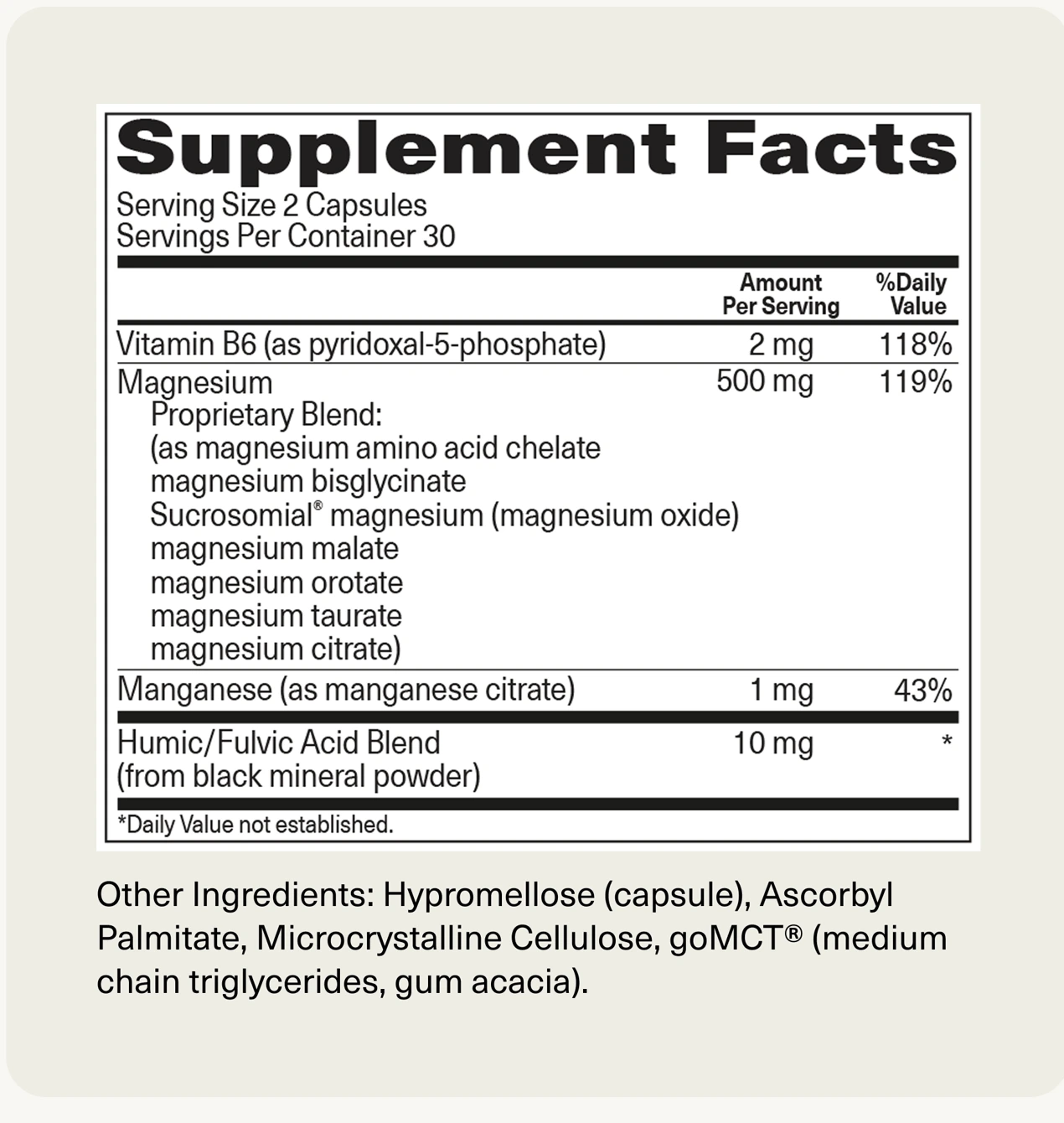
This is the panel behind every form named on this page: one elemental line, seven names underneath it, no split between them.
Read September 3, 2026, from the seller's own label image.
Seven forms, one blend, no split
Every form on this page is a name until a label says how many milligrams of it are in the capsule. The panel above belongs to a real product, and the itemised-but-not-disclosed pattern is the finding a full review of that bottle was built around.
Two tips: find the elemental milligram line first, and what a "Proprietary Blend" over several forms hides
Find the elemental milligram line first, before you compare compound names. It is the only number two different labels can be compared on directly.
If a panel prints "Proprietary Blend" over more than one form, you cannot compute an exposure number for any single one of them, including a form a regulator has flagged, like orotate. Ask for the split, or choose a label that already publishes it.
The full label, all six order-form totals and the subscription terms, each with the date we read it.