The short answer: bisglycinate names the chemistry, glycinate is the everyday word for it
Magnesium bisglycinate is the compound name for magnesium chelated to glycine, in the two-glycine pairing that Schuette et al. 1994 describes as an intact dipeptide.
Magnesium glycinate is the same compound, said the short way. Neither name is more correct: one counts the two glycines, with the prefix bis-, the other drops the count and keeps the amino acid. The clinical literature uses two more names for the identical chemistry, and both come from published trials, not from a brand.
Naming per Schuette et al. 1994, PMID 7815675, and Walker et al. 2003, PMID 14596323, both read September 3, 2026.
What the "bis" is counting, and why the clinical literature says "diglycinate"
Bis- and di- both mean two. Both count the same pair of glycines, chelated to one magnesium ion, which is why the 1994 bioavailability trial on this chelate class never uses the word bisglycinate at all.
The 1994 trial's own sentence: "magnesium diglycinate (chelate)", absorbed in part as an intact dipeptide
"Magnesium diglycinate (chelate) represents a highly available form of magnesium that is absorbed in part as an intact dipeptide in the proximal small intestine."
Schuette et al. 1994, PMID 7815675, read September 3, 2026Di- and bis- are not two different chelates. They are two ways to say "two," attached to the same molecule.
Quote per Schuette et al. 1994, PMID 7815675, read September 3, 2026.
The fourth name: "magnesium amino acid chelate," and why the trials do not confirm it
A fourth name shows up in the trials that compare magnesium forms against each other: magnesium amino acid chelate. It is a category name; any magnesium chelated to an amino acid qualifies. Walker and colleagues compared three preparations, amino acid chelate, citrate and oxide, at 300 mg of elemental magnesium a day in 46 healthy people, double-blind and placebo-controlled, for 60 days.
The organic forms, citrate and amino acid chelate, showed greater absorption than oxide at 60 days (P = 0.033). Oxide performed no differently than placebo.
"Amino acid chelate" in that sentence names a category, not a specific amino acid. Walker's paper never says whether that amino acid is glycine, so it does not confirm this is the same chemistry as the bisglycinate printed on a bottle. The trial names it by category; the label, elsewhere, names it by structure.
Walker 2003, quoted in its own words, and the citation
"The relative bioavailability of three preparations of Mg (amino-acid chelate, citrate and oxide) were compared at a daily dose of 300 mg of elemental Mg in 46 healthy individuals... randomised, double-blind, placebo-controlled, parallel intervention, of 60 days duration."
Walker et al. 2003, PMID 14596323, read September 3, 2026Trial detail per Walker et al. 2003, PMID 14596323, read September 3, 2026.
A seven-form label that lists "amino acid chelate" and "bisglycinate" as two of its seven
Magnesium Breakthrough's own front panel sells a count: "7 FORMS OF MAGNESIUM" and "500mg PER SERVING." Its own Supplement Facts panel prints the roster inside one proprietary blend line.
"Proprietary Blend: (as magnesium amino acid chelate, magnesium bisglycinate, Sucrosomial® magnesium (magnesium oxide), magnesium malate, magnesium orotate, magnesium taurate, magnesium citrate)"
Magnesium Breakthrough's own panel, read September 3, 2026Seven names are printed. Entries one and two, magnesium amino acid chelate and magnesium bisglycinate, could be the literature's names for one chelate class, or they could be two different chelates. Walker's trial never says which amino acid its chelate uses, so nothing in the trials confirms it either way.
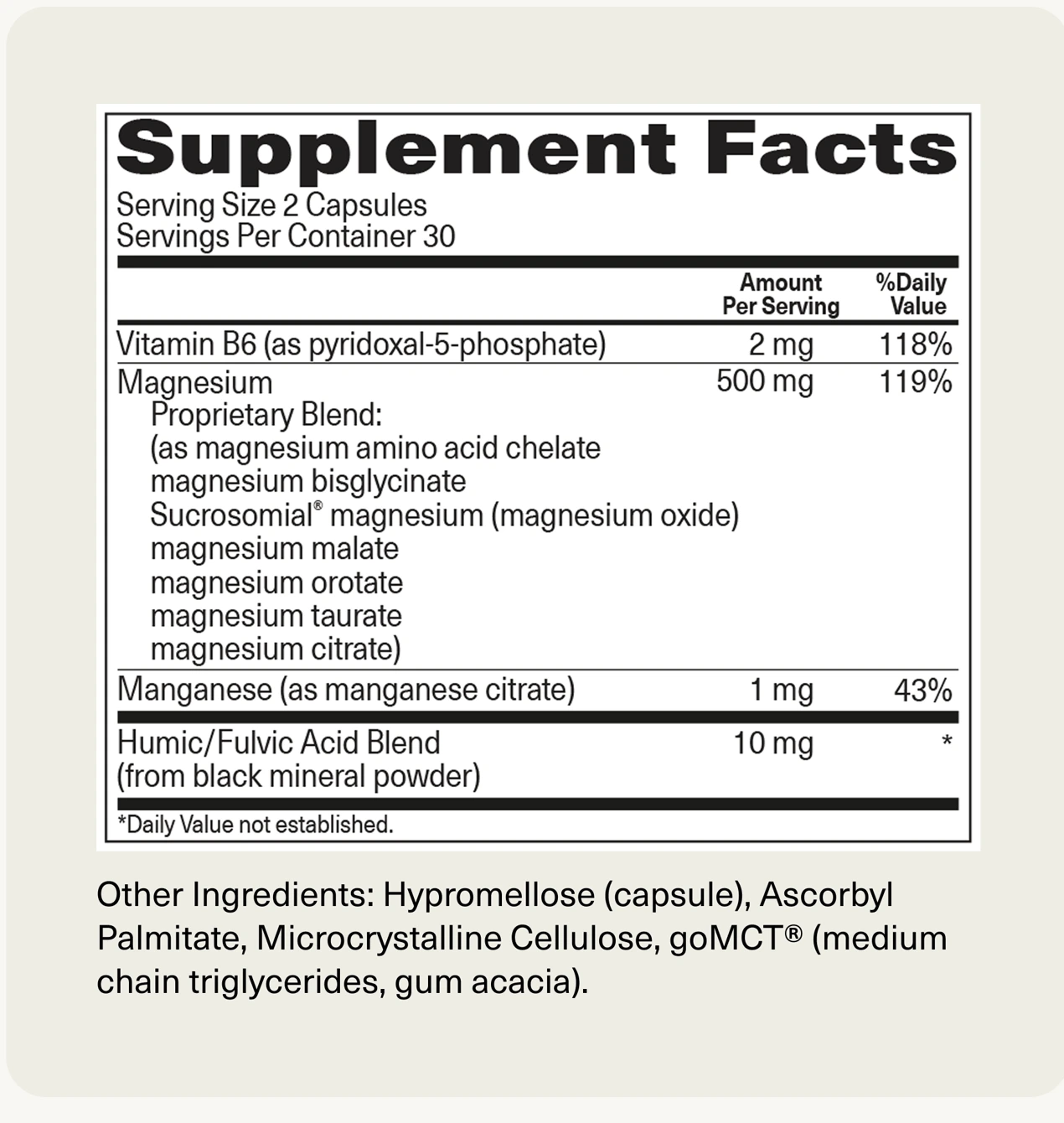
This is the Supplement Facts panel we transcribed on September 3, 2026. The elemental line sits on top; the seven-form blend line sits underneath it.
The blend line has no split by form. What it does have, read closely, is one specific chelate name sitting one line apart from a category name that may or may not be it.
Each of the seven names read against the literature, line by line
| Name printed on the label | Literature reading |
|---|---|
| Magnesium amino acid chelate | A category name; Walker 2003 does not state which amino acid. |
| Magnesium bisglycinate | Also called diglycinate per Schuette et al. 1994; not confirmed as the same entry as amino acid chelate above. |
| Sucrosomial® magnesium (magnesium oxide) | A distinct delivery technology, not a glycine chelate |
| Magnesium malate | A distinct organic salt |
| Magnesium orotate | A distinct organic salt |
| Magnesium taurate | A distinct organic salt |
| Magnesium citrate | A distinct organic salt; Walker's own third arm |
The label does not lie about names. It lists seven terms, and each one is a real ingredient the manufacturer added. What the roster does not do is tell a reader whether its first two lines, amino acid chelate and bisglycinate, describe one chemistry or two. It also does not publish how many of the 500mg elemental total came from that chelate.
Panel quoted from Magnesium Breakthrough's own label, read September 3, 2026.
What was actually measured on the chelate, in whom, and at what dose
Schuette and colleagues ran a double-blind crossover in 12 patients. All 12 had undergone ileal resection, a clinical population with impaired magnesium absorption, not a general population. Each patient took a 100 mg dose of magnesium labelled with the isotope 26Mg, once as the chelate, once as magnesium oxide.
Across the whole group, the chelate and the oxide performed the same. A difference showed up only in a subgroup. The honest claim from this trial is tolerability first, and an absorption edge only in the worst absorbers, not a blanket "better absorbed" line for everyone.
The two absorption numbers in the trial's own words: 23.5% vs 22.8% across all 12 patients, 23.5% vs 11.8% in the four worst absorbers
"26Mg absorption was low but was not different for the two supplements (23.5% vs 22.8% for magnesium chelate and MgO, respectively)."
Schuette et al. 1994, PMID 7815675"26Mg absorption was substantially greater from the chelate (23.5% vs 11.8%; p < .05) in the four patients who showed the greatest impairment of magnesium absorption with MgO and was better tolerated by all patients."
Schuette et al. 1994, PMID 7815675Trial detail per Schuette et al. 1994, PMID 7815675, a clinical population (ileal resection), read September 3, 2026.
The bisglycinate sleep trial and its dose: 250 mg elemental
The one trial in this file that puts "bisglycinate" in its own title is a 2025 sleep study: 155 adults aged 18 to 65 with self-reported poor sleep, 250 mg of elemental magnesium a day or placebo. Sleep quality is a self-reported measure here, the Insomnia Severity Index, not a diagnosis of insomnia.
The bisglycinate arm fell 3.9 points on that index. The placebo arm fell 2.3 points (95% CI -5.8 to -2.0 vs -4.1 to -0.4; p = 0.049). The authors size that gap at Cohen's d = 0.2, and call it "a modest benefit."
The paper declares its own conflict. One author, Adrian Lopresti, is managing director of a contract research group that takes funding from nutraceutical companies. We print that next to the result, not instead of it.
The trial's own enrolment sentence and the citation
"...155 adults aged 18-65 years with self-reported poor sleep quality... magnesium bisglycinate supplementation (250 mg elemental magnesium, daily) or placebo capsules."
Schuster, Cycelskij, Lopresti & Hahn 2025, PMID 40918053Trial detail per Schuster et al. 2025, PMID 40918053 (PMC12412596), read September 3, 2026.
Sleep is a self-reported score, and the wider review is more cautious than one trial
None of the trials in this file tested the seven-form product on this page; each tested one chelate, alone, at a stated elemental dose.
A 2026 systematic review of magnesium and sleep, pooling twelve randomised trials, found: "Certainty of evidence was low to very low. Current evidence does not support oral magnesium as a routine treatment for insomnia."
Four more limits: the questionnaire score, the ileal-resection population, a Sucrosomial trial with a PharmaNutra partenariat, and no elemental percentage by weight
- The 2025 sleep trial measured a questionnaire score in adults with self-reported poor sleep. That is not a diagnosis of insomnia, and its own effect size is small.
- Schuette's absorption numbers come from patients with ileal resection, a clinical population with impaired absorption, not from healthy shoppers.
- A separate cross-over trial found Sucrosomial magnesium ahead of bisglycinate on red blood cell levels. It was published by researchers whose partenariat on the paper is PharmaNutra S.p.A.
- No source in our file supports a percentage of elemental magnesium by compound weight. The EFSA dose table only carries a footnote, "Referred to elemental Mg." That is not a conversion figure.
Per Lopresti et al. 2026, PMID 42661485, and Brilli et al. 2018, PMID 29630135, both read September 3, 2026. What this means for you: a matched name on two labels is a naming fact, not a promise about how a given person will sleep.
Why the elemental milligram line is the only number two glycinate bottles share
Compound names are not comparable across bottles, and milligrams of the compound are not either, because different chelates carry different amounts of magnesium per gram. What is comparable is the elemental line: the milligrams of magnesium itself, once the glycine, citrate, or oxide is subtracted out.
A supplement panel makes the same split, in its own layout. Magnesium Breakthrough's label prints one elemental line: Magnesium 500 mg, 119% DV. Below it sits a separate list of compound names, with no milligram number attached to any of them.
That is why "1,000 mg of magnesium bisglycinate" and "1,000 mg of magnesium" are different claims. The first is a compound weight, glycine included. The second is the elemental line the trials use.
We are not printing a percentage of elemental magnesium by compound weight here. No source in our file, read today, publishes that conversion. The EFSA footnote above is qualitative, not a formula.
The EFSA footnote ("Referred to elemental Mg"), the sources, what checking the names buys you, and three plain alternatives when a blend will not publish its split
The EU's own tolerable-intake table for magnesium supplements carries a footnote making exactly that split explicit.
"* Referred to elemental Mg"
EFSA/SCF Tolerable Upper Intake Level opinion for magnesium, Table 3, read September 3, 2026Elemental footnote per the EFSA/SCF Tolerable Upper Intake Level opinion for magnesium, read September 3, 2026. Label line per Magnesium Breakthrough's own panel, read September 3, 2026.
What checking the names buys you, and what it still doesn't
What checking for a repeated name gives you
- A reason to ask whether a seven-form count is seven different chemistries, or fewer.
- A way to ask a brand which of its "forms" are the same chelate under two labels.
- A dose you can line up against a trial, once the elemental line is separated out.
What it still doesn't give you
- The split of milligrams inside a proprietary blend. That stays unpublished unless the label itemizes it.
- Evidence that the finished multi-form product was tested as a whole.
- A reason to expect the sleep trial's small effect from a different dose or a different product.
When a blend will not publish its split, the honest alternatives stay plain. One: a single-form product that states both the compound and elemental milligrams per serving. Two: a product that matches a trial's own dose, 250 mg or 300 mg elemental. Three: a single chelate name on the panel, with no second, ambiguous entry sitting beside it.
A four-line check before you compare two of them
The four questions, in order, and the trial dose each one lines up against (250 mg and 300 mg elemental)
Four questions, in this order, before any brand argument starts.
Read every name on the panel
Not just the front-panel headline count. The Supplement Facts line is where the real roster lives.
Check for a chelate under two names
"Magnesium amino acid chelate" and "magnesium bisglycinate" (or "glycinate") often sit one line apart. The trials never say which amino acid the "chelate" entry uses, so a label like this will not tell you whether that is one chemistry counted twice, or two.
Find the elemental milligram line
It sits apart from the compound list, the way this label prints "Magnesium 500 mg, 119% DV" above an unsplit blend.
Match a dose claim to its own trial
250 mg elemental is the 2025 sleep trial's dose. 300 mg elemental is Walker's 60-day chelate trial. Neither number describes a compound weight.
Questions people also ask
Are magnesium bisglycinate and magnesium glycinate the same thing?
Yes, they are names for the same chemistry: magnesium chelated to glycine. The clinical literature also calls it "diglycinate." A separate trial adds a fourth term, "magnesium amino acid chelate," without naming the amino acid, so it is not confirmed to be the same chelate.
What does the bis in bisglycinate actually count?
The two glycine molecules bound to each magnesium, in the pairing Schuette et al. 1994 describes as absorbed "in part as an intact dipeptide." That is why the 1994 trial on the form calls it "magnesium diglycinate (chelate)": di- and bis- count the same pair.
Is magnesium amino acid chelate another name for bisglycinate?
The trials do not settle it: Walker 2003 labels its arm "amino-acid chelate" without naming the amino acid, and Schuette 1994 calls its chelate "magnesium diglycinate." A label that prints both terms has not told the reader whether they are one chemistry or two.
How much magnesium bisglycinate did the sleep trial use?
The 2025 randomised trial in 155 adults aged 18 to 65 with self-reported poor sleep used 250 mg of elemental magnesium per day, and measured a fall of -3.9 points on the Insomnia Severity Index against -2.3 on placebo (p = 0.049), with a small effect size (Cohen's d 0.2).
Why does the elemental milligram line matter when comparing two bottles?
Because compound names and elemental magnesium are different quantities. The EFSA dose table is explicitly footnoted "Referred to elemental Mg," and a supplement panel separates the elemental line from the compound list for exactly that reason.
How we built this page
Every source on this page and the date we read it
This is a nomenclature page, built from published trials and one label, not a lab test.
- This chelate has three confirmed names: bisglycinate, glycinate and diglycinate, per Schuette et al. 1994 (PMID 7815675). A fourth term, amino acid chelate, appears in Walker et al. 2003 (PMID 14596323) without naming the amino acid it uses; both papers are confirmed against PubMed on September 3, 2026.
- The seven-form roster and the elemental line come from Magnesium Breakthrough's own label panel. We read it September 3, 2026, and filed it in our review's recon the same day.
- The 2025 sleep trial, and its declared conflict, are quoted from Schuster et al. 2025 (PMID 40918053, PMC12412596). We confirmed it September 3, 2026.
- The elemental-versus-compound footnote is quoted from the EFSA/SCF Tolerable Upper Intake Level opinion for magnesium, read September 3, 2026.
- We did not test any product. We did not calculate a percentage of elemental magnesium by compound weight for any form named on this page.
- Nothing here is medical advice. A new supplement while you are pregnant, nursing or on medication is a conversation with your doctor first.
Counting the seven against the panel
We counted one seven-form roster against its own Supplement Facts, then followed the bottle to the checkout. The review reads the whole panel line by line, prints the elemental total against the unsplit blend, and quotes the checkout and refund clauses in the seller's own words.
Two tips before you compare two bottles
Before you compare two bottles by their form count, count the names first. Some may describe the same chelate twice, and that changes what "seven forms" and "500mg" actually mean.
Then separate the elemental line from the compound list on any panel you're holding. That is the one number two different bottles can actually be compared on.
Label panel, elemental total and the checkout clauses, each with the date we read it.