The short answer: citrate moved the number furthest, glycinate was built around tolerating the dose
One trial fixed both molecules at 300 mg of elemental magnesium a day. Citrate produced the highest serum magnesium reading, both after one dose and after 60 days. Glycinate has a different case. A small clinical trial built it around gentler digestion, not around winning that same test.
Citrate's advantage in serum magnesium over the other two forms tested, after 60 days of 300 mg elemental magnesium a day.
PMID 14596323, Walker et al., 2003
Subjects with mild diarrhoea on lactate/citrate tablets at 365 mg/day elemental, in the regulator's own dose-by-dose safety table.
SCF/EFSA opinion, read Sep 3, 2026
What the two actually are: an amino acid chelate against an organic acid salt
Glycinate rides inside an amino-acid pair; citrate is a salt that EFSA says has a dose-dependent laxative effect; neither name states the elemental dose
Magnesium glycinate is also sold as magnesium bisglycinate or magnesium diglycinate. A related trial describes it as "absorbed in part as an intact dipeptide in the proximal small intestine," which is another way of saying the mineral rides inside an amino-acid pair. That makes it a chelate. Some absorption research counts that as a separate class from a plain mineral salt.
Magnesium citrate binds magnesium to citric acid. It is an organic acid salt, not a chelate. Easily dissociable magnesium salts like this one, per EFSA's own opinion, "exert dose-dependent laxative effects."
Neither name tells you the elemental magnesium content by itself. A citrate capsule and a glycinate capsule can carry wildly different milligram totals. The number on the front of most bottles is the compound's total weight, not the magnesium inside it. The line that matters is the one marked "elemental," further down this page. For how that elemental total adds up against the daily targets, see our how much magnesium per day page.
The head-to-head that held the dose constant: 46 people, 300 mg elemental, 60 days
Walker and colleagues randomised 46 healthy adults into four groups: an amino acid chelate, magnesium citrate, magnesium oxide, or placebo. Each active group took 300 mg of elemental magnesium a day. The trial ran double-blind for 60 days.
The three quoted results (citrate led, P = 0.006; citrate and chelate beat oxide, P = 0.033), and why the chelate arm is not proof about glycinate
"The relative bioavailability of three preparations of Mg (amino-acid chelate, citrate and oxide) were compared at a daily dose of 300 mg of elemental Mg in 46 healthy individuals... randomised, double-blind, placebo-controlled, parallel intervention, of 60 days duration."
"Mg citrate led to the greatest mean serum Mg concentration compared with other treatments following both acute (P = 0.026) and chronic (P = 0.006) supplementation."
"Supplementation of the organic forms of Mg (citrate and amino-acid chelate) showed greater absorption (P = 0.033) at 60 days than MgO."
Walker, Marakis, Christie & Byng, Magnesium Research, 2003 · PMID 14596323Walker's paper names that arm only as an amino-acid chelate. It does not say which amino acid, so the trial cannot be read as a test of the two-glycine bisglycinate most sleep and stress products sell today, and cannot rule it out either. Still, it lost to citrate on the trial's own main measure. It did beat magnesium oxide, alongside citrate. That is the honest shape of the evidence: citrate won the serum test, the amino acid chelate came second, oxide came last.
Where they really separate: a regulator's dose-by-dose diarrhoea table
The European Food Safety Authority's own opinion on the tolerable upper intake of magnesium prints a table built for exactly this question. How many people got mild diarrhoea. At what dose. On what salt.
| Dose (mg/day, elemental) | Form / salt | Mild diarrhoea |
|---|---|---|
| 250 | Hydroxide, tablets | 0/31 |
| 365 | Lactate/citrate, tablets | 4/17 |
| 365 | Aspartate HCl, tablets | 0/17 |
| 365 | Aspartate HCl, granules | 0/39 |
| 365 | Aspartate HCl, tablets | 1/278 |
| 476 | Oxide, capsules | 18/50 |
Where the table comes from (EFSA Table 3, read Sep 3, 2026) and the opinion's own sentence on mild diarrhoea
Table 3, "Mild diarrhoea induced by daily oral magnesium supplements," SCF/EFSA opinion on the Tolerable Upper Intake Level of Magnesium, footnoted "Referred to elemental Mg." Read Sep 3, 2026 at efsa.europa.eu.
"Mild diarrhoea can be taken as the most sensitive non-desirable effect if Mg supplements are taken for nutritional purposes."
SCF/EFSA opinion on the Tolerable Upper Intake Level of Magnesium, 2001Bisglycinate, the specific two-glycine chelate sold in most modern products, is not in this table at all. What the table does show: citrate sits in the same family as lactate here, at a dose within reach of a real daily serving. An aspartate salt at that same dose barely moved the needle.
Elemental milligrams are the only number the two labels share
A "500 mg magnesium citrate" capsule and a "500 mg magnesium glycinate" capsule do not hold the same amount of magnesium. Citric acid and glycine each add their own weight to that total. The only fair comparison is the milligram figure a label marks as elemental, or "as magnesium."
Why EFSA's table and Walker 2003 both count elemental milligrams, not compound weight
EFSA's own diarrhoea table makes the same point. Every dose in it carries the footnote "Referred to elemental Mg." A raw compound weight would make the rows impossible to compare. That is also exactly why Walker's 2003 trial fixed all three arms at 300 mg elemental, not 300 mg of each compound.
Two trials, two different questions, one gap between them
- Walker 2003 tested healthy adults on an amino acid chelate, citrate and oxide. Its paper never names the amino acid, so it cannot be read either as a test of the bisglycinate most sleep and stress supplements sell, or as a test that excluded it.
- No study in our file puts magnesium glycinate and magnesium citrate head-to-head, at matched elemental doses, measuring the same serum outcome in the same people.
- Neither source claims one form works better for sleep, mood or any diagnosed condition. Both are absorption and tolerance data, nothing more.
What this means for you: "citrate absorbs better than glycinate" is a claim that outruns the evidence we could find. "Citrate outperformed an amino acid chelate and oxide in one 60-day trial" is what the record actually supports.
Magnesium oxide, the third form that keeps showing up in these comparisons
In Walker's 2003 trial, oxide never separated from placebo on serum magnesium. A separate bioavailability study found the same pattern from a different angle.
The two quoted findings on oxide (no difference from placebo; 4 per cent fractional absorption) and the same paper's caveat that inorganic salts can match organic ones
Oxide is not one of the two molecules in this page's title. It still appears in nearly every trial that tests glycinate or citrate. It is the cheapest, most common comparison arm.
"Mg oxide supplementation resulted in no differences compared to placebo."
Walker et al., 2003 · PMID 14596323"Relatively poor bioavailability of magnesium oxide (fractional absorption 4 per cent)."
"Inorganic magnesium salts, depending on the preparation, may have bioavailability equivalent to organic magnesium salts."
Firoz & Graber, Magnesium Research, 2001 · PMID 11794633That second line is worth sitting with. The same paper that measured oxide's weak 4 per cent absorption also warns against the reflex that "organic always beats inorganic." The honest reading is form-specific, not a blanket rule. Oxide's own record here is just weak, on both measures.
What happens when one capsule contains both forms and prints no split
Some multi-form magnesium products put a bisglycinate and a citrate, plus several other forms, into a single capsule. We read one such label, for Magnesium Breakthrough, line by line on September 3, 2026, to see what that arrangement actually discloses.
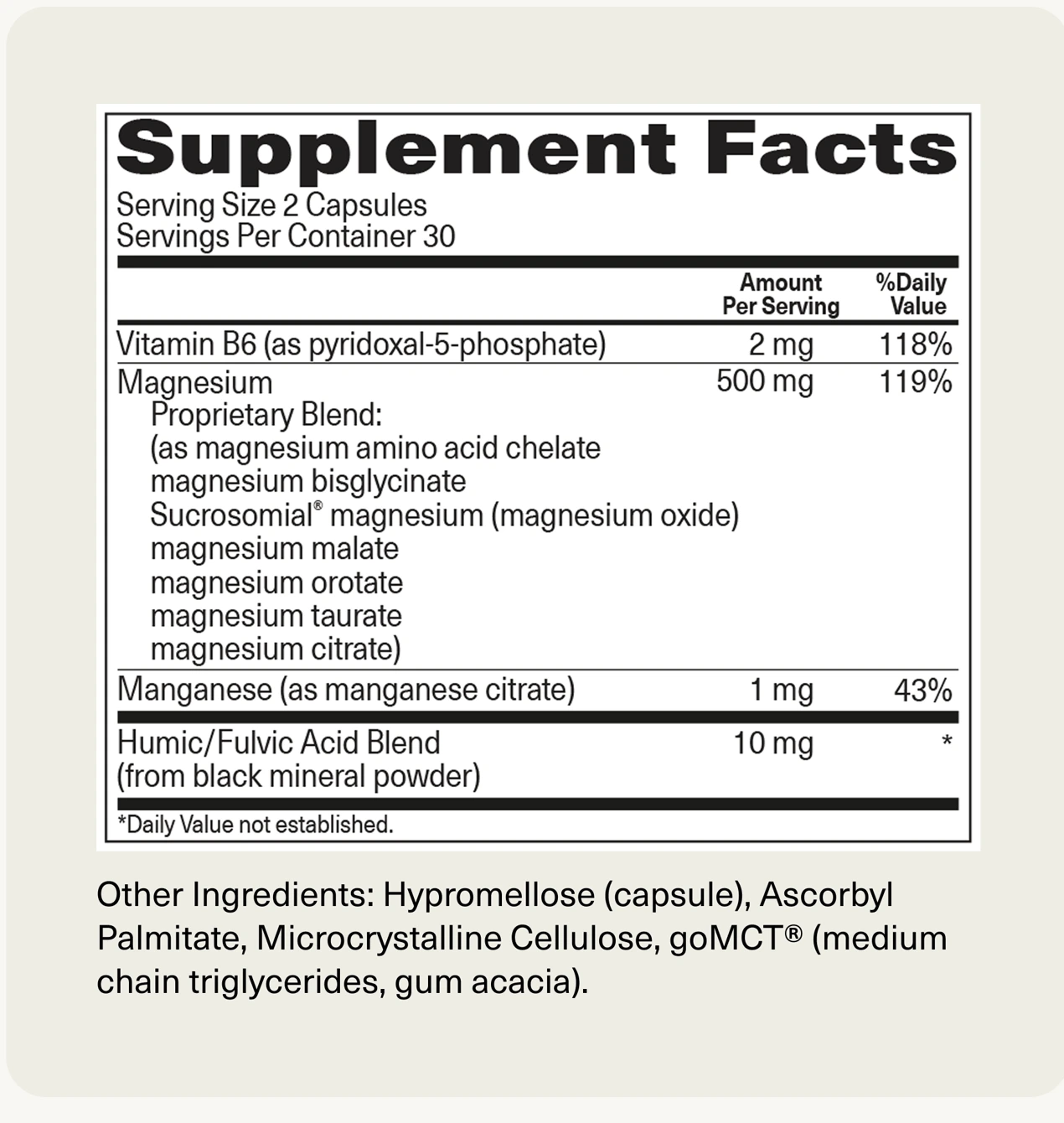
The seller's own Supplement Facts panel, read September 3, 2026.
Magnesium bisglycinate and magnesium citrate are both named, third and last, inside one 500 mg blend line.
Neither carries its own milligram figure.
- Magnesium amino acid chelate
- Magnesium bisglycinate
- Sucrosomial® magnesium (magnesium oxide)
- Magnesium malate
- Magnesium orotate
- Magnesium taurate
- Magnesium citrate
What the panel publishes (one 500 mg total, seven names) and what it does not (no per-form split on the label, sales page or FAQ)
The total elemental line is published. Every one of the seven forms is named. But nothing says how many of the 500 milligrams come from any single form. Not the label. Not the sales page. Not the FAQ. Per Magnesium Breakthrough's own panel, read September 3, 2026.
That is the practical cost of a blend like this. This page's whole comparison, citrate against glycinate at a known dose, loses its answer once both names sit inside one "Proprietary Blend" line. You cannot tell whether you got 5 mg of citrate, or 300 mg of it.
Which one to reach for, and the honest limits of what was measured
Reach for citrate when
- you want the form with an actual head-to-head result behind it, at a matched elemental dose
- you can tolerate a mild laxative effect, or want that effect on purpose
- the label states a clear elemental milligram figure, on its own line, not inside a blend
Reach for glycinate when
- a sensitive stomach is your main constraint. Its own trial found no serum edge over oxide, but better tolerance among poor absorbers
- you want a form built and studied around a clinical population that struggled to tolerate other salts
- you take other supplements too, and want to isolate variables one form at a time, not inside a seven-form blend
The glycinate trial behind that list (12 ileal-resection patients, PMID 7815675) and three generic alternatives: plain oxide, a multi-form blend, or food
The glycinate data above comes from a small crossover trial. It studied 12 patients recovering from ileal resection, a clinical population, not healthy volunteers. Across the whole group, glycinate and oxide absorbed equally. Only the four worst absorbers showed an edge for glycinate. All patients tolerated it better (PMID 7815675).
If neither single form fits, three generic alternatives exist.
A plain magnesium oxide product: cheap, but the weakest performer on both absorption and serum change in the trials above.
A multi-form blend, like the one audited above: it trades a published split for a broader ingredient list.
Or food itself. Leafy greens, nuts and whole grains carry magnesium without any of this label math.
Questions people also ask
Is magnesium glycinate or citrate better absorbed?
In the one trial that equalised the elemental dose (300 mg/day, 46 healthy adults, 60 days, Walker 2003), citrate produced the greatest mean serum magnesium concentration both acutely (P = 0.026) and chronically (P = 0.006); citrate and amino acid chelate both beat oxide on absorption at 60 days (P = 0.033).
Which magnesium form is more likely to loosen the stool?
In the dose-by-dose table of the SCF/EFSA opinion, at 365 mg/day of elemental magnesium, lactate/citrate tablets gave mild diarrhoea in 4 of 17 subjects, against 0/17, 0/39 and 1/278 for aspartate at the same dose; oxide capsules at 476 mg gave 18/50.
Do glycinate and citrate deliver the same amount of magnesium per capsule?
Only if the elemental magnesium line matches. The EFSA dose table is explicitly footnoted "Referred to elemental Mg," and that is exactly why Walker 2003 fixed all three arms at 300 mg elemental.
Can you take magnesium glycinate and citrate together?
Multi-form formulas do exactly that, and the label we audited lists both inside a Proprietary Blend under a single 500 mg total. What that arrangement costs you is the amount of each form, which is not published anywhere.
Does magnesium oxide belong in this comparison at all?
In Walker 2003 oxide did not differ from placebo, and Firoz and Graber (2001) measured 4 per cent fractional absorption. The same authors caveat that inorganic salts, depending on the preparation, can match organic salts for bioavailability.
How we built this page
This is a source-reading page. It is not a lab test, and it is not medical advice.
Every source with the date we read it, the NIH ODS access error, and the doctor-first note
- The head-to-head trial and its results come from PMID 14596323 (Walker et al., Magnesium Research, 2003), verified against PubMed E-utilities September 3, 2026.
- The diarrhoea table and its framing quote come from the SCF/EFSA opinion on the Tolerable Upper Intake Level of Magnesium, read at efsa.europa.eu September 3, 2026.
- The oxide bioavailability figures come from PMID 11794633 (Firoz & Graber, Magnesium Research, 2001), read September 3, 2026.
- The glycinate clinical-population data comes from PMID 7815675 (Schuette, Lashner & Janghorbani, JPEN, 1994), read September 3, 2026.
- The seven-form label panel was read directly from the seller's own Magnesium Breakthrough product image on September 3, 2026.
- We did not print the US NIH ODS upper-limit figure for supplemental magnesium. Its fact sheet returned an access error on every attempt today. This page cites only the sources we could actually read.
- Nothing here is medical advice. A new supplement, at any dose named on this page, is worth a conversation with a doctor first, especially if you are pregnant, nursing, or on medication.
A seven-form label that contains both of them
The choice on this page quietly disappears the moment a label puts both forms into one proprietary blend, under a single 500 mg total.
Before you buy any multi-form blend, look for the word "Proprietary" on the panel. It is the label's own admission that the split you want is not printed.
If the elemental milligram line is missing entirely, not just the split, that is a bigger gap than a blend. Neither the total dose nor its source is confirmed.
The full label panel, the six checkout prices, and the subscription clauses, each with the date we read it.