How much L-arginine per day, by studied goal
How much L-arginine per day depends entirely on what it is being taken for. There is no single dose that applies across every use, because the trials behind each use tested different amounts for different endpoints.
| Goal | Studied dose | What it targeted |
|---|---|---|
| Erectile function | 1.5 to 5 g/day | IIEF score in men with mild to moderate ED (10 pooled trials); one 3-month trial in vasculogenic ED used 6 g/day |
| Blood pressure | 4 to 24 g/day (11 trials); a 2022 dose-response analysis spans 2 to 30 g/day | Systolic and diastolic blood pressure |
| Exercise / pre-workout | 3 to 6 g, 30 to 60 min before training | Blood flow and oxygen cost; inconsistent in already-trained athletes |
| Semen parameters (historical) | 4 g/day as reported in later reviews (Schachter 1973; primary paper paywalled, figures not independently confirmed) | Sperm count and motility in infertile men, early 1970s |
None of these trials tested a 250 mg capsule, or one specific formula. A later placebo-controlled crossover trial in 64 infertile men (Pryor et al., 1978) found no significant difference in semen quality or conception rates, and the 2022 dose-response meta-analysis found systolic decreases from about 4 g/day upward with no additional benefit above 9 g/day.
The sources behind each row, the 15-man 1,000 mg/day study we could not read in full, and what this table does not say
Erectile-function figures per Rhim et al., J Sex Med 2019, PMID 30770070 (10 RCTs, 540 patients, 1,500 to 5,000 mg) and Menafra et al., J Endocrinol Invest 2022, PMID 34973154 (6 g/day, 3 months, 51 vs 47 men). Blood-pressure range per Dong et al., Am Heart J 2011, PMID 22137067; dose-response findings per Shiraseb et al., Adv Nutr 2022, PMID 34967840. Exercise range summarized from published pre-workout trials. Semen-parameter figure per Schachter et al., J Urol 1973, DOI 10.1016/s0022-5347(17)60199-x, which has no PubMed abstract and no open full text, so it is quoted as reported in later reviews. All read Sep 7, 2026.
None of these trials tested a 250 mg capsule, or one specific formula
- The 1973 semen-parameter figure comes from an early trial. A later placebo-controlled crossover trial in 64 infertile men (Pryor et al., 1978) found no significant difference in semen quality or conception rates.
- One 15-man study at 1,000 mg/day (Manssor et al., Tikrit J Pure Sci 2019;24(5); DOI 10.25130/tjps.v24i5.408, whose publisher domain no longer serves the article, so we read the paper's abstract through its Crossref record, Sep 7, 2026) reported total sperm count, motility and ejaculate volume all higher than baseline. It is a small trial in a minor regional journal we could not read in full, not a dose band on this table.
- The 2022 dose-response meta-analysis found systolic decreases from about 4 g/day upward with no additional benefit above 9 g/day, and a dose relation only for diastolic pressure, so a higher gram figure is not shown to lower systolic pressure more than a lower one.
- None of the studies here tested any multi-ingredient formula, including the one whose label this page quotes later.
The observed safe level: 20 g a day, and the trial that found real harm at 9 g
A formal risk assessment, Shao and Hathcock's 2008 review in Regulatory Toxicology and Pharmacology, sets the observed safe level for oral L-arginine at 20 g a day in healthy adults: the highest daily intake with no consistent pattern of adverse effects across the trials it reviewed. Below that, cramping and diarrhea are the usual complaint once a single dose passes roughly 10 g, a threshold reported across the supplement literature rather than in the risk assessment itself, and one more reason trials split the daily total.
VINTAGE MI (153 patients, 6 months, 3 g three times a day, 9 g total, enrolled days after a heart attack): six deaths on L-arginine over 6 months versus zero on placebo (8.6% vs 0%, P=.01), enrollment closed early by the safety board, and no significant change in vascular stiffness or left ventricular ejection fraction in either group. The authors do not recommend L-arginine following a recent heart attack.
The VINTAGE MI trial card by card: design, result, efficacy endpoints, the trial's own conclusion, and both sources
A lower daily dose, 9 g, well under that 20 g observed safe level, was still the dose used in a trial stopped early for a reason that has nothing to do with an upset stomach.
Randomized, placebo-controlled, enrolled days after a heart attack (STEMI). Target dose: 3 g three times a day, 9 g total, added to standard post-infarction care.
Six deaths on L-arginine over 6 months, versus zero on placebo (P=.01). The safety board closed enrollment early over the mortality signal.
No significant change from baseline to 6 months in vascular stiffness or left ventricular ejection fraction, in either group, including the trial's primary endpoint, ejection fraction in participants aged 60 or older, and the whole study group.
The trial's own conclusion: L-arginine, added to standard postinfarction therapies, did not improve the measurements it was testing and may be associated with higher postinfarction mortality, and the authors do not recommend it following a recent heart attack. Who else has a clear reason to be cautious is covered further down this page.
VINTAGE MI figures per Schulman SP et al., L-Arginine Therapy in Acute Myocardial Infarction: The VINTAGE MI Randomized Clinical Trial, JAMA 2006;295(1):58-64, PMID 16391217, read Sep 7, 2026. Observed safe level per Shao A, Hathcock JN, "Risk assessment for the amino acids taurine, L-glutamine and L-arginine," Regul Toxicol Pharmacol, 2008;50(3):376 to 399, PMID 18325648, read Sep 7, 2026.
Timing and splitting: why trials rarely dose it once a day
Plasma arginine peaks about an hour after a 10 g oral dose and then declines gradually; in the pharmacokinetic study this page cites, levels were still above baseline at 8 hours, the end of the study's routine sampling period. Most of the trials above nonetheless split the daily total into two or three servings.
Food slows absorption without preventing it, so an empty-stomach dose peaks faster than one taken with a meal; no trial above reports that this changed whether an effect showed up, only how fast the level rose.
Why L-citrulline raises plasma arginine more than arginine itself, and the sources
Worth knowing for nitric-oxide-related goals: arginine is broken down substantially in the gut and liver before reaching general circulation, called first-pass metabolism. L-citrulline mostly skips that step, converting to arginine later in the kidneys, which is why an oral dose of citrulline raises circulating plasma arginine more than an equal dose of arginine itself. That is why it shows up as a substitute in nitric-oxide products, though it is a different molecule with its own dosing literature, not a milligram-for-milligram swap.
Peak timing per Tangphao et al., Pharmacokinetics of intravenous and oral L-arginine in normal volunteers, Br J Clin Pharmacol 1999, PMID 10215749, read Sep 7, 2026. Citrulline comparison summarized from published reviews of L-citrulline and cardiometabolic health, not a single named paper.
What a normal diet already supplies before any capsule
Arginine is a standard amino acid in ordinary protein foods, and a typical mixed diet in adults supplies roughly 4 to 6 g of it a day without any supplement at all.
Arginine per 100 g in pumpkin seeds, peanuts, soybeans and turkey, set against the trial floors, and the sources
| Food, per 100 g | Arginine | Against the trial floors |
|---|---|---|
| Pumpkin seeds, dried | ~5.4 g | More arginine than the entire 1.5 g/day floor of the erectile-function trials above |
| Peanuts, raw | ~3.1 g | A common snack contribution on top of the rest of the day's protein |
| Soybeans, dry | ~3.2 g | Similar order of magnitude to peanuts, before cooking loss |
| Turkey breast, roasted | ~1.7 g | A typical lean-meat serving's worth, smaller than the seed and legume figures |
Put a number on it: a 100 g handful of pumpkin seeds, a bit under a cup, carries more arginine than the entire floor of the erectile-function trials above. That is the scale a capsule dose has to be measured against: a supplement contributing a few hundred milligrams adds a small fraction to a pool the diet already fills; one contributing several grams does something an ordinary diet generally does not.
Food-composition figures from USDA-based nutrient databases; values are approximate and vary with preparation. Dietary total summarized from published reviews of arginine intake and metabolism, not a single named paper. Both read Sep 7, 2026.
The label-dose check: what 250 mg actually means
One 4-capsule serving of a multi-ingredient men's supplement we read prints L-Arginine HCl at 250 mg, right there on the Supplement Facts panel, not folded into an unlabeled blend.
Set that next to the numbers above. Diet alone supplies roughly 4 to 6 g a day, so 250 mg is only about five percent of a dietary day's total, and it sits below every studied dose above, including the lowest, the 1.5 g/day erectile-function floor: 250 mg is roughly one-sixth of that.
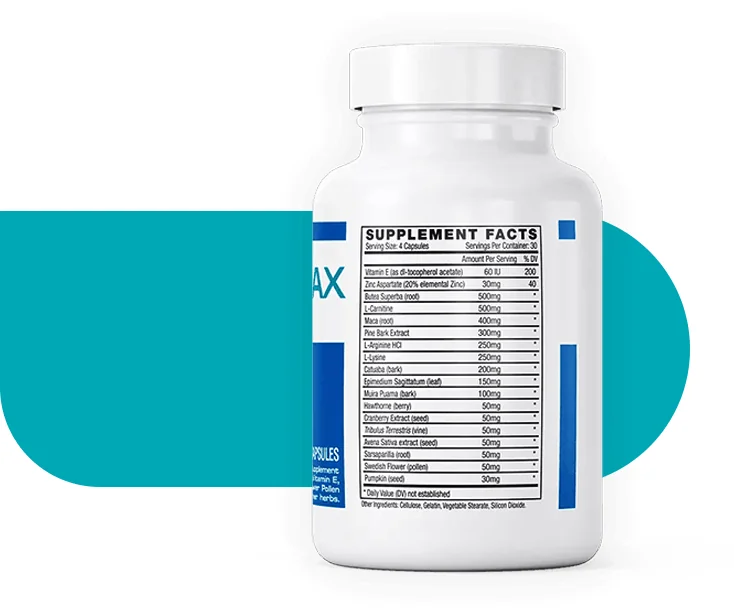
The panel we read: L-Arginine HCl at 250 mg per 4-capsule serving, alongside seventeen other named ingredients, each with its own amount. From the maker's own materials, read September 2026.
The rule that follows for any multi-ingredient label, and where the figures were read
A label that prints the milligram number lets a reader run this check. One that hides it inside a blend does not.
A workable rule follows: on a multi-ingredient label, an ingredient dosed under 1 g sits below the floor of every trial above. That does not make it decorative, since diet already contributes several grams toward the same pool, but the line alone was not dosed at a level any of these trials tested, closer to a marketing dose than a studied one.
Label figures transcribed from one Supplement Facts panel, read Sep 2026.
The lysine problem hiding on the same label
The same Supplement Facts panel that prints 250 mg of L-Arginine HCl prints 250 mg of L-Lysine directly below it.
A label dosing both at an identical 250 mg has not necessarily cancelled either one out; at that scale the competition is real but modest, not a proven wash. It is also the opposite ratio used deliberately in the lysine-for-cold-sores approach, where lysine runs much higher than any arginine, to tilt that competition one way. A 1:1 label makes no such choice.
The shared CAT-1 transporter, how lysine reduces arginine uptake in cell studies, and the source
Arginine and lysine are both cationic amino acids sharing the same family of cell-membrane transporters, principally CAT-1, to move from the gut into the bloodstream and into cells. When both are present at once, they compete for that carrier, an antagonism described as more pronounced when lysine is in excess: added lysine measurably reduces arginine's uptake and its downstream nitric-oxide production in cell studies.
Transporter competition summarized from published reviews of cationic amino acid transport and lysine metabolism, not a single named paper, read Sep 7, 2026.
Who should ask a doctor before taking any dose
A few groups have a clearer reason to ask first before taking any dose above.
Generally discussed as lower-risk in trials
- Healthy adults with normal kidney function, at doses inside the trial ranges above
- Adults not on nitrates or blood-pressure medication, without a recent cardiac event
Ask a doctor first if you
- Have kidney disease: arginine shifts potassium out of cells, and case reports describe severe hyperkalemia after intravenous arginine in patients with reduced kidney function, in one report alongside liver disease and a potassium-sparing diuretic
- Take blood-pressure medication or nitrates: arginine's own blood-pressure-lowering effect can add to theirs
- Had a heart attack recently: VINTAGE MI found higher mortality at 9 g/day after a heart attack, not a benefit
- Get cold sores or genital herpes: arginine is required for the virus to replicate, so some clinicians advise caution at high intakes
The case reports and the review behind each caution
Hyperkalemia case reports per Bushinsky DA and Gennari FJ, Ann Intern Med 1978, PMID 717931, an intravenous arginine infusion rather than an oral supplement dose, and Hertz P and Richardson JA, Arch Intern Med 1972, PMID 5083420, which PubMed indexes by title only. Herpes mechanism per Pedrazini MC, Martinez EF, dos Santos VAB and Groppo FC, narrative review of L-arginine and viral multiplication, Future J Pharm Sci 2024, DOI 10.1186/s43094-024-00673-7 (not PubMed-indexed). All read Sep 7, 2026. This is general information, not a substitute for medical advice.
Questions people also ask
Is 1000 mg of L-arginine a day enough?
One gram sits below every dose band above: erectile-function trials start near 1.5 g/day, blood-pressure trials run from 2 g/day up, with systolic decreases appearing from about 4 g/day, exercise trials use 3 to 6 g, and the older semen-parameter studies used about 4 g/day. It is also less than the roughly 4 to 6 g/day most adults already get from food. The only trial we found at that dose is a 15-man study in a minor regional journal (Tikrit J Pure Sci 2019), not a dose any of the bands above rests on.
What is the maximum safe dose of L-arginine per day?
There is no set upper limit, but a 2008 risk assessment (Shao and Hathcock, Regul Toxicol Pharmacol, PMID 18325648) sets an observed safe level of 20 g/day for oral L-arginine in healthy adults. Trials at that level generally split the daily total into two or three servings, and single doses above roughly 10 g are commonly reported to cause diarrhea and cramping. A lower dose, 9 g/day, was used in the 2006 VINTAGE MI trial, stopped early after L-arginine patients showed higher mortality than placebo following a heart attack. Kidney disease, low blood pressure, a recent cardiac event, or blood-pressure medication and nitrates are reasons to ask a doctor first.
Should L-arginine be taken on an empty stomach?
Trials have used both, so there is no required rule. Plasma arginine peaks roughly an hour after a 10 g oral dose and then declines gradually, still above baseline at 8 hours in the pharmacokinetic study, and most trials split the daily total into two or three servings. Food slows absorption, so an empty-stomach dose peaks faster, but that has not been shown to change whether an effect occurs.
Is L-citrulline better than L-arginine?
For raising plasma arginine itself, most evidence says yes. Citrulline mostly avoids the first-pass breakdown in the gut and liver that arginine goes through, so an oral dose raises circulating arginine more than an equal dose of arginine does. It is a different molecule with its own dosing literature, not a milligram-for-milligram substitute.
How we built this page
Every source with its PubMed identifier or DOI, the label figures, and what we did not test
This is a label-and-literature page, not a lab test.
Every number on it comes from a document we read, on a date we print, all Sep 7, 2026 unless noted, except where the src line says the point is a literature summary with no single named paper.
- The four dose ranges come from Rhim et al., J Sex Med 2019, PMID 30770070, and Menafra et al., J Endocrinol Invest 2022, PMID 34973154, for erectile function, two blood-pressure meta-analyses (Dong et al., Am Heart J 2011, PMID 22137067, for the range; Shiraseb et al., Adv Nutr 2022, PMID 34967840, for dose-response), published exercise trials, and Pryor et al.'s 1978 controlled follow-up, via PubMed or PubMed Central; Schachter et al.'s 1973 semen trial (J Urol, DOI 10.1016/s0022-5347(17)60199-x) has no PubMed abstract and no open full text, so its 4 g/day figure is quoted as reported in later reviews.
- The VINTAGE MI figures are quoted from Schulman SP et al., JAMA 2006, PMID 16391217. The observed safe level is quoted from Shao and Hathcock, Regul Toxicol Pharmacol, 2008, PMID 18325648. Timing comes from Tangphao et al., 1999; the citrulline comparison is summarized from published reviews of L-citrulline and cardiometabolic health, not a single named paper. Food-composition figures come from USDA-based nutrient data; the roughly 4 to 6 g/day dietary total is summarized from published reviews of arginine intake and metabolism, not a single named paper.
- The kidney-disease caution rests on two hyperkalemia case reports, Bushinsky DA and Gennari FJ, Ann Intern Med 1978, PMID 717931, an intravenous arginine infusion rather than an oral supplement dose, and Hertz P and Richardson JA, Arch Intern Med 1972, PMID 5083420, which PubMed indexes by title only; the herpes caution on Pedrazini et al.'s 2024 narrative review in Future J Pharm Sci, DOI 10.1186/s43094-024-00673-7.
- The 250 mg L-Arginine HCl and L-Lysine figures come from one Supplement Facts panel we read, September 2026. We did not test any product or estimate a figure for a label that omits one.
- Nothing here is medical advice. A new supplement while pregnant, nursing, on blood thinners, with kidney disease, or after a recent cardiac event is a conversation with your doctor first.
Where a 250 mg dose actually sits
Semenax prints 250 mg of L-arginine HCl on its label, and our Semenax review weighs that figure against its 63-man trial and its guarantee terms so you can judge the whole formula, not just this one line.
Why this label is the kind the checklist is built to read, and two tips before judging the formula
One product in this category prints its L-arginine dose in plain milligrams instead of folding it into a proprietary blend, exactly the kind of label this page's checklist is built to read.
Read the milligram number, then place it: 250 mg is below every trial floor above, including the lowest at 1.5 g/day. That does not make the formula worthless, since arginine is one of eighteen ingredients, but it was not dosed at a studied threshold.
Check what else shares the panel. The same label carries 250 mg of L-Lysine, which competes with arginine for the same transporter; our review lists every other dose on the panel so you can weigh the whole formula.
Every ingredient dose on that label, the 63-man trial's fine print, and the 67-day guarantee terms, each with the date we read it.