The short answer: one total, ten names, and an order that is not decoration
A proprietary blend is a group of dietary ingredients declared under one name and one combined weight instead of individual amounts.
It is allowed by 21 CFR 101.36(c), under the term "Proprietary Blend" or a fanciful name. The label still owes you one thing: the names have to run in descending order by weight, heaviest first. That order is the only dose fact a blend line must carry, and it is enough to compute a real number, not just a shrug.
Regulation text: 21 CFR 101.36(c), govinfo, Code of Federal Regulations Title 21, read September 3, 2026.
The rule itself, word for word (21 CFR 101.36(c))
Three sentences. One name for a group, one order it must keep, one weight that covers the whole group. That is the entire allowance.
The three paragraphs of 21 CFR 101.36(c), quoted: the name, the descending order, and the total weight
No article ranking for this term prints the actual paragraph numbers. Here they are, quoted rather than paraphrased.
"A proprietary blend of dietary ingredients shall be included in the list of dietary ingredients ... and identified by the term 'Proprietary Blend' or other appropriately descriptive term or fanciful name and may be highlighted by bold type."
21 CFR 101.36(c), govinfo"Dietary ingredients contained in the proprietary blend ... shall be declared in descending order of predominance by weight, in a column or linear fashion, and indented under the term 'Proprietary Blend' or other appropriately descriptive term or fanciful name."
21 CFR 101.36(c)(2), govinfo"The quantitative amount by weight specified for the proprietary blend shall be the total weight of all other dietary ingredients contained in the proprietary blend."
21 CFR 101.36(c)(3), govinfoAll three paragraphs: 21 CFR 101.36, govinfo, read September 3, 2026.
The one dose fact a blend still owes you: descending order by weight
Everything else about the ten names inside a blend can stay hidden. The order cannot. The regulation itself says the order "shall" run heaviest first: a requirement, not a suggestion. Operation Supplement Safety, a Department of Defense consumer resource, restates it to shoppers as "should," which is softer wording for the same binding rule.
The OPSS explanation for shoppers, quoted in full, and the citation
A public body has already said this plainly, for shoppers rather than lawyers.
"FDA requires manufacturers to list all of a product's ingredients on the Supplement Facts panel of a dietary supplement product label, along with the amount of each by weight, except when the ingredients are part of a 'proprietary blend.' The specific amount of each individual ingredient in a proprietary blend does not have to be listed; only the total combined amount in the blend must be given. Ingredients in a proprietary blend should, however, be listed in descending order by weight."
Operation Supplement Safety (OPSS), Consortium for Health and Military Performance, Uniformed Services University, updated March 28, 2018Notice the gap between the two verbs. The regulation itself says the order "shall" run heaviest first: a requirement, not a suggestion. OPSS restates it to consumers as "should," which is softer wording for the same binding rule.
Either way, the order is printed on every proprietary blend that follows the rule. That is one real fact you can use, and the next section shows exactly how far it goes.
Quote: Operation Supplement Safety, "Proprietary blends: What does this mean?", read September 3, 2026. Regulation text: 21 CFR 101.36(c)(2), govinfo, read September 3, 2026.
How far the order gets you: the arithmetic, and exactly where it stops
Say a blend names n ingredients that add up to a total weight T, printed in descending order. The first name weighs at least T ÷ n. The name in position k weighs at most T ÷ k. Those are bounds, not doses.
Why the floor and the ceiling hold, and where the arithmetic stops
Descending order sounds like a formality. It is actually a constraint, and constraints can be turned into numbers.
That is the whole trick, and it works on any blend that discloses its total and keeps the order honestly. The next two sections cover what the arithmetic cannot fix, before applying it to a real ten-name panel.
Why "Daily Value not established" sits next to the blend
The symbol is required by 21 CFR 101.36(c)(3), the panel we read carries it, and a blend row without a percent is not a red flag by itself
A proprietary blend line almost never carries a percent. It carries a symbol instead.
That symbol is required, not a cautionary sign added by the maker.
"A symbol (e.g., asterisk) ... shall be placed under the heading '% Daily Value,' if present, or immediately following the quantitative amount by weight for the proprietary blend," pointing to the statement "Daily Value not established."
21 CFR 101.36(c)(3) and 101.36(b)(3)(iv), govinfoThe rule makes sense once you see why. A blend total mixes several botanicals and compounds that mostly have no established Daily Value on their own, so no single percent could describe the group honestly. The footnote is the label's way of saying so.
On a real panel we read, the Proprietary Blend row carries a symbol in its %DV column. Every other row on that panel carries a number instead. The panel prints both footnotes, and "Daily Value not established" is the one that applies to an ingredient with no Daily Value.
None of that is a red flag by itself. A blend row without a percent is the label working as designed, not the label hiding something extra.
Symbol requirement: 21 CFR 101.36(c)(3) and 101.36(b)(3)(iv), govinfo, read September 3, 2026. Panel detail: TheyaVue's own Supplement Facts panel, read September 3, 2026.
Extract weight is not active weight
"... the weight of the ingredient shall be the weight of the dried extract."
21 CFR 101.36(b)(3)(ii), govinfoSay the arithmetic gives a floor of 24 milligrams for the heaviest name in a blend. That floor is 24 milligrams of the ingredient as declared. If the name is an extract, those 24 milligrams are dried-extract weight. That is not a guaranteed milligram count of the one active compound a reader actually wants.
Which names in a blend are extracts, and why the math never becomes a dose of one active
The arithmetic above bounds a weight printed on the label. It does not bound what that weight is made of.
Several names inside a typical blend are extracts, not the raw compound: a bilberry extract, a grape seed extract, a standardized herb. The regulation is specific about what their printed weight means.
This is why the math in this piece stops at a weight range for the named ingredient. It never converts that range into a dose of a specific active like lutein or zeaxanthin, and no honest reading of a blend label can make that jump either.
21 CFR 101.36(b)(3)(ii), govinfo, read September 3, 2026.
A worked example on a real ten-ingredient blend
Per TheyaVue's own panel, read September 3, 2026, the Proprietary Blend line totals 240.5 mg per capsule. That one weight sits in the %DV column, marked with a symbol instead of a percent. Ten components share it, listed in this order: Lutein, Bilberry Extract, Alpha Lipoic Acid, Eyebright, Zeaxanthin, Quercetin, Rutin, L-Taurine, Grape Seed Extract, Lycopene.
| Position | Ingredient, panel order | Bound for this position, per capsule |
|---|---|---|
| 1 | Lutein | Floor ≥ 24.05 mg |
| 2 | Bilberry Extract | ≤ 120.25 mg |
| 3 | Alpha Lipoic Acid | ≤ 80.17 mg |
| 4 | Eyebright | ≤ 60.13 mg |
| 5 | Zeaxanthin | ≤ 48.10 mg |
| 6 | Quercetin | ≤ 40.08 mg |
| 7 | Rutin | ≤ 34.36 mg |
| 8 | L-Taurine | ≤ 30.06 mg |
| 9 | Grape Seed Extract | ≤ 26.72 mg |
| 10 | Lycopene | ≤ 24.05 mg |
Two numbers are worth sitting with. Lutein, first in line, must weigh at least 24.05 mg per capsule, which is 48.1 mg a day at TheyaVue's own instructed dose of two capsules daily. Zeaxanthin, fifth in line, cannot weigh more than 48.10 mg per capsule, because it sits behind four heavier names inside the same 240.5 mg.
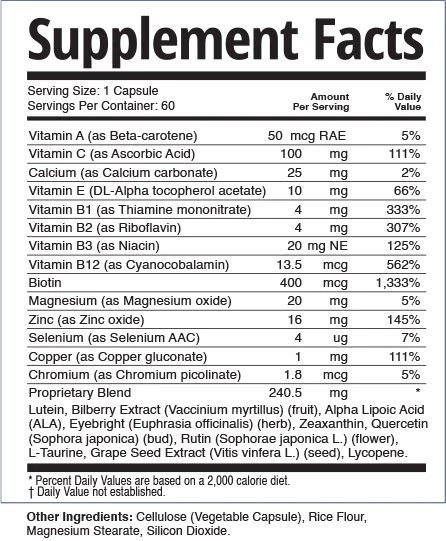
This is the panel we transcribed on September 3, 2026: fourteen actives with individual milligram or microgram amounts, then one 240.5 mg blend line covering ten more names.
The serving size printed on the panel is one capsule. The maker's own directions call for two capsules a day, which doubles every number on this panel, blend included, at the real daily dose.
How the table was computed, the AREDS2 reference dose (10 mg lutein, 2 mg zeaxanthin a day) and why its finding, no further drop in risk in the primary analysis, is not evidence about this blend
Here is the arithmetic applied to an actual panel rather than a hypothetical one.
Applying the floor and ceiling rules from above, with T = 240.5 mg and n = 10:
Neither number is guesswork; both come straight out of the order the label itself prints.
That is our own arithmetic, applied to the panel's own published order and total, not a figure printed anywhere on the bottle.
A public dosing reference exists. It is not evidence about this blend
The National Eye Institute's AREDS2 formulation, a public reference rather than a product, uses 10 mg of lutein and 2 mg of zeaxanthin a day, individually dosed, not blended.
That trial tested its own specific formula added to a base AREDS regimen. The people in it already faced meaningful risk of disease progression. In the primary analysis, adding lutein and zeaxanthin to the base formula did not further lower that risk. The researchers mainly saw lutein and zeaxanthin as a safer swap for beta-carotene, which carries its own cancer-risk concern in former smokers.
None of that is a finding about proprietary blends. None of it is a finding about TheyaVue. It is a study of a different, individually dosed formula. We cite it only as a public reference point for a milligram range, never as evidence that any blend works.
Panel figures: TheyaVue's own Supplement Facts panel, read September 3, 2026. AREDS2 dose and finding: Age-Related Eye Disease Study 2 Research Group, JAMA 2013, PMID 23644932, read September 3, 2026. AREDS2 dosing reference: National Eye Institute, read the same day.
When a blend is defensible and when it is not
Our own read: what makes a blend defensible, what counts as a caution, and three alternatives when a blend will not print amounts
This is our own read, built only from the regulation and the panel above.
What makes a blend defensible
- The total weight is printed and the order genuinely runs heaviest to lightest.
- You can compute a real floor for the first name from the order alone.
- Other actives on the same panel are dosed individually, outside the blend.
- The serving size on the panel matches the maker's own directions for daily use.
What counts as a caution
- A well-known, normally potent ingredient sitting near the last position, where the ceiling is smallest.
- A panel written for one serving while the directions call for two or more, silently doubling every number without saying so.
- No individual doses anywhere on the panel, not even for the ingredients outside the blend.
- A brand argument in place of the label's own order and total.
Say a blend will not print individual amounts. Three honest alternatives exist. A label that discloses every ingredient's own weight. A single-ingredient product whose dose matches a trial you can look up. Or a source, such as a food, where the amount is published outside any brand's panel.
None of those is automatically a better result. They are simply panels you can check against a number instead of a name.
The panel we read line by line
The worked example above is not invented: it is a bottle we read line by line, where a 240.5 mg blend carries ten names, lutein first and zeaxanthin fifth, and the directions quietly double the whole panel.
Two tips for reading any blend to its limit: total, order, floor, ceiling
You can now read any blend to its limit: total, order, floor, ceiling.
Two minutes with the panel in front of you replaces a week of forum opinions about whether a brand is "hiding" its doses.
Count the names in the blend and divide the blend total by that count before you read any marketing copy. That one division is the strongest dose statement a blend allows.
Check whether the serving size line and the directions agree. A panel written per capsule next to instructions for two capsules a day silently doubles the whole blend total.
The full panel, the real two-capsule dose, and the checkout prices we read on the vendor's own order form.
Questions people also ask
What is a proprietary blend on a supplement label?
A group of dietary ingredients declared under one name and one combined weight, allowed by 21 CFR 101.36(c) and identified by that term or by a fanciful name.
Does the label have to say how much of each ingredient is in the blend?
No. Only the blend's total weight is required, under 21 CFR 101.36(c)(3), which the Department of Defense's Operation Supplement Safety states plainly for consumers.
Can you work out the doses in a proprietary blend?
Only partly. Because 101.36(c)(2) requires descending order by weight, the first-listed ingredient must weigh at least the blend total divided by the number of names. That is a floor on the ingredient's weight and nothing more.
Is a proprietary blend automatically a red flag?
No, but it removes your ability to compare a dose against a published one, which is the entire purpose of reading a panel.
What does the asterisk and "Daily Value not established" mean?
It is required by 21 CFR 101.36(b)(3)(iv) for ingredients with no established Daily Value. It says nothing about quality or dose.
How we built this page
Every source on this page and the date we read it
This is a regulation-and-label page, not a lab test.
- The quoted paragraphs of 21 CFR 101.36 come from the govinfo Code of Federal Regulations, read September 3, 2026.
- The OPSS quote comes from Operation Supplement Safety, Uniformed Services University, last updated March 28, 2018 and read September 3, 2026.
- The 240.5 mg blend total, the ten-ingredient order, the serving size and the two-capsule directions come from TheyaVue's own Supplement Facts panel, read September 3, 2026.
- The floor and ceiling figures in the worked-example table are our own arithmetic, applied to that panel's own published total and order; none of those figures is printed on the label itself.
- The AREDS2 dose and finding are confirmed against the PubMed record for PMID 23644932 and the National Eye Institute's own page, both read September 3, 2026, and are cited only as a public reference point, never as evidence about any blend or product.
- We did not test any product, and we did not estimate a dose for any ingredient beyond the floor or ceiling the order itself allows.
- Nothing here is medical advice. A new supplement while you are pregnant, nursing or on medication is a conversation with your doctor first.