"Bilberry for eyes" is really two separate questions. Night vision has a systematic review against it: the hypothesis is not supported by rigorous trials.
Screen fatigue has two small randomized trials behind it, at 240 mg and 480 mg of extract a day, each measuring one narrow eye-muscle metric, not comfort or eyesight in general.
The short answer: two different questions, and only one has trials behind it
The night-vision claim is the older of the two, and it is the one that has been pooled and re-checked: a 2004 systematic review in Survey of Ophthalmology gathered the placebo-controlled trials behind it. The screen-fatigue claim is a separate, newer line of research, on a separate question, at a different dose. One has a negative review behind it. The other has two small trials, each with real limits.
Trial and review identifiers below are PMIDs, confirmed against PubMed on September 3, 2026 for our TheyaVue file.
What bilberry extract is on a label
On the label we transcribed for this cluster, the ingredient is printed exactly as "Bilberry Extract (Vaccinium myrtillus) (fruit)". It sits inside a proprietary blend, with no percentage or milligram figure of its own.
Neither of the two trials below records a standardization percentage in the abstract we read, and the label we transcribed does not print one either. That gap comes back in the last section of this page.
Label wording transcribed from TheyaVue's own supplement-facts panel, read 2026-09-03, per our TheyaVue recon.
Night vision: the systematic review that says the claim is not supported
Canter and Ernst reviewed placebo-controlled trials of bilberry and normal night vision, published in Survey of Ophthalmology in 2004. Their conclusion, verbatim:
"The hypothesis that V. myrtillus anthocyanosides improves normal night vision is not supported by evidence from rigorous clinical studies."Canter PH, Ernst E. Surv Ophthalmol 2004, PMID 14711439
The four most recent and most methodologically rigorous randomized trials in the review were all negative. And 11 of the 12 trials tested people with normal vision to begin with; the review found no rigorous research in people whose night vision was impaired by an eye condition either.
The review's citation, PMID 14711439
Source: Canter PH, Ernst E, "Anthocyanosides of Vaccinium myrtillus (bilberry) for night vision: a systematic review of placebo-controlled trials," PMID 14711439, read September 3, 2026.
Screen fatigue: two randomized trials, and what each one measured
Screen fatigue is a newer, narrower line of bilberry research, and it is not the same claim as night vision. Two randomized, double-blind, placebo-controlled trials sit behind it. Neither measured "eye health" broadly. Each measured one specific eye-muscle or visual-function metric after screen work, and neither tested a finished multi-ingredient eye product.
Both trials in full: Kosehira 2020 (240 mg/day, 12 weeks, 109 adults, ciliary-muscle recovery better than placebo at weeks 8 and 12) and Ozawa 2015 (480 mg/day, 8 weeks, 88 screened display workers, flicker-fusion drop blunted, near point accommodation unchanged)
Standardized bilberry extract, display-task accommodation
109 healthy adults aged 20 to 60. The measured endpoint, HFC-1, tracks how well the eye's ciliary muscle recovers focus after a display-work task.
Post-task HFC-1 was better in the bilberry group than placebo at week 8 (p=0.014) and week 12 (p=0.017).
PMID 32106548, Nutrients 2020;12(3):600
Bilberry extract, video display terminal workers
281 office workers aged 20 to 40 were screened; only the 88 with the lowest baseline critical flicker fusion (CFF) and near point accommodation scores were enrolled, and 80 completed.
The display-induced drop in CFF was blunted versus placebo (95% CI 0.10–1.60, p=0.023). Near point accommodation did not differ.
Participants' own ratings of eye fatigue, pain, heaviness, discomfort and a foreign-body sensation also improved more than placebo at week 8 (p<0.05), and the trial recorded no serious adverse events.
PMID 25923485, J Nutr Health Aging 2015;19(5):548–54
Both records confirmed against PubMed on September 3, 2026 for our TheyaVue file. Neither trial tested a finished multi-ingredient eye product.
The doses those trials used: 240 mg and 480 mg a day
Both figures describe bilberry extract given by itself, not bilberry as a small piece of a larger formula. That distinction becomes the whole question once bilberry shows up inside a multi-ingredient blend.
The two doses on one scale, 0 to 480 mg of extract a day
Put next to each other, the two doses sit at opposite ends of a range, on different schedules.
Scale: 0 to 480 mg of bilberry extract a day, taken alone in each trial. Doses per PMID 32106548 and PMID 25923485, read September 3, 2026.
Who paid for what, printed next to the finding
One of the two screen-fatigue trials names its own conflict of interest in the published paper.
"M.K. and N.M. are employees of Omnica Co., Ltd., Japan"Kosehira et al., Nutrients 2020, PMID 32106548, conflict of interest statement
Omnica Co., Ltd. is the maker of the standardized bilberry extract (SBE) the trial tested. Printing that is the paper doing its job. It does not, by itself, invalidate the p-values above. But it does mean the 240 mg finding came from a trial with a financial stake in the result. The 480 mg trial (Ozawa 2015) is the one where we found no such statement in the abstract record we read; we are not asserting one exists.
Conflict-of-interest statement quoted verbatim from the PubMed abstract record for PMID 32106548, read September 3, 2026.
Neither trial tested comfort, night driving, or a finished eye formula
"Bilberry for eyes" is not one settled claim. It is a negative review on one question and two narrow, positive-but-limited trials on a different one. Neither trial tested night driving, general "eye health," any macular condition, or bilberry inside a multi-ingredient product.
The five things the two trials did not measure, one by one
It is worth being precise about what these two trials did not measure.
- Neither trial's primary endpoint was subjective comfort; Kosehira measured a physical ciliary-muscle response and Ozawa measured flicker-fusion threshold and near point accommodation, though Ozawa's own subjective-symptom ratings improved too, at week 8.
- Neither trial tested night driving, general "eye health," or any macular condition.
- Near point accommodation, one of two endpoints in the Ozawa trial, did not differ from placebo.
- Neither trial tested bilberry as part of a multi-ingredient product; both gave the extract alone.
- The 2004 systematic review on night vision predates both screen-fatigue trials and answers a different question entirely.
What this means for you: "bilberry for eyes" is not one settled claim. It is a negative review on one question and two narrow, positive-but-limited trials on a different one.
What the trial dose means for a multi-ingredient eye formula
The 240 mg and 480 mg figures above describe bilberry extract taken alone. On the label we transcribed for this cluster, bilberry sits inside a ten-name blend, printed as 240.5 mg per capsule at a serving of one capsule.
Proprietary Blend 240.5 mg: Lutein, Bilberry Extract (Vaccinium myrtillus) (fruit), Alpha Lipoic Acid, Eyebright, Zeaxanthin, Quercetin, Rutin, L-Taurine, Grape Seed Extract, Lycopene
Label panel, read 2026-09-03, per our TheyaVue reconThe seller's own instructions call for two capsules a day, which puts the full blend at 481 mg a day, split across ten named ingredients. Bilberry is listed second in that blend, right after lutein. Federal labeling rules for proprietary blends require descending order by weight, so second place means bilberry cannot be the largest share. For that 481 mg blend to reach even the lower trial dose, 240 mg, bilberry alone would need roughly half the entire blend. Nothing on the label states that share, and the ordering rule alone cannot supply it either.
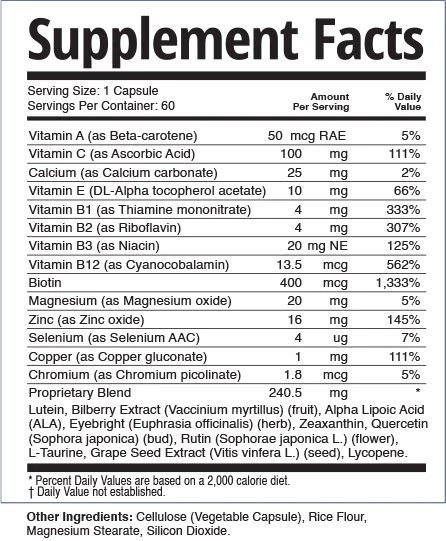
This is the panel we transcribed: fourteen dosed actives above the fold, then the 240.5 mg Proprietary Blend line with ten names underneath it and no individual weights.
Bilberry Extract is the second name in that list, right after Lutein.
The label read and the ordering rule, cited
Blend composition and order per TheyaVue's own label panel, read 2026-09-03. Ordering rule: 21 CFR 101.36(c)(2), "descending order of predominance by weight," per our TheyaVue recon.
How to read a bilberry label without a percentage on it
A trial dose is a milligram figure. A label is often just a name, with no milligram figure attached. That gap is where a federal labeling rule matters.
The extract-weight rule (21 CFR 101.36(b)(3)(ii)), why "240 mg of extract" is not one fixed thing, and two practical steps for any bottle
Extract weight is not active-compound weight
"the weight of the ingredient shall be the weight of the dried extract"21 CFR 101.36(b)(3)(ii)
That rule governs any extract on a Supplement Facts panel, bilberry included. A milligram figure for "Bilberry Extract" is the weight of the dried extract material, not a stated weight of anthocyanins.
Neither the trials above nor the label we read print an anthocyanin percentage for the extract used. So even a bottle that printed "240 mg Bilberry Extract" on its own line would not automatically match the material Kosehira 2020 tested. "240 mg of extract" is not one fixed thing across manufacturers.
Two practical steps close most of that gap on any bottle in front of you.
Compare the trial dose to the blend total, not the ingredient name
An ingredient inside a blend can never weigh more than the blend's stated total. If the blend total is below the trial dose, the ingredient is too.
Read the directions before the panel
A panel written per single capsule, next to an instruction to take two, doubles every figure on that panel. Do the multiplication before comparing anything to a trial dose.
21 CFR 101.36(b)(3)(ii), read via govinfo.gov, September 3, 2026, per our TheyaVue recon.
Our reading, in plain terms
What the evidence supports, and what it does not
What the evidence supports
- Two small randomized, placebo-controlled trials on bilberry extract and specific screen-fatigue measures, at 240 mg and 480 mg a day.
- A statistically significant result on the endpoint each trial reported as its lead result, within that trial's own narrow measure.
- A clearly stated conflict of interest in the 240 mg trial, printed by the authors themselves.
What it does not support
- The claim that bilberry improves normal night vision; a systematic review found that not supported.
- Any dose of bilberry as part of a named multi-ingredient blend, since neither trial tested a blend.
- A guarantee that "Bilberry Extract" on two different labels is the same material at the same potency.
If the label does not print a bilberry dose, the honest alternatives are plain ones
Three formats, not brand names: a single-ingredient extract with its own dose, a formula that itemises every weight, or no supplement at all
We are not naming a competing brand as a villain here. The useful alternatives are formats, not names.
- A single-ingredient bilberry extract that prints its own milligram dose and, ideally, its anthocyanin percentage, so it can be compared directly to a trial.
- A finished formula that discloses each ingredient's individual weight rather than only a blend total, so the bilberry share is not a guess.
- No supplement at all, which is the only option on this list with no dose-matching problem: neither trial above tested a blend, and neither tested a finished product.
The bottle where this arithmetic actually applies
We put that arithmetic against a real bottle whose ten-ingredient blend totals 481 mg a day with bilberry listed second, and the review shows the whole panel, the directions that double it, and what the seller does and does not print.
Two tips before you compare any bottle to a trial dose
If a bottle in front of you lists bilberry inside a blend with no individual dose, the next step is the full label read.
That review walks the whole panel line by line, including where bilberry sits and what the label leaves out.
Compare the trial dose to the blend total, not to the ingredient name. An ingredient inside a blend can never exceed the total the blend is declared at.
Check the directions before the panel. A per-capsule panel next to a two-capsule instruction doubles the blend total and changes the whole comparison.
The full label panel, where bilberry sits in the blend, and what the seller does and does not print.
Questions people also ask
Does bilberry improve night vision?
A systematic review of placebo-controlled trials (PMID 14711439) concluded the hypothesis that bilberry anthocyanosides improve normal night vision is not supported by rigorous clinical studies, with the four most recent trials negative.
What dose did the eye-fatigue trials use?
240 mg a day of standardized extract for 12 weeks (PMID 32106548) and 480 mg a day for 8 weeks (PMID 25923485).
How long did those trials run, and who was in them?
Twelve weeks in 109 healthy adults aged 20 to 60, and eight weeks in 88 display workers selected from 281 screened for the lowest baseline flicker-fusion and near-point scores.
Who funded the bilberry screen-fatigue research?
The 2020 Nutrients trial prints its own conflict of interest statement: two of its authors were employees of the extract manufacturer.
Can a multi-ingredient eye supplement deliver a trial dose of bilberry?
Only if bilberry is a very large share of the formula. An ingredient inside a blend can never weigh more than the blend total, and blends do not print the split.
How we built this page
Every source on this page and the date we read it
This is a reading of published trial records and one product label, not a lab test of our own.
- The systematic review and both randomized trials were pulled from PubMed and confirmed on September 3, 2026, and are linked above by PMID.
- The conflict-of-interest quote is verbatim from the PubMed abstract record for PMID 32106548.
- The blend composition, order and total weight come from TheyaVue's own supplement-facts label panel, read 2026-09-03, per our TheyaVue recon.
- The labeling rule on extract weight and ingredient order is quoted from 21 CFR 101.36, read via govinfo.gov, September 3, 2026.
- We did not test any product for anthocyanin content, and we did not estimate a milligram figure for an ingredient the label does not itemize.
- Nothing here is medical advice. A vision change, however small, is a conversation with an eye care professional, not a supplement page.