The short answer: a table by real serving weight, not by 100 grams
Per 100 grams, USDA data ranks raw spinach and kale highest for combined lutein and zeaxanthin.
Per real serving, the gap narrows fast: a cup of raw kale weighs about 20 grams, not 100, so it supplies roughly 1.3 mg, not the double-digit figures some lists print. Cooked greens, peas, pistachios, egg yolks and yellow corn each add smaller, real amounts, and every one of these figures is a combined lutein-plus-zeaxanthin number, never lutein alone. The American Academy of Ophthalmology's own framing is food-first: eating the right food is the best way to get eye-healthy nutrients.
USDA FoodData Central figures (api.nal.usda.gov), read September 3, 2026. See "How we built this page" for the individual food records.
Why every food figure is a single combined number
Nutrient name, as published by the USDA: "Lutein + zeaxanthin", one value, in micrograms per 100 grams.
USDA FoodData Central, api.nal.usda.gov, read September 3, 2026The USDA does not publish lutein on its own for any food; the nutrient field itself is one thing, both nutrients added together. That single line is where every "foods highest in lutein" ranking online actually comes from, and none of them, ours included, can tell you what share of the number is lutein and what share is zeaxanthin.
USDA FoodData Central, read September 3, 2026.
The USDA table, per 100 g and per the USDA's own portion
| Food | Per 100 g | USDA's own portion | Per that portion |
|---|---|---|---|
| Kale, raw | 6,260 µg (6.26 mg) | 1 cup, ~1″ pieces = 20.6 g Reference amount = 85 g | ≈1.29 mg ≈5.32 mg |
| Kale, cooked, boiled, drained | 4,980 µg (4.98 mg) | Not published in this record | Not published in this record |
| Spinach, raw (SR Legacy) | 12,200 µg (12.2 mg) | 1 cup = 30 g | ≈3.66 mg |
| Spinach, raw (Survey/FNDDS) | 6,020 µg (6.02 mg) | Not published in this record | The USDA's own second value for the same raw food |
| Spinach, cooked, boiled, drained | 11,300 µg (11.3 mg) | Not published in this record | Not published in this record |
| Egg, yolk, raw | 1,090 µg (1.09 mg) | 1 large yolk = 17 g | ≈0.19 mg |
| Peas, green, raw | 2,480 µg (2.48 mg) | Not published in this record | Not published in this record |
| Pistachio nuts, raw | 2,900 µg (2.9 mg) | Not published in this record | Not published in this record |
| Squash, summer, all varieties, raw | 2,120 µg (2.12 mg) | Not published in this record | Not published in this record |
| Corn, sweet, yellow, raw | 644 µg (0.64 mg) | Not published in this record | Not published in this record |
| Corn, sweet, white, raw | 34 µg (0.03 mg) | Not published in this record | Not published in this record |
Which records these are, and how each per-portion figure was computed (our own arithmetic on the USDA's own numbers)
These are the food records we read, each with the USDA's own per-100-gram figure and, where the same record publishes one, the USDA's own portion weight.
USDA FoodData Central (api.nal.usda.gov), read September 3, 2026. The nutrient published is "Lutein + zeaxanthin", summed by the USDA itself. Every "per that portion" figure is our own arithmetic on the USDA's own per-100-gram value and the USDA's own portion weight from the same record, not a USDA-published serving figure. Full record identifiers are listed under "How we built this page".
Where "22 mg of lutein per cup of kale" comes apart
A number close to 22 mg per cup of kale shows up across the top results for this exact search, repeated from list to list. We cannot trace where that figure first came from. What we can say is narrower: neither portion the current USDA record publishes for raw kale produces it. On the 20.6-gram cup, the record's own arithmetic gives about 1.3 mg; on the 85-gram reference amount, about 5.3 mg. Neither is 22 mg, and the record does not publish a third, larger portion that would close the gap.
USDA FoodData Central, kale, raw, Foundation record, read September 3, 2026.
Raw against cooked: what the rows actually show
Both cooked rows read lower than raw (kale 6,260 to 4,980 µg; spinach 12,200 to 11,300 µg per 100 g), and raw spinach itself carries two USDA figures, 12,200 and 6,020 µg
Raw kale reads 6,260 µg per 100 g. Cooked, boiled and drained, the same food reads 4,980 µg.
Raw spinach, in the SR Legacy record, reads 12,200 µg per 100 g. Cooked, boiled and drained, it reads 11,300 µg.
Both cooked rows read lower than their raw counterpart. We will not guess why: the USDA does not publish a mechanism, and we did not cook and test a leaf ourselves.
There is a second reason to hold that movement loosely. Raw spinach itself carries two different USDA figures for the same food: 12,200 µg in one record, 6,020 µg in another. That gap is far larger than the raw-to-cooked change above.
A dataset that disagrees with itself by that much on one raw food is not a place to read too much into a small raw-to-cooked shift.
USDA FoodData Central, read September 3, 2026.
Yellow corn against white corn: the pigment is visible
Yellow sweet corn 644 µg against white 34 µg per 100 g: roughly 19 times more, the same pigment you can see on the cob
Yellow sweet corn, raw, reads 644 µg of combined lutein and zeaxanthin per 100 g.
White sweet corn, raw, the same species picked for a different color, reads 34 µg per 100 g.
That is roughly 19 times more in the yellow ear than in the white one.
This is a rare place where the number and the color agree. The pigment in the USDA's data is the same pigment you can see on the cob.
USDA FoodData Central, corn, sweet, yellow and white, raw, read September 3, 2026.
How many servings it takes to reach the 12 mg a trial used
The trial most often cited for a lutein number, AREDS2, did not test 10 mg alone. It tested 10 mg of lutein plus 2 mg of zeaxanthin a day, in the trial's own terms a 12 mg combined dose, in 4,203 adults aged 50 to 85 who already had large deposits in both eyes, or an advanced stage of the same eye condition in one eye. Food data cannot make that same split between the two nutrients, so the honest comparison is against the 12 mg combined figure, not the 10 mg alone. Using our own division on the USDA's own per-portion numbers above, this is what 12 mg looks like on a plate:
12 mg ÷ about 1.29 mg per 20.6-gram cup.
Our own arithmetic, not a USDA total.
12 mg ÷ about 3.66 mg per 30-gram cup, SR Legacy figure.
Our own arithmetic, not a USDA total.
12 mg ÷ about 5.32 mg per 85-gram reference amount.
Our own arithmetic, not a USDA total.
AREDS2 did not test a bowl of greens, and adding the combination did not help in its own primary result
In the trial's own primary analysis, adding lutein and zeaxanthin, with or without omega-3s, did not further lower the risk the trial was tracking; they stood in for beta-carotene as a safer swap, not an added boost. The cup counts above are a unit conversion, not a recommendation.
What AREDS2 actually tested, in whom, and the three things the cup counts do not mean
AREDS2 tested a manufactured, measured capsule. The people in it already had a specific, advanced eye finding, not a general population eating a normal diet.
In the trial's own primary analysis, adding lutein and zeaxanthin, with or without omega-3s, did not further lower the risk the trial was tracking. The trial's own reasoning was different: lutein and zeaxanthin stood in for beta-carotene, an ingredient the earlier formula used that raises lung cancer risk in former smokers. They were a safer swap, not an added boost.
- None of the cup counts above were tested in any trial. They are our own division of a food number by a trial dose.
- AREDS2 does not support reading 12 mg, from any source, as better than a smaller amount for a given person.
- Nothing here says a bowl of kale, or a bottle, changes the course of any eye condition.
What this means for you: the cup counts above are a unit conversion, not a recommendation.
AREDS2 trial detail, PMID 23644932, confirmed against the PubMed abstract September 3, 2026.
What a plate cannot tell you, and what most labels cannot either
Our own read: what eating for it gives you, what it still does not, and the three honest alternatives
This is our own read, from the USDA data and the trial above.
What eating for it gives you
- A combined number you can multiply by a real portion, when the USDA has published a portion for that food.
- A pigment you can sometimes see for yourself, the way yellow corn shows against white.
- Whole foods that already show up in general healthy-eating guidance for reasons beyond one pigment.
- A way to compare two foods honestly, cup for cup, instead of gram for gram.
What it still does not give you
- A guarantee you have hit any specific milligram target: the USDA's own spinach numbers do not even agree with each other.
- A separate number for zeaxanthin. Every combined figure hides the split.
- A dose that lines up with a trial like AREDS2, which measured a manufactured capsule, not a home-cooked plate.
- Any promise about what a given amount, from food or a bottle, changes for a given person.
If a plate feels like guesswork, the honest alternatives are the same ones that apply to any nutrient gap.
Eat the foods above more often and accept the estimate that comes with them. Look for a single-ingredient lutein or zeaxanthin supplement that prints its own milligram number rather than a blend total. Or read a multi-ingredient label one line at a time, the way we do below.
What a bottle would have to print to compare
Comparing a plate to a bottle only works when the bottle prints a number, and the eye supplement we read line by line prints a 240.5 mg blend total with lutein and zeaxanthin somewhere inside it.
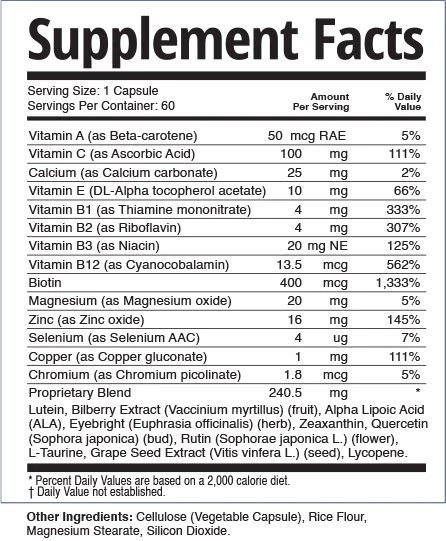
This is the panel our TheyaVue review transcribed line by line, read September 3, 2026.
The Proprietary Blend reads 240.5 mg, with lutein and zeaxanthin two of the ten named components and no individual milligram figure for either one.
Two tips: weigh a cup of greens once, and read the milligram number before the marketing
You now know what a plate delivers, cup for cup, because the USDA prints the arithmetic behind it.
That is the same comparison a bottle owes you, and a proprietary blend total does not offer it on its own.
Weigh a cup of greens once, on a kitchen scale. The gap between 20 g of raw kale and 100 g of it is the whole argument on this page.
When a bottle claims to replace the greens, look for the milligram number before the marketing. A blend total with no per-ingredient split is the absence of an answer, not a bigger one.
The full label, 14 dosed actives, and the 240.5 mg blend, each with the date we read it.
Questions people also ask
What food has the most lutein?
Per 100 g, cooked and raw spinach and kale lead the USDA rows (raw spinach 12,200 ug per 100 g in SR Legacy, kale 6,260 ug per 100 g). Per realistic serving the gap narrows sharply, because a cup of raw kale is only about 20 g.
How much lutein is in a cup of kale?
About 1.3 mg, using the USDA's own value and the USDA's own cup weight of 20.6 g for about 1 inch pieces.
Do eggs have lutein?
Yes, and less than most lists suggest: 1,090 ug per 100 g of raw yolk, which is roughly 0.19 mg in one large yolk.
Can I get 10 mg of lutein and zeaxanthin from food?
From cooked greens measured by the 100 g, yes on paper. From a garnish-sized cup of raw leaves, no.
Are lutein and zeaxanthin listed separately in food data?
No. The USDA publishes them as one combined figure, so no food table can tell you the split.
How we built this page
Every record on this page, with its USDA id and the date we read it
This is a food-data page, not a lab test.
Every number on it comes from a published record we read, on a date we print.
- All per-100-gram lutein-plus-zeaxanthin figures come from USDA FoodData Central (api.nal.usda.gov), read September 3, 2026. Record IDs (fdcId): kale raw 323505 (Foundation); spinach raw 168462 (SR Legacy) and 2709614 (Survey/FNDDS); spinach cooked 169287 (SR Legacy); kale cooked 169238 (SR Legacy); egg yolk raw 172184 (SR Legacy); peas raw 170419 (SR Legacy); pistachio raw 170184 (SR Legacy); squash raw 170487 (SR Legacy); corn yellow raw 169998 (SR Legacy). The white sweet corn figure of 34 ug per 100 g is published in the same USDA comparison we read on September 3, 2026; we are not printing a record id for it because we did not record one.
- Every "per that portion" milligram figure is our own division of the USDA's per-100-gram value by the USDA's own portion weight in the same record. None of these per-portion figures is a value the USDA itself publishes as a single number.
- The food-first framing above comes from the American Academy of Ophthalmology's "Fabulous Foods to Boost Eye Health". Author Celia Vimont, reviewed by Brenda Pagan-Duran, MD. Page updated April 10, 2026, read September 3, 2026.
- The AREDS2 trial detail, PMID 23644932, was confirmed against its PubMed abstract September 3, 2026, and is quoted here only for the dose it tested and the finding it reported.
- USDA food records were read at USDA FoodData Central, api.nal.usda.gov.
- The 240.5 mg blend total comes from our own TheyaVue review, which transcribed the seller's own label panel, read September 3, 2026.
- We did not run our own laboratory analysis on any food, and we did not estimate a milligram figure for any portion the USDA record does not publish.
- Nothing here is medical advice. A specific concern about your own eyes is a conversation with an eye doctor.