The short answer: 10 mg, 20 mg, and the few milligrams a normal day of eating gives you
Three numbers cover almost every honest answer to this question.
Ten milligrams a day, plus 2 mg of zeaxanthin, is the dose one clinical trial tested.
That trial added it to a different formula, not to a lutein product on its own.
Twenty milligrams a day is a safety ceiling from a single 2006 risk assessment.
It is a ceiling, not a target to aim for.
A normal day of leafy vegetables supplies a few milligrams. Not tens.
And lutein has no percent Daily Value on any label, anywhere, because none has been set.
The three numbers as cards, with the PMIDs (23644932, 16814439) and the USDA read date
Lutein plus zeaxanthin a day, added to a base AREDS formula in one clinical trial.
The highest daily lutein intake one 2006 risk assessment called safe. Above it, data ran out.
A cup of raw kale or spinach, by USDA's own portion weights, not a 100-gram figure nobody eats.
USDA FoodData Central, read Sep 3, 2026
Where the 10 mg comes from: one trial, one formula, and what it actually found
The number traces to the second Age-Related Eye Disease Study, AREDS2: 4,203 participants, ages 50 to 85, given ten milligrams of lutein and two milligrams of zeaxanthin a day, on top of a base AREDS formula. It was not tested alone.
In the trial's main analysis, adding lutein and zeaxanthin to the base formula did not further reduce the risk of progressing to advanced disease.
Who was in AREDS2 (large drusen in both eyes or advanced disease in one), why lutein stood in for beta-carotene, and why 10 mg was never a recommendation (PMID 23644932)
Every participant already had large drusen in both eyes, or advanced eye disease in one eye.
This was not a study of healthy adults with normal vision.
Researchers viewed the added lutein and zeaxanthin mainly as a safer stand-in for beta-carotene, the original AREDS ingredient linked to lung cancer risk in former smokers.
Not as a proven boost on its own.
So the 10 mg figure is real.
It is also a dose from one trial, tested inside a different formula, in a population already at risk.
It was never framed as a recommendation for a healthy adult.
AREDS2 Research Group, JAMA, 2013. PMID 23644932, read September 3, 2026.
Where the 20 mg ceiling comes from, and who wrote it
The other number worth knowing is a ceiling, not a target: 20 milligrams a day.
It comes from a 2006 risk assessment of two carotenoids, lutein and lycopene, published in Regulatory Toxicology and Pharmacology. Both authors worked for the Council for Responsible Nutrition, a supplement trade association.
Shao and Hathcock 2006, quoted (evidence of safety strong up to 20 mg/d, data above that insufficient), and the trade-association address printed on the paper (PMID 16814439)
"The OSL risk assessment method indicates that the evidence of safety is strong at intakes up to 20mg/d for lutein... Although much higher levels have been tested without adverse effects and may be safe, the data for intakes above these levels are not sufficient for a confident conclusion of long-term safety."
Shao & Hathcock, 2006 · PMID 16814439Its address is printed on the paper itself.
That does not make the number wrong.
It does mean an interested party wrote it, and we think you should know that before reading 20 mg as a neutral finding. Our lutein side effects page walks through what an Observed Safe Level does, and does not, promise.
Neither number is a target written for you personally
Neither trial set a daily amount for a healthy adult with normal eyes.
- AREDS2 tested a dose inside a different formula, in people already at risk of advanced eye disease, not a general population.
- The 2006 risk assessment set a safety ceiling. It never claimed that more lutein works better than less.
- No source in our file says a bigger number produces a better outcome than 10 mg, for anyone.
What this means for you: 10 mg and 20 mg are both real figures from real documents. Neither one is medical advice aimed at you.
Lutein has no Daily Value, and that is a labeling rule, not an oversight
Next to lutein, a label shows a dagger or an asterisk, not a percentage. That symbol is not a maker skipping a step. It is federal regulation, written this way on purpose, because no Daily Value has been set for lutein.
The rule quoted (21 CFR 101.36) and what the dagger next to lutein does and does not mean
"Other dietary ingredients shall bear a symbol (e.g., an asterisk) in the column under the heading of '% Daily Value' that refers to the same symbol placed at the bottom of the nutrition label and followed by the statement 'Daily Value not established.'"
21 CFR 101.36(b)(3)(iv), via govinfo.govNo Daily Value has been set for lutein.
Every label that follows the rule prints the dagger, not a percentage, next to it.
So when a panel shows lutein with no percent sign, that is the rule working as written.
It says nothing about the quality of the product underneath it.
What a real serving of food supplies
These numbers use USDA's own values and USDA's own serving weights, not a 100-gram figure nobody actually eats.
| Food | Lutein + zeaxanthin, per 100 g | USDA's own portion | Amount in that portion |
|---|---|---|---|
| Kale, raw | 6,260 mcg | 1 cup, ~1-inch pieces (20.6 g) | ~1.3 mg |
| Spinach, raw | 12,200 mcg | 1 cup (30 g) | ~3.7 mg |
| Egg, yolk, raw | 1,090 mcg | 1 large yolk (17 g) | ~0.2 mg |
USDA FoodData Central, api.nal.usda.gov, read September 3, 2026. The per-portion math is ours, not USDA's.
The 22 mg-per-cup kale figure that does not match USDA, the full cup-by-cup table on our foods page, and the American Academy of Ophthalmology's plain version
One figure circulates widely online: kale at roughly 22 mg of lutein per cup.
That number does not match USDA's current Foundation value for kale, at either portion weight published in the same record. Our foods high in lutein and zeaxanthin page runs the full USDA table, cup by cup.
The American Academy of Ophthalmology puts the plain version well.
Eating the right food is the best way to get eye-healthy nutrients.
American Academy of Ophthalmology, "Fabulous Foods to Boost Eye Health," read September 3, 2026.
Lutein and zeaxanthin are two numbers, and most sources give you one
USDA's own FoodData Central publishes a single combined figure, "Lutein + zeaxanthin," for every food in the table above. It never reports a lutein-only number.
AREDS2 is one of the rare places a real split exists: 10 mg lutein and 2 mg zeaxanthin, a five-to-one ratio, inside the formula it tested.
Why "macular pigment" names the pair, and why most sources give you one number
Lutein rarely travels alone. Zeaxanthin sits beside it in food, and beside it in the eye's own macular pigment.
Most databases do not separate the two.
That is why "macular pigment" is worth knowing as a phrase.
It names the pair together, not lutein on its own, and it is usually what a single combined number is actually describing.
Why the number on the bottle is often unknowable
A single-ingredient bottle can print a real milligram figure for lutein. A blended one often cannot: federal rule requires only the blend's total weight, not each named ingredient's own share of it.
"The specific amount of each individual ingredient in a proprietary blend does not have to be listed; only the total combined amount in the blend must be given."
Operation Supplement Safety (OPSS), Uniformed Services University, updated March 2018Here is what that rule looks like on a real label we read for a vision-supplement review. Our what is a proprietary blend page walks through what that total-weight rule allows, and what it hides.
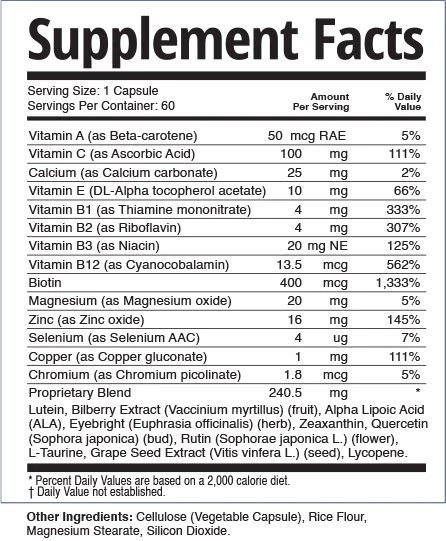
TheyaVue's own panel, read September 3, 2026.
Lutein is named first among ten ingredients sharing one 240.5 mg Proprietary Blend line. Zeaxanthin is fifth on the same line.
Neither carries its own milligram figure.
The panel's Serving Size is printed for one capsule; the same vendor's own FAQ instructs two capsules a day.
What a printed number gives you (a figure to compare against the 10 mg in AREDS2) and what it still does not (no proof the finished product was tested, no reason to assume more is better)
What a printed number gives you
- A figure you can compare against a published trial dose, like the 10 mg in AREDS2.
- A way to tell two products apart when both name the same ingredient.
- A number the maker has committed to in print, on the bottle.
What it still does not give you
- Proof that the finished product was tested in people, at that exact dose.
- Any reason to assume a bigger number works better than a smaller one.
- Information about where an ingredient sits inside a blend that names it, but never doses it.
Three alternatives when a blend hides the number: a single-ingredient product, a formula that publishes a 10 mg plus 2 mg split, or the foods in the table
When a blend hides the number, three honest alternatives exist.
A single-ingredient lutein product that states its own milligrams, outside any blend.
A formula that publishes a split matching a real trial, such as 10 mg lutein and 2 mg zeaxanthin.
Or the foods in the table above, where the amount is never a secret.
A three-line check before you buy
Find the unit
Is lutein on its own line, with its own milligram figure? Or only named inside a blend?
Find its position
Blend ingredients must be listed in descending order by weight.
Where lutein sits in that order is the only dose clue the rule guarantees.
Find the real serving
Check the panel's serving size against any separate dosing instructions on the same page.
A panel written for one capsule next to a two-capsule instruction doubles every number on it.
One label where we did the arithmetic
You now have a number worth carrying to a label.
We ran exactly this check on a bottle that names lutein first in its blend, and never prints a single milligram of it.
Read the serving size line before the amounts column.
A panel written per capsule, next to a two-capsule instruction, doubles every number on it.
Find the ingredient's position inside a blend before you judge the blend.
Position is the only dose information the rule guarantees you.
The full label panel, the blend order, and the two-capsule arithmetic, each dated.
Questions people also ask
How much lutein should I take per day?
The number people quote, 10 mg, comes from the AREDS2 trial's supplement arm (10 mg lutein plus 2 mg zeaxanthin, PMID 23644932). It is a dose a trial used in a different formula, not an FDA recommendation, and no Daily Value exists for lutein.
Should I take more than 10 mg of lutein a day?
Ten milligrams is the dose a trial tested, not a ceiling to reach for. A separate 2006 risk assessment set the safety ceiling most people ask about next, and our lutein side effects page walks through where that number comes from and who wrote it.
How many milligrams of lutein does one cup of greens give me?
Not from a garnish. Using USDA's own portion weights, a cup of raw kale is about 1.3 mg and a cup of raw spinach about 3.7 mg, so the trial's 10 mg is several large servings of cooked greens rather than a side salad. Our foods high in lutein and zeaxanthin page runs the full table.
Why is there no percent Daily Value next to lutein?
Because none has been established. 21 CFR 101.36(b)(3)(iv) requires the asterisk and the footnote "Daily Value not established" instead.
Does a bigger blend total mean more lutein?
No. A blend total is the combined weight of every name on that line, so a larger total can still leave any one ingredient small. Our what is a proprietary blend page shows how far the label's ordering rule lets you bound a single name, and where it stops.
How we built this page
This is a source-reading page. It is not a lab test, and it is not medical advice.
Every source with the date we read it, which arithmetic is ours, and the doctor-first note
- The AREDS2 dose and its primary result come from PMID 23644932, read September 3, 2026.
- The 20 mg ceiling and the funding note come from PMID 16814439, read September 3, 2026.
- The Daily Value and proprietary-blend rules are quoted from 21 CFR 101.36, read via govinfo.gov on September 3, 2026.
- The blend-disclosure quote is from Operation Supplement Safety (OPSS), Uniformed Services University, a page last updated March 2018, read September 3, 2026.
- The food amounts are USDA FoodData Central's own values and own portion weights, read September 3, 2026. The per-portion math is ours.
- TheyaVue's label panel was read from the vendor's own partner materials on September 3, 2026, for our TheyaVue review.
- A new supplement, at any dose named on this page, is worth a conversation with a doctor first, especially if you are pregnant, nursing, or on medication.