The short answer: one published safety ceiling, and a lot of "not enough data"
One paper hands you a number. In 2006, a risk assessment set an Observed Safe Level, or OSL, for lutein at 20 mg a day.
An OSL is not a government limit. It is one method's read of the published safety data, done by two named authors. Above 20 mg a day, the same paper does not say lutein is unsafe. It says the evidence has not been tested carefully enough to know.
The paper's own sentence on the 20 mg ceiling, and where we read it
"The OSL risk assessment method indicates that the evidence of safety is strong at intakes up to 20mg/d for lutein... Although much higher levels have been tested without adverse effects and may be safe, the data for intakes above these levels are not sufficient for a confident conclusion of long-term safety."
Shao & Hathcock, Regulatory Toxicology and Pharmacology, 2006, PMID 16814439Quoted from the abstract of Shao A, Hathcock JN, "Risk assessment for the carotenoids lutein and lycopene," Regulatory Toxicology and Pharmacology 2006, PMID 16814439, read September 3, 2026.
Where 20 mg a day comes from, and who wrote it
The 20 mg figure did not come from a government agency setting a rule. It came from Andrew Shao and John Hathcock. They built the number using what the paper itself calls the Observed Safe Level, or OSL, risk assessment method.
The paper's own partenariat line lists both authors at the Council for Responsible Nutrition. That is a supplement industry trade association. That does not make the number wrong. A trade group can publish a real risk assessment. It does mean the number was not written by a neutral referee.
The paper's exact wording above 20 mg, its separate 75 mg lycopene figure, and the source line
The paper's own statement is direct: the data for intakes above 20 mg/d are not sufficient for a confident conclusion of long-term safety. Twenty milligrams a day is that number for lutein. Seventy-five milligrams a day is the paper's separate number for the carotenoid lycopene, a different compound entirely.
A page that quotes 20 mg without naming who wrote it leaves out the part a careful reader wants.
partenariat and dose per Shao & Hathcock, PMID 16814439, read September 3, 2026.
Lutein has no FDA Daily Value, and what that changes
Lutein carries no FDA Daily Value, which is why federal rule requires a symbol next to it instead of a percentage, followed by the statement "Daily Value not established" (21 CFR 101.36(b)(3)(iv)). You can see that absence printed on almost every supplement panel that carries lutein.
That symbol is not an advisory. It is a gap: the panel has no established Daily Value to show you a percentage of, so it cannot compare your dose to one.
The regulation's wording, and why the 2006 ceiling only helps if you already know your dose
An Observed Safe Level is one method's read of published safety data, not a government limit. The 2006 paper says so itself: it is a risk assessment, published by two named authors in a journal. What we can show you on a label is narrower and firmer.
For lutein, the only ceiling you can check against is the 2006 industry paper above. That only works if you already know your actual dose.
"...followed by the statement 'Daily Value not established'..."
21 CFR 101.36(b)(3)(iv), Federal labeling rule for dietary ingredients without a Daily ValueHere is the practical change. For a nutrient that has an established Daily Value, a label lets you check your percentage of it.
Regulation text per 21 CFR 101.36, U.S. Government Publishing Office, read September 3, 2026.
The lung cancer advisory belongs to beta-carotene, not to lutein
A search for "lutein side effects" often surfaces a real advisory about smokers and eye supplements. It is real, and it is not about lutein.
"Current and former smokers should take the AREDS2 formula and avoid the AREDS formula with beta-carotene, which increases lung cancer risk."
National Eye Institute, About AREDS/AREDS2The ingredient behind that advisory is beta-carotene, dosed at 15 mg a day in the original AREDS formula. Lutein and zeaxanthin were not the concern. They were the fix. The follow-up AREDS2 formula replaced beta-carotene with lutein and zeaxanthin. That is the swap the National Eye Institute points smokers to, and it is why the advisory follows the beta-carotene, not the lutein.
How to read that advisory on any eye vitamin, the beta-carotene line on the TheyaVue label, and the sources
So remember a swap, not a caveat. If a page says an eye vitamin raises lung cancer risk in smokers, ask which ingredient it names. If the answer is beta-carotene, it is not describing lutein.
One clarification worth stating plainly, since the bottle in question does list beta-carotene: on the label we transcribed for this cluster, TheyaVue's beta-carotene sits under "Vitamin A (as Beta-carotene)" at 50 mcg RAE per capsule, 5% DV, which is 100 mcg RAE at the maker's own two-capsule dose. That is an order of magnitude below the 15 mg of beta-carotene that motivated the NEI advisory. One gap remains: the panel prints only the RAE equivalent and never a beta-carotene milligram figure, so this comparison rests on RAE, not on the two doses expressed in the same unit.
Advisory and formula history per the National Eye Institute, About AREDS/AREDS2, read September 3, 2026. Label wording transcribed from TheyaVue's own supplement-facts panel, read 2026-09-03, per our TheyaVue recon.
What the AREDS2 trial reported at 10 mg plus 2 mg
The 10 mg lutein plus 2 mg zeaxanthin dose that gets quoted everywhere comes from one large trial: the Age-Related Eye Disease Study 2, or AREDS2. The trial gave that daily dose to 4,203 participants aged 50 to 85, which is why 10 mg is the number people quote.
Here is the finding a lutein page has to state plainly. In the trial's main analysis, adding lutein and zeaxanthin to the base AREDS formula did not further reduce participants' risk. That risk was progression to the advanced stage of the eye condition the trial enrolled for. The trial's own framing treated lutein and zeaxanthin as a safer substitute for beta-carotene, not as an added benefit on top of it.
This page's claims are not intended to diagnose, treat, prevent, or slow the progression of any eye disease. AREDS2 tested a specific formula in a specific trial population. It is not evidence about lutein as a general supplement. It is not evidence about any product named elsewhere on this page.
What the research does not say: a safe dose is not a dose proven to work better, and neither source tested a product
A dose that is safe is not a dose proven to work better
The 20 mg OSL and the 10 mg AREDS2 dose answer two different questions, and neither answers a third one people often ask.
- The OSL paper studied safety data, not outcomes. It never claims 20 mg improves anything.
- AREDS2 studied a specific trial population already at risk of eye disease progression, using a full formula, not lutein alone.
- No source in our file says a higher lutein dose works better than a lower one for any outcome.
- Neither source tested any single commercial eye supplement by name.
What this means for you: a safety ceiling tells you what has been tested without harm. It does not tell you what dose, if any, does something for you.
Trial detail per the AREDS2 Research Group, JAMA, 2013, PMID 23644932, read September 3, 2026.
The part no page can answer for you: an unlabelled dose
Everything above assumes you know your daily lutein dose. Plenty of labels never give you that number at all.
Here is a real one. Per TheyaVue's own panel, read September 3, 2026, its Supplement Facts print a Proprietary Blend of 240.5 mg. Ten ingredients share that line: Lutein, Bilberry Extract, Alpha Lipoic Acid, Eyebright, Zeaxanthin, Quercetin, Rutin, L-Taurine, Grape Seed Extract, and Lycopene. Not one of those ten carries its own milligram amount. The panel gives only the combined total, 240.5 mg per capsule. The product's own directions call for two capsules a day.
This is legal. Federal rule lets a "proprietary blend" disclose only its total weight and the ingredient order. Each ingredient's own share can stay hidden. See what a proprietary blend legally has to disclose, and what it does not.
What the panel gives you and what it does not, the bilberry line, and the sources
Bilberry Extract, the blend's second-listed name here, has its own dosed research worth reading on its own; see bilberry for eyes, read honestly.
Blend composition per TheyaVue's own panel, read September 3, 2026. Federal rule per 21 CFR 101.36.
What the label ordering rule lets you bound, and what it does not
A blend total is not a total blackout. Ingredients inside a proprietary blend must be listed in descending order by weight (21 CFR 101.36(c)(2)). On TheyaVue's ten-name, 240.5 mg blend, lutein is named first, so it is at least 24.05 mg per capsule, at least 48.1 mg a day at the product's own two-capsule instruction. Zeaxanthin is named fifth, which caps it at no more than 48.1 mg per capsule.
Now the caveat that keeps this honest. For extracts, the declared weight is the weight of the dried extract, not the weight of the pure compound inside it (21 CFR 101.36(b)(3)(ii)). "Lutein" on a label can be a standardized extract, so the bound above limits the weight of that ingredient line. It does not necessarily mean milligrams of pure lutein. That is why the honest answer stays "not knowable" rather than a number. This page does not write a lutein milligram figure for any product, including this one.
The arithmetic step by step, the two regulation quotes, the bound table, and the source line
That single rule lets you do real arithmetic on a blend you cannot otherwise read. Lutein is named first, so it is the heaviest of the ten. Ten shares that sum to 240.5 mg cannot all fall below the average share. So lutein is at least 24.05 mg per capsule. At the product's own two-capsule instruction, that is at least 48.1 mg a day. Zeaxanthin is named fifth. The first four names must each weigh at least as much as the fifth. The top five names together can carry no more than the full 240.5 mg. That caps zeaxanthin at no more than 48.1 mg per capsule. Neither should you take a lutein figure from a blend total alone.
"Dietary ingredients contained in the proprietary blend...shall be declared in descending order of predominance by weight..."
21 CFR 101.36(c)(2)| Ingredient | Position in the blend | Weight bound, our arithmetic |
|---|---|---|
| Lutein | 1st of 10 named ingredients | At least 24.05 mg/capsule (48.1 mg/day at 2 capsules) |
| Zeaxanthin | 5th of 10 named ingredients | No more than 48.1 mg/capsule |
"...the weight of the ingredient shall be the weight of the dried extract."
21 CFR 101.36(b)(3)(ii)Descending-order and extract-weight rules per 21 CFR 101.36(c)(2) and (b)(3)(ii). Arithmetic and blend order are our own reading of TheyaVue's own panel, read September 3, 2026.
If you already take an eye formula, three lines to check tonight
You need three lines on the box already in your cabinet: the blend order, the real serving size, and every other product you take that carries lutein.
The three steps, what a ceiling number gives you and what it does not, and three alternatives you can actually check
Find the blend order
Is lutein named first, fifth, or last inside a "Proprietary Blend" or "Eye Complex" line?
Order tells you roughly where it sits, even without a milligram.
Find the real serving size
Read the Supplement Facts serving size, then read the actual directions.
A panel can be written per one capsule while the directions call for two, doubling every number on it.
Add up every source
A multivitamin, an eye formula, and a greens powder can each carry lutein.
Total them before you compare anything to the 20 mg ceiling above.
Do all three, and you have turned an unlabeled blend into a rough, honest estimate instead of a guess.
What a ceiling number gives you
- A figure to compare your total daily intake against, once you add every source up.
- A published safety review with its own stated limits, not a marketing line.
- A concrete reason to ask a manufacturer for its blend's exact ingredient order.
- A way to catch a hidden high dose that is only obvious once several products are combined.
What it still does not give you
- Confirmation that any one labeled product sits safely under that ceiling.
- Evidence that a higher lutein dose works better than a lower one.
- The individual milligram amount hidden inside a proprietary blend.
- A substitute for telling your own doctor what you take, especially if you smoke.
If an unlabeled blend bothers you, three honest alternatives exist. A single-ingredient lutein supplement that prints its own milligram dose. A formula that lists every eye-health active outside any blend, with an amount next to each. Whole foods that carry lutein and zeaxanthin without a supplement label at all. None of those is automatically the better choice. Each one is simply a label you can actually check. See foods high in lutein and zeaxanthin for the food-based route, with amounts per serving.
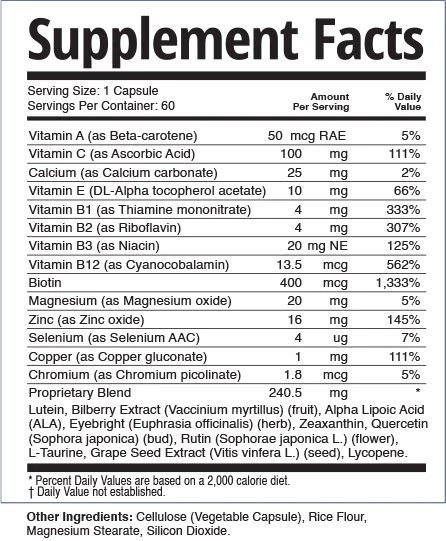
This is the panel we read line by line: fourteen dosed actives, then a single 240.5 mg Proprietary Blend line naming ten more.
Lutein and zeaxanthin sit inside that blend, in the first and fifth positions, with no milligram amount printed for either.
The label we read line by line
That is not hypothetical: on the eye supplement we read line by line, lutein is the first name in a 240.5 mg blend, the directions call for two capsules, and the only number the label will ever give you is the total.
Why the comparison needs a printed number, and two tips before you judge a bottle
You now have a ceiling to compare a real dose against, 20 mg a day per the 2006 risk assessment above.
The comparison only happens if the bottle in front of you prints a number that lets you count. Our full read of that label lives in the review below. So does the rest of what its order form and guarantee actually say.
Add up every source before you judge one bottle. A multivitamin, an eye formula, and a greens powder can each carry lutein. The total is what matters against a ceiling, not any one label alone.
If a panel shows a blend total instead of a per-ingredient milligram, record your intake from that product as unknown, not as low. A large blend total does not mean any one ingredient's share is small.
The full label, the real two-capsule dose, and the order-form prices, each with the date we read it.
Questions people also ask
Is 20 mg of lutein a day safe?
A 2006 risk assessment (PMID 16814439) identified 20 mg/day as an Observed Safe Level and said data above that intake are not sufficient for a confident conclusion about long-term safety. Its authors were connected with a supplement trade association, which the page states.
Does lutein have a Daily Value on the label?
No. That is why supplement panels print a symbol and "Daily Value not established" next to it, as 21 CFR 101.36(b)(3)(iv) requires.
Do lutein supplements increase lung cancer risk in smokers?
The advisory the National Eye Institute publishes is about beta-carotene, which is why smokers and former smokers are told to avoid the original AREDS formula. AREDS2 replaced beta-carotene with lutein and zeaxanthin for that reason.
How long has the 10 mg dose been studied?
AREDS2 gave 10 mg lutein plus 2 mg zeaxanthin daily to 4,203 participants aged 50 to 85.
Can I tell how much lutein is in a supplement that uses a proprietary blend?
No. The panel is only required to give the blend's total weight and the ingredient order, so your intake is unknown rather than low.
How we built this page
Every source, the date we read it, and what we did not do
This is a label-and-literature page, not a lab test and not medical advice.
- The 20 mg Observed Safe Level and its authorship come from Shao & Hathcock, Regulatory Toxicology and Pharmacology 2006, PMID 16814439, read September 3, 2026.
- The federal labeling text on Daily Value, blend order, and extract weight comes from 21 CFR 101.36, U.S. Government Publishing Office, read September 3, 2026.
- The smoker advisory and the AREDS/AREDS2 formula history come from the National Eye Institute's own page, read September 3, 2026.
- The AREDS2 dose and trial size come from the AREDS2 Research Group, JAMA 2013, PMID 23644932, read September 3, 2026.
- The blend total, ingredient order, and serving directions come from TheyaVue's own Supplement Facts panel, read September 3, 2026.
- The milligram bounds in the ordering-rule section are our own arithmetic from that panel, not a number printed anywhere by the manufacturer.
- We did not test any product, and we do not write a lutein milligram figure for any product whose label does not print one.
- Nothing here is medical advice. A new supplement while you smoke, are pregnant, are nursing, or take medication is a conversation with your doctor first.