Weeks, not days. The human trials behind two common gut ingredients ran 8 weeks and 12 weeks; one seller tells its own buyers colonizing takes 6 to 8 weeks, and recommends three months.
Digestive comfort can shift sooner for some people. No honest source promises a date.
The short answer: weeks, not days, and the trials ran 8 to 12 weeks
The trial lengths and the seller's own wait agree. A third number, the refund window, does not.
One scale, zero to thirteen weeks. Trial lengths from PubMed, read September 3, 2026; the seller figures from Bioma's own FAQ and Terms of Service, read August 31, 2026.
What one seller tells its own buyers: 6 to 8 weeks to colonise, three months recommended
Bioma answers the question in its own FAQ:
"It typically takes 6-8 weeks for the good gut bacteria to fully colonize your gut. That's why we recommend taking Bioma probiotics for at least 3 months."Bioma FAQ, our render read August 31, 2026
That is also, quietly, a statement that one bottle is not the test.
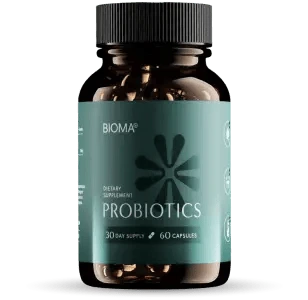
The same FAQ prints the dose: "Take two capsules with a full glass of water, one time per day, before breakfast."
The front label we transcribed says "30 DAY SUPPLY" and "60 CAPSULES", which matches that dose exactly.
One bottle is 30 servings. A three month course, on the seller's own advice, is three of them.
Source: Bioma's own FAQ and product packshot, our dumps of August 31, 2026 and September 2, 2026. Product photo from the seller's own materials.
What the trials used as a clock: 8 weeks with XOS, 12 weeks with B. breve
Finegold 2014, xylooligosaccharides
A double-blind randomized trial in 32 adults, run for 8 weeks, testing 1.4 g or 2.8 g of XOS a day against placebo.
It found more bifidobacteria at the higher dose, and no change in lactobacilli. Published in Food & Function.
PubMed 24513849, checked September 3, 2026.
Minami 2018, Bifidobacterium breve B-3
A double-blind randomized trial in 80 pre-obese adults, run for 12 weeks, using a named strain at 2x10^10 CFU a day, the unit explained in what CFU means on a probiotic label.
It reported lower fat mass against placebo, with no significant change in total body weight.
PubMed 30094122, checked September 3, 2026.
Both records re-verified against PubMed on September 3, 2026. Neither trial tested any finished retail product.
What the research does not say
Neither trial promised a symptom timeline, and neither one measured how you feel. Finegold counted bacteria; Minami measured body fat. Those are lab endpoints, not a start date for relief.
- No trial we found tested a finished multi-ingredient probiotic product as a whole, only single ingredients or single strains.
- Strain codes matter. Minami used B. breve B-3 specifically, not the species in general.
- The pooled weight effect across 15 randomized trials in 957 people was −0.60 kg versus placebo, 95% CI −1.19 to −0.01 kg (Borgeraas 2018, PubMed 29047207). The authors themselves call these small effect sizes.
- Any product that promises a specific number of kilos on a specific date is ahead of that evidence.
The clock that runs out first: a 14-day guarantee counted from delivery
The checkout badge on that same seller reads "14-Day Money-Back Guarantee". The clause behind it is narrower.
"within 14 days from the date of delivery"Bioma Terms of Service, clause 7.1, read August 31, 2026
Fourteen days from delivery is two weeks; the seller's own schedule asks for six to eight. So the window closes roughly a month before the seller says the product has finished doing its job.
Terms of Service clause 7.1, our render of August 31, 2026.
Declared delivery in the same seller's FAQ is 3 to 8 business days, inside that same fortnight.
Sealed jar only, and a $9 label: what the refund clause actually covers
What clause 7 actually requires
"unopened and in its original packaging and in a condition fit for resale" or "not as described or faulty"Bioma Terms of Service, clause 7.1, read August 31, 2026
Read plainly: opening the jar to try it is what ends the refund option. That makes the badge a sealed-product return window, not a try-it-and-see guarantee.
a prepaid label of $9 USD, "deducted from the final refund"Bioma Terms of Service, clauses 7.2 and 7.3, read August 31, 2026
Clause 7.4 then puts the refund at 10 to 30 business days after inspection, and adds "up to 14 working days" more before the money shows on your statement.
All four quotes above are verbatim from the seller's own Terms of Service, our render of August 31, 2026.
We did not buy, so no post-payment screen is verified by us.
Recurring shipments sit outside the return window
The same clause 7.1 carves subscription deliveries out of the refund entirely:
refunds for products that are unopened "will only be issued for the initial purchase and not for recurring subscription goods"Bioma Terms of Service, clause 7.1, read August 31, 2026
So the first box has a sealed-jar window; every box after it has none. Which tab you are on when you pay decides that, and it is preselected: we rendered that checkout twice in a real browser on September 1, 2026, and the Subscribe tab loads active both times, with the one-time tab greyed beside it.
Confirmed two ways: the live DOM state of the plan toggle, and a screenshot of the page at load. Both in our September 1, 2026 build check.
Two things to do in the first fourteen days if you want to keep the option open
None of this is a reason to avoid probiotics. It is a reason to read two lines before you open the box.
Step 1, the return window and when it starts counting. Step 2, which checkout tab is active
Check the return window before you break the seal
Find out how many days you get, and whether the count starts at delivery or at purchase. Those are different dates.
If the window is shorter than the course the seller recommends, you now know that before you open anything.
Check which checkout tab is active before you commit
A recurring plan is usually cheaper on the first charge, and it is often the tab that loads selected.
Confirm that on screen. A repeat shipment can be the one delivery with no return window at all.
What a realistic timeline looks like
What is reasonable to expect, and what is not supported by what we read
Reasonable to expect
- A course measured in weeks, planned as two or three bottles rather than one
- A printed daily dose you can actually keep, in this case two capsules before breakfast
- Mild digestive changes early on in some people: the seller's own FAQ notes temporary bloating, and we did not capture that sentence verbatim
- A published trial length you can look up yourself, 8 weeks and 12 weeks in the two above
Not supported by what we read
- A date when it "starts working". No source we read names one
- A refund window long enough to cover the seller's own six to eight week estimate
- A refund at all on an opened jar, or on any recurring shipment
- A specific weight outcome by a specific week
If the timeline is the problem, the alternatives are boring on purpose
Four alternatives, named as formats rather than brands
We are not naming a rival brand as a villain here. The useful alternatives are formats, not names.
- What Is a Proprietary Blend? The FDA Label Rule
- A single-strain product that prints its strain code and CFU count, so you can look up the actual trial that used it.
- A food-first route. Fermented foods and everyday fibre cost nothing to trial and have no return window to miss. The branded ingredient route on the same shelf is read separately in our tributyrin supplement page.
- A pharmacy own-brand with a plain label, bought in one month at a time, so the clock and the money stay small.
- A clinician, first, if the reason you are shopping is a symptom rather than curiosity. That is not a supplement question.
Questions people also ask
How long do probiotics take to work?
Plan in weeks, not days.
The two human trials we checked ran 8 weeks: xylooligosaccharides, Finegold 2014.
The other ran 12 weeks: Bifidobacterium breve B-3, Minami 2018.
One seller in the category, Bioma, answers this in its own FAQ.
It says it "typically takes 6-8 weeks for the good gut bacteria to fully colonize your gut".
It then recommends taking its probiotics "for at least 3 months".
Neither the trials nor the seller promise a day when you will feel different.
How long before probiotics help with bloating?
No honest source we read puts a date on that.
Probiotics may support digestive comfort in some people, and some people notice a change sooner than the trial clocks above.
That is not a promise, and it is not what either trial measured.
If bloating is persistent or painful, that is a question for a doctor, not for a supplement page.
Is there a best time of day to take them?
Follow the instruction printed on the product you actually bought.
On the one we read, Bioma's own FAQ (read August 31, 2026) says this.
"Take two capsules with a full glass of water, one time per day, before breakfast."
One bottle holds 60 capsules, which is 30 servings, or 30 days at that dose.
A daily habit you can keep matters more than the hour on the clock.
If it takes 6 weeks, does a 14-day guarantee still help?
Not once the jar is open.
Bioma's Terms of Service clause 7.1 (read August 31, 2026) counts 14 days "from the date of delivery".
It only refunds a product that is "unopened and in its original packaging and in a condition fit for resale".
The other route is "not as described or faulty".
So the return window closes about four weeks before the seller's own 6 to 8 week schedule even ends.
And taking the capsules is what ends it.
What does returning it cost?
On the terms we read, two things.
Bioma's clauses 7.2 and 7.3 say the company provides a prepaid return label of $9 USD.
That label is "deducted from the final refund".
Clause 7.4 puts the refund at 10 to 30 business days after inspection.
It adds "up to 14 working days" more for the money to show on your statement.
Clause 7.1 also excludes recurring subscription shipments from refunds.
How we built this page
This is a reading of published documents, not a lab test and not a trial of our own.
- We did not buy anything, so nothing after a payment screen is verified by us and we do not describe it.
- Nothing here is medical advice. A persistent gut symptom is a doctor's question first.
Sources and dates: the two PubMed records, the seller's FAQ and Terms, and the checkout renders
- The two trial records were pulled from PubMed and re-checked on September 3, 2026, and both are linked above so you can open them yourself.
- Every seller quote is verbatim from that seller's own FAQ or Terms of Service, from our dated renders of August 31 and September 1, 2026.
- The checkout tab behaviour was confirmed twice in a real browser, by inspecting the live toggle state and by screenshot, on September 1, 2026.
- Where a number is not published, we say so instead of estimating one.