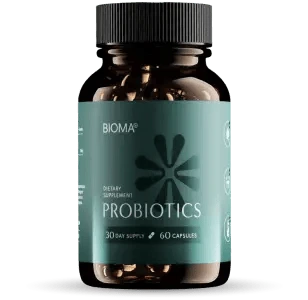
The short answer: a butyrate-releasing triglyceride, and the branded evidence is a laboratory model
A tributyrin supplement delivers butyrate in a sturdier form. Tributyrin is a triglyceride. Enzymes in the small intestine cut it, and butyrate is released. The branded version on the label we read is CoreBiome. The one exact-match study we found, Duysburgh 2025, ran in a gut simulator and in cell lines, never in a living person.
Butyrate is a short-chain fatty acid that gut bacteria make from fibre; tributyrin is one way to carry it past the stomach. The evidence for the branded form is a separate question.
Study details fetched from the PubMed record for PMID 41473189 on September 3, 2026. Label figures come from Bioma's own published label panel, read August 31, 2026.
Tributyrin against butyrate: what the difference is on a label
The 2025 CoreBiome paper states the difference in its own background section:
"Oral butyrate is unstable during upper gastrointestinal tract (GIT) transit and very little reaches the colon. Tributyrin, a butyrate precursor, resists gastric acid and is converted to butyrate by pancreatic lipases."Duysburgh et al., Frontiers in Nutrition, 2025, PMID 41473189
Read that as the premise the study set out to test, not as its result. We found no human head-to-head trial of tributyrin against sodium butyrate, so the only comparison available is the hydrolysis this model measured.
The four words on a butyrate label, and what we can say about each today
| The word on the label | What we can say about it today |
|---|---|
| Butyrate, free, usually a sodium or calcium and magnesium salt | The 2025 paper's own background calls oral butyrate unstable in the upper gut. We did not read a trial of any butyrate salt for this page. |
| Tributyrin | A triglyceride that releases butyrate. Acid-resistant, and cut by pancreatic lipases, per the same paper. |
| Tributyrin as CoreBiome | The branded material. The one exact brand match in our Bioma file is in vitro, and it was funded by the brand's owner. |
| Tributyrin against butyrate, head to head | No human comparison found in our research. This page does not rank the two for you. |
Quotes above are verbatim from the abstract of PMID 41473189, fetched September 3, 2026.
CoreBiome, the branded form, and the dose one label prints
CoreBiome is a brand name for tributyrin, not a different molecule. The 2025 study tested that exact brand, in a capsule and in a softgel. The other three PubMed records in our Bioma file carry no brand match to a line on this label.
From Bioma's own published label panel on bioma.health, read August 31, 2026. No CFU count is printed for the probiotic blend on that panel.
Ninety milligrams is what that one label prints, not a category standard. The 2025 study never publishes a milligram dose for people, only percentages of whatever dose it gave the model, so no page, this one included, can hand you a research-backed daily amount.
The 2025 study read in full: a SHIME simulator and two cell lines, no human
Duysburgh C, Verstrepen L, Van Meulebroek L, Marzorati M. "Tributyrin (CoreBiome) enhances butyrate levels and modulates the gut microbiota, barrier function, and immune response in vitro." Frontiers in Nutrition, 2025;12:1712993.PubMed record 41473189, fetched September 3, 2026
It has three parts. None of them is a person.
Upper gut simulation
A bench simulation of stomach and small intestine transit. It measured how much tributyrin survived, and how much became butyrate.
The SHIME model
The Simulator of the Human Intestinal Microbial Environment: vessels of cultured gut microbes. It ran three weeks of daily dosing.
Caco-2 and THP1 co-culture
Two human cell lines grown together, used to watch barrier and immune response. Cells in a dish, not a body.
Who paid for it, and why we print that next to the result
"Authors CD, LV, LVM, and MM were employed by company 'ProDigest, Zwijnaarde, Belgium'. This research was funded by Compound Solutions, Inc. The study sponsor was involved in the decision to submit the article for publication. The study sponsor was not involved in the study design, the collection, analysis, and interpretation of data, and the writing of the report."Conflict of interest statement, PMID 41473189
Compound Solutions owns the CoreBiome brand that was tested. That is not a reason to throw the paper out: sponsor funding is a fact about the paper, not a verdict on its science. It is a reason to print the funding beside the number, and to quote the statement whole, including what the sponsor did not do.
What the model showed: 40.9 to 48.7 percent hydrolysed in the simulated small intestine
Capsule formulation
40.9 percent hydrolysed to butyrate in the simulated small intestine. 59.1 percent stayed intact for the colon.
Softgel formulation
48.7 percent hydrolysed to butyrate in the simulated small intestine. 51.3 percent stayed intact for the colon.
"The upper GIT simulations showed that 40.9 and 48.7% of the tributyrin dose administered via the capsule or softgel, respectively, was hydrolyzed to butyrate in the small intestine; 59.1 and 51.3% remained stable and was available to enter the colon."Results, PMID 41473189
Then came three weeks of daily dosing in the SHIME vessels.
"3 weeks of daily tributyrin supplementation increased butyrate levels and enhanced the abundance of several bacterial species, including Bifidobacterium spp. and Akkermansia mucinophila."Results, PMID 41473189; spelling as printed in the abstract, the species is A. muciniphila
In the cell co-culture the authors report a protective effect on the intestinal barrier, plus immunomodulatory properties. Their own conclusion is hedged:
"Enhanced butyrate concentrations and beneficial impacts on the gut microbial community composition were observed in an in vitro simulation of the human intestinal environment, suggesting that tributyrin could be considered as a solid alternative to butyrate supplementation."Conclusion, PMID 41473189
The observation happened in an in vitro simulation. The authors say so themselves.
What this research does not say
Nobody swallowed anything in the study with the brand match. Everything below is a gap in the evidence, not a strike against the ingredient.
Five things the exact-match study never tested
- No living person took CoreBiome tributyrin in it. The subjects are vessels and cells.
- No symptom, digestion or weight outcome was measured. The endpoints are chemistry, microbes and cells.
- No human safety data for this branded form appears in anything we verified.
- No milligram dose for people is recommended anywhere in the paper.
- No head-to-head against a butyrate salt, in the model or in a person.
What we can say, what we cannot, and the alternatives named generically
What we can say
- The brand match is exact: the label line and the tested material carry the same name.
- The hydrolysis numbers are specific, and the paper says which formulation gave which.
- The funding and the conflict of interest are printed in the paper itself.
- Butyrate is a long-studied short-chain fatty acid, not a novelty compound.
What we cannot
- A model result does not carry over to a person on its own.
- The sponsor owns the brand tested, and helped decide to publish.
- Nothing here supports a claim about your digestion, your weight or your energy.
- There is no dose to copy and no human safety record for this form.
The alternatives, named generically
If butyrate is the goal, three routes exist, and we rank none of them. Free butyrate salts, sodium or the calcium and magnesium blends, are the older option. Tributyrin, branded or not, is the acid-resistant route this page is about. And fibre still feeds the bacteria that make butyrate for you, at no cost. Either route is measured in weeks, which is how long a probiotic course actually runs. We name no competing brand here, because we tested none of them.
This page is information, not medical advice. Talk to a doctor before adding a supplement, especially with a gut condition or any prescription.
Two questions to ask before buying a tributyrin supplement
Model or people, and who funded it: where to look, and which words mean a bench model
Is the branded ingredient's study in people, or in a model?
Search the brand name and the word study. Then read the methods sentence.
Words like in vitro, simulator, SHIME, Caco-2 or cell line mean a bench model.
A model can be careful science and still not be a result in you.
Who funded it, and who employed the authors?
Journals print a funding and conflict of interest statement, usually at the end.
It is one paragraph. Read it before the abstract, not after.
Brand funding is worth knowing about. An unmentioned funder is the part that should worry you.
Neither question needs a subscription. PubMed prints both for free.
Questions people also ask
What is tributyrin?
A triglyceride that releases butyrate. In the Duysburgh 2025 model, 40.9 percent of a capsule dose and 48.7 percent of a softgel dose were hydrolysed to butyrate in the simulated small intestine. The rest, 59.1 and 51.3 percent, stayed intact and was available to enter the colon. That test ran in vitro, never in a person.
Tributyrin or butyrate: which should I buy?
We cannot answer that from what we verified. The Duysburgh 2025 paper describes oral butyrate as unstable in the upper gut and tributyrin as acid-resistant, but it measured tributyrin alone, inside a simulator. We found no human head-to-head comparison, so this page does not pick for you.
Is there a human trial on CoreBiome tributyrin?
Not among the four PubMed records in our Bioma file. The only exact brand match is in vitro: an upper gut simulation, a SHIME model and a Caco-2/THP1 cell co-culture. No living person took the ingredient in that study.
Does it matter who funded the study?
It is a fact we print beside the result, not a verdict on the science. The paper's own conflict of interest statement says the research was funded by Compound Solutions, Inc., which owns the CoreBiome brand being tested, and that the sponsor was involved in the decision to submit the article for publication.
What dose do tributyrin supplements use?
One label we transcribed prints 90 mg of tributyrin as CoreBiome. We do not generalise that to the category. The 2025 study reports percentages of the dose it administered to the model, not a milligram amount for people, so there is no research-backed daily dose to quote here.
How we built this page
This is a reading of one paper and one label. It is not a lab test. Nothing here is medical advice, and no supplement replaces a conversation with your doctor.
Sources, dates, and what we did not do
- The study details came from the PubMed record for PMID 41473189, fetched on September 3, 2026, not from a summary of it.
- Every quoted sentence above is verbatim from that record's abstract or its conflict of interest statement.
- The three label lines are from Bioma's own published label panel, read on August 31, 2026, and transcribed as printed.
- Where we found no evidence, the page says so instead of estimating a number, a dose or a side effect.
- We bought nothing and clicked no seller link to write this page.