The short answer: CFU counts live organisms, and it is the unit a probiotic dose is made of
CFU is short for colony-forming units.
One colony-forming unit is one organism, or one clump of them, able to grow a visible colony in a lab dish.
So a CFU count answers one question. How many live organisms does a serving deliver?
That is the question a probiotic dose is made of, and it is how trials write it down.
Minami 2018 gave 80 pre-obese adults 2 × 10¹⁰ CFU a day of one Bifidobacterium breve strain.
That is 20 billion CFU a day, taken for 12 weeks.
A label that skips the count has skipped the part the trial was built on.
Trial detail per Minami 2018, PMID 30094122, confirmed against the PubMed record on September 1, 2026 for our Bioma file.
CFU against milligrams: why a blend printed in mg does not tell you the dose
Both numbers are real. They answer different questions.
Ninety milligrams of probiotic powder can hold very different headcounts.
Nothing on that panel lets a buyer turn one number into the other.
Xylooligosaccharides (as iXOS, from Corn Cob) 100 mg · Tributyrin (as CoreBiome) 90 mg · Proprietary Probiotic Blend 90 mg (Bifidobacterium lactis, Bifidobacterium longum, Bifidobacterium breve)
Bioma's own label panel, read August 31, 2026Read that line again and notice what it does carry: three species, named.
Then notice what it does not: a count, and a code for any of the three.
Panel quoted from the seller's own site, read August 31, 2026, and filed in our Bioma recon the same day.
One brand, two labels, only one with a CFU number
The clearest way to see the gap is inside a single house.
The same seller publishes both of these bottles, and they do not disclose the same way.
| Bottle, same brand | Probiotic dose printed | Strain codes printed |
|---|---|---|
| Flagship gut and weight bottle | 90 mg blend, no CFU | None: three species named only |
| Feminine Health bottle | 15 billion CFU | Coded, such as La-14 and HN001 |
What two disclosure standards in one house mean, and the two source lines
Same house. Same aisle. Two different disclosure standards.
That is what makes the missing count a choice rather than a category rule.
It also means you can hold a brand to its own better label.
Both product pages read on the seller's own site, August 31, 2026.
The Feminine Health front panel was transcribed from the seller's own packshot on September 2, 2026. It reads "BIOMA DIETARY SUPPLEMENT FEMININE HEALTH SYNBIOTIC + URINARY TRACT WELLNESS".
Why the strain code matters as much as the count
A CFU number on its own is still half an answer.
Species is not product.
Minami 2018 tested Bifidobacterium breve B-3, a specific patented strain from one maker.
Why "Bifidobacterium breve" alone cannot be matched to the B-3 trial, and the source lines
A label that prints only "Bifidobacterium breve" has named the species, not the organism that was tested.
In the flagship blend above, B. breve is one of three species inside a single undivided 90 mg line.
No count, no code, and no way to know its share of the 90 mg.
So the trial number cannot be carried over to that bottle, and we will not do the arithmetic anyway.
A count plus a code is what makes a label checkable. Either one alone is not.
Strain identity per Minami 2018, PMID 30094122. Blend composition per the seller's own label panel, read August 31, 2026.
How many CFU should a probiotic have? What the trials actually used
There is no threshold we can honestly hand you.
Nothing we read supports a universal "at least this many billion" rule.
What we can print is what the trials themselves used.
One coded strain, B. breve B-3, given to 80 pre-obese adults for 12 weeks.
Fat mass and body fat share fell against placebo. Total body weight did not change significantly.
Meta-analysis of 15 randomised trials, 957 participants, on probiotics and body weight.
Mean difference −0.60 kg, 95% CI −1.19 to −0.01 kg. The authors call these "small effect sizes".
A prebiotic fibre, XOS, in 32 adults over 8 weeks, at two daily doses against placebo.
Printed in grams, not in CFU: a prebiotic feeds organisms, so it is weighed rather than counted.
All three records confirmed against PubMed on September 1, 2026 for our Bioma file, and quoted here only for what they measured.
A bigger CFU number is not a proven better result
None of the three trials above set out to find a CFU floor for shoppers.
None of them tested a finished multi-species product like the one on this page.
- Minami 2018 ran one strain at one dose, so it cannot say whether more or less would have done the same.
- Borgeraas 2018 pooled mixed strains and mixed doses, and the pooled effect is a fraction of a kilogram.
- Finegold 2014 measured a fibre in grams, so it says nothing about any CFU count at all.
- No source in our file supports reading 50 billion as better than 20 billion for a given person.
What this means for you: a CFU number makes a label checkable. It does not, on its own, make a product work.
What a printed count buys you, and what it does not
Four things a CFU number gives you, four it does not, and three plain alternatives
This is our own read, from the labels and trials named above.
What a CFU number gives you
- A dose you can line up against a published trial, when a strain code is printed too.
- A figure the maker has committed to in print, on the bottle in your hand.
- A way to tell two products apart when both list the same species.
- A fair question for support: which strain, at which count, per serving?
What it still does not give you
- Evidence that the finished product was tested in people.
- A reason to read a bigger count as a better outcome.
- Anything about the rest of the panel, which may be weighed in grams or milligrams.
- A promise about how a given person will respond.
If a label will not print a count, the honest alternatives are plain ones.
A product that prints CFU per strain. A single-strain product matching a trial you can look up. Or a food with live cultures.
None of those is a better result by itself. They are just labels you can actually check.
A three-line label check
Three steps: the unit, the strain code, and the serving printed on Bioma's own panel and FAQ
Three questions, in this order, before the brand argument starts.
Find the unit
Is the probiotic line printed in CFU, or in milligrams?
If it is milligrams only, the dose in trial format has not been published. Say that plainly to yourself.
Find the strain code
A species name like B. breve is a family. A code like B-3 is the organism a trial used.
No code means no trial can be matched to that bottle, whatever the count says.
Find the serving and the count
Bioma's front panel prints 30 DAY SUPPLY and 60 CAPSULES.
Its own FAQ prints the serving: "2 capsules", taken "one time per day, before breakfast".
So a serving is two capsules, and a bottle holds 30 of them. That count is also the clock: it is how long a course actually runs.
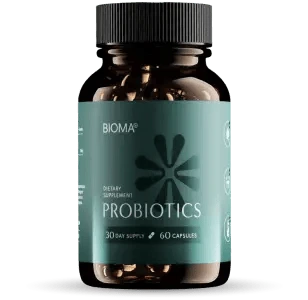
This is the front panel we transcribed on September 2, 2026: brand, product type, supply length and capsule count, all printed.
What is not on it is the composition panel. The 90 mg blend line comes from the seller's own "Show label" view on its site, read August 31, 2026.
That split is normal. It is also why a front panel alone never settles the dose question.
Front panel transcribed from the seller's own packshot, September 2, 2026. Serving wording quoted from the seller's own FAQ, read August 31, 2026.
Questions people also ask
What does CFU mean on a probiotic label?
Colony-forming units, the count of viable organisms per serving; it is the unit probiotic trials use to express a dose (for example 2 x 10^10 CFU/day in Minami 2018).
Is a probiotic blend printed in milligrams the same thing?
No: milligrams measure the mass of the blend powder, not how many viable organisms the serving delivers. A label that prints only "90 mg" has not published the dose in the format the trials used.
How many CFU should a probiotic have?
Our reading does not support a universal threshold; what it does support is what the trials used: 2 x 10^10 CFU/day of one named strain in Minami 2018 over 12 weeks.
Why does the strain code matter as much as the number?
Without a strain code, "Bifidobacterium breve" is a species match, not the organism that was tested: B-3 is a specific patented strain.
What is on a label besides the count?
On the label we transcribed: product type, "30 DAY SUPPLY", "60 CAPSULES", and a published serving of two capsules once a day before breakfast.
How we built this page
Sources, the dates we read them, and what we did not do
This is a label-reading page, not a lab test.
Every number on it comes from a document we read, on a date we print.
- The 90 mg blend line, the 100 mg and 90 mg ingredient lines and the three species names come from the seller's own label view, read August 31, 2026.
- The front panel wording, "30 DAY SUPPLY" and "60 CAPSULES", was transcribed from the seller's own packshot on September 2, 2026.
- The 15 billion CFU figure and the coded strains are the same seller's own Feminine Health product page, read August 31, 2026.
- The three trials were confirmed against their PubMed records on September 1, 2026, and are linked by PMID above.
- We did not test any product, and we did not estimate a CFU count for a label that does not print one.
- Nothing here is medical advice. A new supplement while you are pregnant, nursing or on medication is a conversation with your doctor first.
The label we read line by line
The missing CFU on one flagship label is not a hypothetical for us: it is the finding a whole review was built around, next to the price grid and the subscription clauses.
What the review walks through, and two tips on units, codes and comparing labels from one house
If a bottle in your cart prints milligrams and no count, the next step is the full label read.
That review walks the whole panel line by line and prints the six checkout prices we read twice.
It also quotes the cancellation and refund clauses in the seller's own words.
Ask for the unit and the strain code before you ask for the brand. A count with no code, or a code with no count, is still half a label.
Compare two labels from the same house before you assume a category standard. One seller's own two bottles disagreed, and that disagreement is this page's subject.
Label panel, six checkout prices and the subscription clauses, each with the date we read it.