The short answer, in one number: about half a kilo on average
Across the best pooled evidence we could find, probiotics shift body weight by about six-tenths of a kilo. That is Borgeraas 2018, a meta-analysis of 15 randomized trials in 957 people: a mean difference of 0.60 kg, with an interval from -1.19 kg to -0.01 kg, whose upper end is almost nothing at all. Body mass index moved by 0.27 in the same pooling. The authors call all of it small.
So the answer is yes, in the sense that the average is not zero. And no, in the sense that half a kilo is not what a checkout headline is selling.
The line the research does not cross
A pooled average is not a forecast for one person. It is what happened, on average, to a mixed group of strains, doses and study designs.
None of the studies on this page tested a finished commercial weight-loss product. They tested organisms, at stated doses, against placebo.
No trial we read reports anything close to a double-digit kilo result. And none of this is medical advice or a reason to skip your doctor.
The biggest meta-analysis: 15 RCTs, 957 people, 0.60 kg
Borgeraas et al., Obesity Reviews 2018
- What it pooled
- 15 randomized controlled trials of probiotics, 957 participants in total
- Body weight
- mean difference 0.60 kg, 95% CI -1.19 to -0.01 kg
- Body mass index
- mean difference 0.27
- The authors' own words
- they describe these as small effect sizes
Two details matter more than the headline figure. The confidence interval reaches -0.01 kg, and a result that faint at one edge is a weak result, not a strong one. And the pooling covers probiotics in general; it is not a study of any single brand, blend or capsule.
Source: Borgeraas H, Johnson LK, Skattebu J, Hertel JK, Hjelmesæth J, Obesity Reviews 2018, PMID 29047207. Figures verified against the record on PubMed.
The trial that moved fat mass but not body weight: B. breve B-3, 12 weeks
Minami et al., Bioscience of Microbiota, Food and Health 2018
- The organism
- Bifidobacterium breve B-3, a patented Morinaga strain, not a generic species
- The dose
- 2x10^10 CFU per day, printed as a count, not as milligrams
- The people
- 80 pre-obese adults, 12 weeks, double-blind against placebo
- The result
- fat mass and body fat share fell against placebo, with no significant change in total body weight
The scale did not move in any significant way. What moved was body composition, measured separately; those are different outcomes, and only one of them is what most buyers mean by weight loss. It is a real, positive human result, and a narrow one, tied to one strain at one stated count.
Source: Minami J et al., Bioscience of Microbiota, Food and Health 2018, PMID 30094122. Verified against the record on PubMed.
Strain and CFU decide the result, and a label without them cannot be matched to a trial
Minami tested B-3, a strain code: a specific patented organism, owned by Morinaga. A label that says only Bifidobacterium breve names the species and does not tell you which strain is inside. The second missing number is the count: Minami printed 2x10^10 CFU a day, the unit the category is measured in.
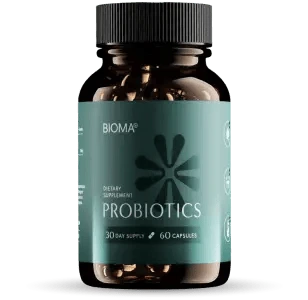
Take the product this cluster was built around. Bioma prints a Proprietary Probiotic Blend at 90 mg, holding three species: Bifidobacterium lactis, longum and breve. Beside it sits the 90 mg of tributyrin on the same panel. No strain code for any of the three, and no CFU count for the blend, only a milligram weight. That is from Bioma's own published label panel, read August 31, 2026; we are quoting the seller, not guessing. The same brand can clearly do it: its Feminine Health product declares 15 billion CFU and coded strains such as La-14 and HN001, per the same reading.
What to look for on any weight-loss probiotic label
- A strain code after the species name, the way B-3 follows Bifidobacterium breve. Without it, no published trial maps onto that jar.
- A CFU count, printed as a number per serving. Milligrams of a blend are not a dose you can compare to a trial.
What a checkout headline promises against what the trials measured
Bioma's checkout carried this headline when we read it on September 2, 2026:
Select your supply to lose 10 kgBioma's own checkout page, read September 2, 2026
That is the seller's promise, printed at the moment of payment. It is not ours, and we do not repeat it as a claim. On the partner landing page recorded in our recon on September 1, 2026, the same chart runs in pounds instead, 80 down to 65.
Bars drawn to one scale. Top bar: Borgeraas 2018 (PMID 29047207). Bottom bar: the seller's own checkout headline, read September 2, 2026, reproduced as their claim.
The same seller publishes the honest version elsewhere on its own site:
Exercise and a healthy diet are necessary to achieve and maintain weight loss.Bioma's own site-wide disclaimer, read August 31, 2026
Both sentences come from the same company. Only one of them agrees with the trials.
Two things worth doing before you buy any weight-loss probiotic
Step 1, decide which number you are buying. Step 2, put the seller's timeline next to its refund clock
Decide which number you are actually buying
The pooled effect on the scale is a fraction of a kilo, per Borgeraas 2018.
The one clear positive we found, Minami 2018, moved fat mass and left scale weight alone.
So pick the outcome you will track, then track it the same way each week.
Put the seller's timeline next to its refund clock
Bioma's own FAQ says gut bacteria typically take 6 to 8 weeks to fully colonize, and it recommends at least 3 months.
Its own Terms give 14 days from delivery, and only for an unopened jar.
Do that arithmetic on any brand before you pay, not after.
What this evidence supports, and what it does not
Supported by the studies we read, and not supported by them
Supported by the studies we read
- A small average decrease in body weight across mixed strains, 0.60 kg (Borgeraas 2018)
- A measured drop in fat mass from one coded strain at a stated CFU count over 12 weeks (Minami 2018)
- Digestive comfort and less bloating for some people, hedged exactly that far
Not supported by them
- Any specific kilo or pound target printed on a checkout page
- Treating a species name on a label as the strain that was tested
- Comparing an undosed milligram blend to a trial that reported CFU
- Weight loss without diet and exercise, by the seller's own disclaimer
If a probiotic is not the right tool
Cheaper places to start, named generically, and when it is a clinician's question
Named generically, because this is a category question and not a brand fight. A plain prebiotic fiber, fermented foods, or a single-strain product that prints its code and its count are all cheaper places to start. And if the goal is a double-digit result, that is a conversation with a clinician, not a capsule.
Questions people also ask
Do probiotics help you lose weight?
A little, on average. In the trials pooled by Borgeraas et al. 2018 (15 randomized trials, 957 people) the mean difference in body weight was −0.60 kg, 95% CI −1.19 to −0.01 kg. The authors themselves describe those as small effect sizes. That figure is an average across mixed strains, doses and populations, not a prediction for one person or one product.
How much weight can a probiotic realistically move?
A fraction of a kilo on the pooled average. Minami et al. 2018 measured a decrease in fat mass and in body fat percentage with Bifidobacterium breve B-3 at 2x10^10 CFU a day over 12 weeks in 80 pre-obese adults, with no significant change in total body weight. Fat mass and scale weight are not the same outcome, and a trial can move one without moving the other.
Do probiotics help with bloating as well as weight?
Probiotics may help digestive comfort and bloating in some people. That is as far as our own reading goes: we found no figure worth printing here, and the effect is not something a label can promise you in advance. Bloating that persists, or that comes with other symptoms, is a question for a doctor rather than for a supplement.
Does the strain matter, or is any Bifidobacterium the same?
It matters. The organism in Minami et al. 2018 was B-3, a patented Morinaga strain, given at a stated CFU count. A label that names only the species, Bifidobacterium breve, is not a match for the organism that was tested, and a label with no CFU count gives you no way to compare the dose either.
Is a probiotic enough on its own?
By the seller's own words, no. The site-wide disclaimer on Bioma's own site, read August 31, 2026, states: Exercise and a healthy diet are necessary to achieve and maintain weight loss. That line sits under the same funnel that prints a kilo target at checkout, and it is the more honest of the two.
How we built this page
This is a reading of published human research and of one seller's own published pages. It is not a lab test and not a trial of our own.
- We did not buy anything to write this page, and no claim here is presented as our own measurement.
- Nothing on this page is medical advice. A weight-management plan belongs with a doctor first.
Sources and dates: PMID 29047207, PMID 30094122, the label panel, and the seller's FAQ
- Both studies were pulled by PubMed ID and checked against the PubMed record: Borgeraas 2018 (PMID 29047207) and Minami 2018 (PMID 30094122).
- Every figure on this page carries its source in the same sentence, or in the line under the block it sits in.
- The label wording, the checkout headline, the disclaimer and the 6 to 8 weeks line are the seller's own text, read on the dates printed beside each quote, on its label panel and on its published FAQ page.
These statements have not been evaluated by the Food and Drug Administration. This product is not intended to diagnose, treat, cure, or prevent any disease.