The short answer: half a gram to a gram a day, and the one panel we read prints a fraction of it
Three numbers cover almost every honest answer to this question.
Half a gram to a gram a day, 0.5 to 1 g, is the Linus Pauling Institute's own recommendation for acetyl-L-carnitine.
1,500 to 3,000 milligrams a day is what a 1,257-person, 52-week trial actually tested.
190 milligrams is what one label we read prints for Acetyl L-Carnitine, on a panel with ten other actives beside it.
Every one of those numbers is read and cited below, section by section, with the date we read each one.
The Linus Pauling Institute's own recommended daily dose of acetyl-L-carnitine, plus a wider 0.5 to 2 g range it lists for typical supplement doses.
lpi.oregonstate.edu, read Sep 4, 2026
The two dose arms of a 52-week trial in 1,257 people with diabetic neuropathy.
PMID 15616239, read Sep 3, 2026
Acetyl L-Carnitine, one of eleven itemized actives on a panel we read for a separate product review.
Per the vendor's own panel, read Sep 3, 2026
Who recommends the half gram, and in exactly what words
The number worth writing down comes from the Linus Pauling Institute's Micronutrient Information Center, in its entry on L-carnitine.
"If you choose to take L-carnitine supplements, the Linus Pauling Institute recommends acetyl-L-carnitine at a daily dose of 0.5 to 1 g."
Linus Pauling Institute, "L-Carnitine" · read September 4, 2026The wider 0.5 to 2 g supplement range, the two category guides that land on the same numbers, and why recommend is not require
The same fact sheet widens the lens a step further, in its section on supplements: "Supplemental doses usually range from 0.5 to 2 g/day."
A second, separate kind of source lands close to the same range. Category guides written for a mitochondrial-supplement audience cite acetyl-L-carnitine at "typically 500-1,000 mg daily" (jinfiniti.com and peptide-db.com, both read September 3, 2026).
Those two are category guides, not clinical evidence, and we say so plainly. But a research institute and two third-party category guides land on the same half-gram-to-one-gram range. Two different kinds of source agreeing is worth noting.
Nothing in either source says a healthy adult needs that amount. Recommend and require are different words.
Acetyl-L-carnitine is not L-carnitine, and the acetyl group is the reason
Acetyl-L-carnitine and L-carnitine share most of a name, and most of a molecule.
"Acetyl-L-carnitine (ALCAR) is available without a prescription as a nutritional supplement. In addition to providing L-carnitine, it provides acetyl groups that may be used in the formation of the neurotransmitter, acetylcholine."
Linus Pauling Institute, "L-Carnitine" · read September 4, 2026Only the L-isomer is active, and ALCAR's bioavailability is thought higher but less studied, in the Institute's words
The same fact sheet adds a safety detail that applies to both forms: "Only the L-isomer of carnitine is biologically active."
One more distinction belongs here. The source states it carefully: "the bioavailability of ALCAR is thought to be higher than that of L-carnitine." But the fact sheet immediately adds: "Less is known regarding the metabolism of the acetylated form."
So the acetyl group is not a marketing flourish. It is the reason the compound has a second name, and a second role in the body, beyond carrying L-carnitine itself.
The trials behind the four-digit numbers: 1,500 and 3,000 mg a day for a year
The four-digit numbers attached to acetyl-L-carnitine trace to one 52-week trial.
Sima and colleagues tested 500 mg or 1,000 mg of acetyl-L-carnitine three times a day across two dose arms, in 1,257 people, for 52 weeks, close enough to call it a year.
Every participant in that trial had diagnosed diabetic neuropathy. This was not a study of healthy adults looking for more energy.
Both dose arms reported improved pain scores and nerve-fiber regeneration over the course of the year, in that diabetic-neuropathy population.
Sima AA et al., Diabetes Care, 2005. PMID 15616239, read September 3, 2026, via Europe PMC.
Absorption is why the study numbers are grams and the panel numbers are milligrams
Trials speak in grams partly because so little of an oral dose actually reaches the blood.
"The bioavailability of L-carnitine from oral supplements (doses, 0.6 to 7 g) ranges between 5% and 25% of the total dose."
Linus Pauling Institute, "L-Carnitine" · read September 4, 2026The ~10-20% line for acylated forms, and the 2 g/day for 50 days that raised plasma ALCAR 43%
A second line from the same fact sheet frames the acylated forms specifically: "the bioavailability of L-carnitine and acylcarnitine derivatives administered orally is low (~10-20%)."
One concrete data point shows what a gram-scale dose does to the body over time. "In humans, administration of 2 g/day of ALCAR for 50 days increased plasma ALCAR concentrations by 43%." Fifty days of two grams a day, for a 43% rise in blood levels. Not an overnight change, and not a small dose either.
What 190 mg works out to, as a share of each of those figures
Here is the arithmetic, done once so nobody has to do it standing in a store aisle.
| Reference figure | Amount | 190 mg is |
|---|---|---|
| LPI recommendation, low end | 500 mg (0.5 g) | 38% |
| LPI recommendation, high end | 1,000 mg (1 g) | 19% |
| Trial's lower arm (Sima 2005) | 1,500 mg | 12.7% |
| Trial's higher arm (Sima 2005) | 3,000 mg | 6.3% |
190 mg per Advanced Mitochondrial Formula's own panel, read September 3, 2026. The four percentages are our own division of 190 mg against each reference figure above. None of them appear printed anywhere on the label itself.
Neither figure was written for a healthy adult chasing energy
The 0.5 to 1 g recommendation and the 1,500 to 3,000 mg trial dose answer different questions, and neither answers this one directly.
- The 52-week trial studied people with diagnosed diabetic neuropathy, not healthy adults looking for more daily energy.
- No source in our file says a bigger acetyl-L-carnitine dose produces a bigger subjective effect than a smaller one, at any amount.
- Nothing we read times how long 190 mg a day would need before doing anything measurable, because no trial tested that exact dose.
What this means for you: 190 mg, 0.5 to 1 g, and 1,500 to 3,000 mg are all real, sourced figures. None of them is medical advice aimed at you personally.
The safety line, the fishy-odour threshold, and the test that does not exist
One number is worth knowing before any other: the point at which carnitine supplements start producing a specific, recognizable side effect.
"Supplements providing more than 3 g/day may cause a 'fishy' body odor."
Linus Pauling Institute, "L-Carnitine" · read September 4, 2026190 mg a day, and even the full 1 g the LPI recommends, sit far under that 3 g threshold.
The other line worth knowing is what does not exist. "At present, there is no test that assesses functional carnitine deficiency in humans." There is no lab result that tells you whether 190 mg, or 1 g, is enough for your own body.
A thirty-second check on any panel that lists carnitine
What a printed number gives you, what it does not, and the three-step check
Once you know the reference figures, the check on a real label is short.
What a printed number gives you
- A figure you can compare against a published trial dose, like the 1,500 to 3,000 mg in the Sima trial.
- A way to tell two products apart when both name the same ingredient.
- A number the maker has committed to in print, on the bottle.
What it still does not give you
- Proof that the finished product was tested in people, at that exact dose.
- Any reason to assume a bigger number works better than a smaller one.
- A test that can confirm the dose is doing anything for your own body.
Find the form
Acetyl-L-carnitine, or plain L-carnitine? Only the L-isomer is biologically active, so confirm the label names one of those two, not a different isomer.
Find the milligram figure
Is it on its own line, with its own number? Or only named inside a blend with one combined total?
Divide by the reference
500 mg to 1,000 mg for the recommendation, 1,500 mg to 3,000 mg for the trial's two arms. The fraction is the number that matters.
The 190 mg we just divided four ways
The panel we reviewed prints Acetyl L-Carnitine 190 mg. The review puts that figure against the half-gram-to-one-gram recommendation and the trial arms above. It also sits beside the ten other actives on the plate, and the three checkout totals we read on the vendor's own order forms.
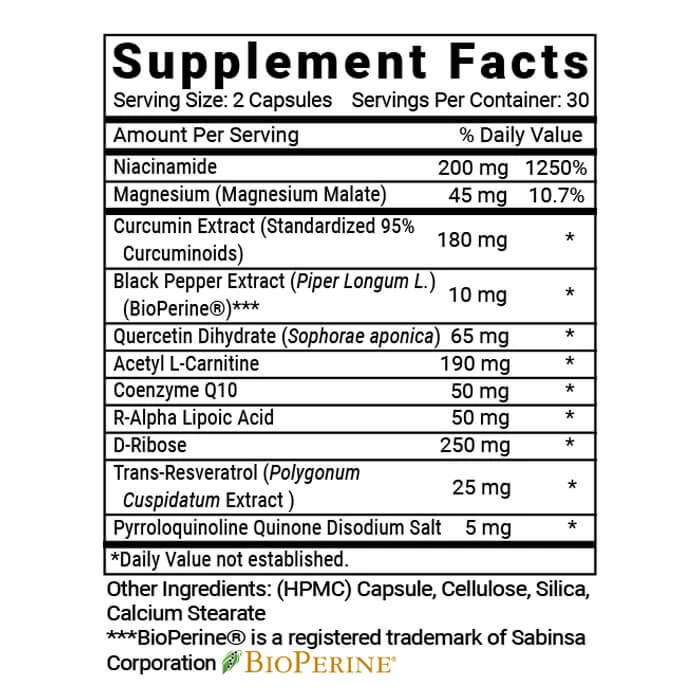
The label we read for this arithmetic, from the seller's own product materials, read September 3, 2026.
Acetyl L-Carnitine sits sixth among eleven itemized actives, each with its own milligram figure. No proprietary blend hides the number here.
Two tips: check the form before the number, and divide before you compare
Check the form printed on the label before the number.
Only the L-isomer of carnitine is biologically active, so confirm the panel says L-carnitine or acetyl-L-carnitine, not a different compound entirely.
Divide before you compare.
A milligram figure only means something once it is divided by a real reference. Use 500 mg to 1,000 mg for the recommendation, and 1,500 mg to 3,000 mg for the trial's two arms.
The full eleven-active panel, the checkout totals, and the guarantee, each dated.
Questions people also ask
What daily dose of acetyl-L-carnitine do reference sources recommend?
The Linus Pauling Institute recommends 0.5 to 1 g a day of acetyl-L-carnitine, and describes current supplement doses as 0.5 to 2 g a day. Third-party category guides cite the same 500 to 1,000 mg daily range.
Does the acetyl group make ALCAR different from plain L-carnitine?
Yes. Besides supplying L-carnitine, the acetylated form supplies acetyl groups that may be used in forming the neurotransmitter acetylcholine, and its bioavailability is thought to be higher than L-carnitine's, though less studied.
Why do carnitine trials use grams when labels print milligrams?
Because oral absorption is low. Bioavailability of L-carnitine from supplements, at doses of 0.6 to 7 g, runs between 5% and 25% of the total dose, and that of the acylated derivatives is described as roughly 10% to 20%.
What does 190 mg work out to as a share of the trial doses?
Against the 52-week trial's arms of 1,500 and 3,000 mg a day, 190 mg is 12.7% and 6.3% respectively; against the recommended 0.5 to 1 g a day band, it is 38% and 19%.
What side effect shows up first at high carnitine intakes?
Supplements providing more than 3 g a day may cause a fishy body odour, per the Linus Pauling Institute. The same fact sheet also notes there is no test that assesses functional carnitine deficiency in humans, so there is no lab result to check a dose against.
How we built this page
Sources, PMIDs, the dates we read them, and which arithmetic is ours
This page reads one fact sheet, one 2005 trial and two category guides. It is not a lab test, and it is not medical advice.
- The 0.5 to 1 g recommendation, the 0.5 to 2 g supplement range, the bioavailability figures, and the safety lines all come from the Linus Pauling Institute's Micronutrient Information Center. We read its entry on L-carnitine on September 4, 2026.
- The 1,500 to 3,000 mg trial dose and its finding come from Sima AA et al., Diabetes Care, 2005, PMID 15616239. We read it via Europe PMC on September 3, 2026.
- The 500-1,000 mg category-guide range comes from jinfiniti.com and peptide-db.com, both read September 3, 2026. These are category guides, not clinical evidence, and we label them as such above.
- The 190 mg figure and the label image come from Advanced Mitochondrial Formula's own Supplement Facts panel. We read it from the seller's product materials on September 3, 2026, for our review of that product.
- The four percentages in the arithmetic table are our own division of 190 mg against each reference figure. They do not appear printed on any label we read.
- This page discusses a supplement dose. Anyone pregnant, nursing, or taking medication should check with a doctor before adding a new one.