The short answer: 50 to 600 mg, and the form printed on the label decides how to read that number
One range covers almost every supplement bottle. What it means depends on three words next to the milligrams.
Supplements run 50 to 600 mg of alpha-lipoic acid a day. The Linus Pauling Institute calls that "likely as much as 1,000 times greater" than diet alone provides.
The same 600 mg sits at the top of that band and in the best-performing arm of one 1995 trial. That trial used one chemical form: the racemic mixture, not an isolated isomer.
A label that instead prints "R-Alpha Lipoic Acid" names a narrower ingredient. It has its own, much thinner, human dose record.
Other pages online quote a wider 200 to 1,800 mg a day ruler for this ingredient. None of the ones we checked split that racemic dose from an R-isomer dose.
The range the Linus Pauling Institute cites for alpha-lipoic acid supplements, any form.
Linus Pauling Institute, Lipoic Acid, read Sep 4, 2026
The ALADIN trial's best-performing daily dose, of the racemic (R,S) mixture, over 3 weeks.
R-Alpha Lipoic Acid, on Advanced Mitochondrial Formula's own label: the floor of the band above.
Vendor's own panel, read Sep 3, 2026
Each figure is read and cited section by section below, with the date we read it.
R, S and the racemic mixture: three names for what looks like one ingredient
The Institute's sentence on what most bottles contain, and what "R-Alpha Lipoic Acid" names instead
Alpha-lipoic acid is a small molecule that comes in two mirror-image forms, called R and S.
Most bottles do not sell either one alone.
"Most lipoic acid supplements contain a racemic mixture of R-lipoic acid and S-lipoic acid (sometimes noted d,l-lipoic acid)."
Linus Pauling Institute, Lipoic Acid, Supplements section · read Sep 4, 2026That racemic, half-and-half blend is what "Alpha Lipoic Acid" or "ALA" usually means on a supplement panel.
A label that prints "R-Alpha Lipoic Acid" or "R-ALA" names something narrower. It is the R isomer alone, sold without its S partner.
It looks like a small wording change. It is a different ingredient, with its own evidence trail. The next two sections walk through it.
Where the 600 mg came from, and what the trial's smallest arm did
That same 600 mg number shows up in one study people repeat: the ALADIN trial, published in 1995.
Researchers randomised 328 people with diabetic neuropathy across three daily doses of racemic alpha-lipoic acid and a placebo arm, for three weeks: 100 mg, 600 mg, or 1,200 mg.
Diabetic neuropathy was that trial's population. We report this only as the trial's scope, not as a claim about what this ingredient does for you.
The smallest arm still moved the needle.
| Source | Form | Daily amount | What it means |
|---|---|---|---|
| Advanced Mitochondrial Formula's own panel | R-Alpha Lipoic Acid (isolated R isomer) | 50 mg | Half the smallest ALADIN dose. A different chemical form, too. |
| ALADIN trial, low arm | Racemic (R,S) mixture | 100 mg | Cut symptom score 43.2%. Response rate 65.2% vs 57.6% placebo. |
| ALADIN trial, best-performing arm | Racemic (R,S) mixture | 600 mg | The trial's best result: an 82.5% response rate. |
Ziegler D et al. (ALADIN study), Diabetologia 1995;38. PMID 8786016, via Europe PMC, read September 4, 2026.
The comparison that has never been published
Here is the question this page turns on. Does the isolated R form work better than the mixture the trials tested?
"Direct comparisons of the bioavailability of the oral racemic mixture and R-lipoic acid supplements have not been published."
Linus Pauling Institute, Lipoic Acid, Racemic mixture versus R-lipoic acid only · read Sep 4, 2026No one has run that comparison, at least not in a way that has made it into the published record.
Nothing here says a bigger label claim means a better result
- No published study has compared the finished-product bioavailability of racemic alpha-lipoic acid against an R-lipoic acid supplement.
- The Institute states plainly: "At present, it remains unclear which supplemental form is best to use in clinical trials."
- No source in our file compares 50 mg of R-lipoic acid to the 100 mg or 600 mg racemic doses above. That comparison does not exist to cite.
What this means for you: the isomer named on a label changes which evidence applies to it. It does not, by itself, tell you the product works better.
Every human dose study used the form the premium labels are not selling
One more fact belongs next to the comparison that was never run.
"all of the published human studies have used R,S-lipoic acid (racemic mixture)."
Linus Pauling Institute, Lipoic Acid, Racemic mixture versus R-lipoic acid only · read Sep 4, 2026Every dosing number on this page comes from the racemic mixture. That includes ALADIN's 100 mg, 600 mg and 1,200 mg arms. None of it comes from the isolated R form alone.
Why R-lipoic acid is marketed as premium: the 40%-50% plasma figure, what it measured, and what is and is not documented
There is a real chemistry reason R-lipoic acid gets marketed as the premium option.
"Following the ingestion of R,S-lipoic acid, peak plasma concentrations of R-lipoic acid were found to be 40%-50% higher than S-lipoic acid, suggesting better absorption of R-lipoic acid."
Linus Pauling Institute, Lipoic Acid, Racemic mixture versus R-lipoic acid only · read Sep 4, 2026That measurement was taken after people swallowed the racemic mixture. It says the R portion absorbs better than the S portion next to it. It is not a measurement of an R-only pill against a racemic one.
What is documented
- The R isomer reaches higher peak plasma levels than the S isomer, within the racemic mixture.
- Every human trial dose on this page is anchored to a real, published number.
- The panel we read prints a specific milligram figure, not a hidden blend total.
What is not documented
- Any published trial of an isolated R-lipoic acid supplement, at any dose, in people.
- A bioavailability comparison between a racemic product and an R-only product.
- Independent purity data for R-only products: the Institute notes that information "is not publicly available."
Thirty minutes before a meal, not with it
Timing carries its own citation, and it runs against the instinct most people bring to a capsule.
The Institute's timing line, and the opposite instruction for CoQ10 on the same label
"Since taking lipoic acid with a meal decreases its bioavailability, it is generally recommended that lipoic acid be taken 30 min prior to a meal."
Linus Pauling Institute, Lipoic Acid, Supplements section · read Sep 4, 2026That is the opposite instruction from a fat-soluble active on the same shelf. Coenzyme Q10 sits on the same label as the R-Alpha Lipoic Acid we read. The Institute's own separate page on CoQ10 says it is "best absorbed with fat in a meal," read the same day.
One busy panel, two ingredients, two opposite timing rules. Neither instruction is optional if the goal is the absorption the research describes.
Where the safety numbers sit, and the side effect people report first
Separate from dose-for-effect, here is what the safety literature says.
"oral lipoic acid at doses as high as 1,800 mg/day for six months and 1,200 mg/day for two years did not result in serious adverse effects."
Linus Pauling Institute, Lipoic Acid, Safety / Adverse effects · read Sep 4, 2026Those are trial-duration ceilings, not a target dose. What people report more often is smaller and more common.
"The most frequently reported side effects of oral lipoic acid supplementation are allergic reactions affecting the skin, including rashes, hives, and itching."
Linus Pauling Institute, Lipoic Acid, Safety / Adverse effects · read Sep 4, 2026One interaction is worth a conversation with a doctor, not advice here. The same fact sheet notes a potential risk of low blood sugar for people who use insulin or an oral anti-diabetic drug.
A thirty-second check on any panel that lists lipoic acid
Three steps: the exact wording, the milligrams against the band, and the timing line
Read the exact wording
"R-Alpha Lipoic Acid" names the isolated isomer.
Plain "Alpha Lipoic Acid" or "ALA" usually means the racemic mixture the trials tested.
Place the milligrams
50-600 mg is the supplement band.
100, 600 and 1,200 mg are ALADIN's tested arms, in the racemic form only.
Check the timing line
Thirty minutes before a meal is the general guidance, the opposite of a fat-soluble active's instruction.
The R-isomer line at the floor of the band
You now have the two numbers worth carrying to a bottle: the band, and the isomer question.
One panel we reviewed prints R-Alpha Lipoic Acid 50 mg, which puts the isomer with no published human dose comparison at the very floor of the supplement band, and the review sets that line beside the other ten actives on the same plate and beside the price the checkout actually charges for them, on a panel that itemises all eleven actives with no proprietary blend.
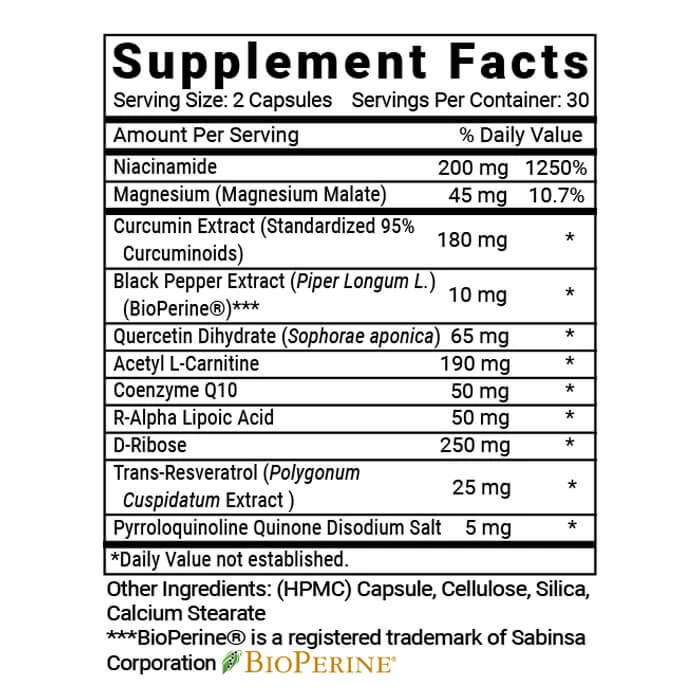
The panel we read for that review, September 3, 2026.
R-Alpha Lipoic Acid is printed at 50 mg, its own line, no blend.
Ten other actives share the same panel, each with its own milligram figure.
Two tips: the panel's timing instructions, and the exact isomer name before comparing numbers
Check the timing instructions on the whole panel, not just this one ingredient.
A capsule that pairs a "before food" active with a "with food" active is asking you to solve two rules at once.
Read the exact isomer name before comparing a milligram figure to a trial dose.
"R-Alpha Lipoic Acid" and plain "Alpha Lipoic Acid" carry different evidence, even at the same number.
The full eleven-active label, four of those doses read against their own published trials, each dated.
Questions people also ask
What is the usual daily amount of alpha-lipoic acid in a supplement?
The Linus Pauling Institute describes a range of 50 to 600 mg in supplements, far above what diet would supply. Bigger figures come from clinical trials, and the most cited of those tested 100, 600 and 1,200 mg a day.
Is R-lipoic acid better than the racemic mixture?
No direct bioavailability comparison between the two supplement forms has been published. What is known is that after ingesting the racemic mixture, peak plasma R-lipoic acid runs 40% to 50% above S-lipoic acid; also that every published human study used the racemic mixture, and that the purity of R-only products is not public information.
Do I take alpha-lipoic acid before a meal or with one?
The general guidance is thirty minutes before a meal, because taking it with food decreases its bioavailability. That is the opposite of the instruction that accompanies fat-soluble actives.
Where does 50 mg sit against the doses trials have used?
It is the floor of the supplement band and half the smallest arm of the ALADIN trial, which already started at 100 mg a day, and with one further difference: that trial used the racemic compound, not the isolated R isomer.
Which lipoic acid side effect is reported most often?
The most frequently reported are allergic skin reactions, including rashes, hives and itching; oral doses up to 1,800 mg a day for six months and 1,200 mg a day for two years have been used in trials without serious adverse effects.
How we built this page
Sources, PMIDs, the dates we read them, and what we did not do
This page reads one fact sheet and one 1995 trial. It is not a lab test, and it is not medical advice.
- One source carries most of this page's facts: the Linus Pauling Institute's "Lipoic Acid" fact sheet, read September 4, 2026. It is the source for the supplement band, the racemic-versus-R comparison, the absorption figure, the timing rule, and the safety data.
- The ALADIN trial's arms and results come from Ziegler D et al., Diabetologia 1995;38, PMID 8786016. We read it via Europe PMC on September 4, 2026.
- The Coenzyme Q10 timing contrast comes from the same Institute's separate "Coenzyme Q10" page, read September 4, 2026.
- Advanced Mitochondrial Formula's label panel was read from the seller's own materials on September 3, 2026, for our Advanced Mitochondrial Formula review.
- A new supplement, at any dose named here, is worth a talk with a doctor first. This matters most if you are pregnant, nursing, managing diabetes, or on medication.