The short answer: with a meal that contains fat, and split it once the daily total passes 100 mg
Coenzyme Q10 is fat-soluble, and the Linus Pauling Institute states plainly that it is best absorbed with fat in a meal; very little of an oral dose ever reaches circulation in the first place. Once a daily total passes 100 mg, the instruction stops being about which meal and starts being about how many times a day. And when a label puts CoQ10 next to another active with a before-meal instruction of its own, a one-line rule cannot answer the meal question.
of an orally administered CoQ10 dose is thought to reach the circulation.
Linus Pauling Institute, Coenzyme Q10, read Sep 4, 2026
is the line above which dosing is generally divided into two or three servings, not one.
Linus Pauling Institute, Coenzyme Q10, read Sep 4, 2026
a meal is what the reference source recommends for lipoic acid, the opposite condition from CoQ10's.
Linus Pauling Institute, Lipoic Acid, read Sep 4, 2026
All three figures are read and cited section by section below, with the date we read each one.
Fat-soluble is not a marketing word: what it changes about the moment you swallow
The Linus Pauling Institute's fact sheet names one condition, fat in a meal, and one reason it carries so much weight: less than 5% of an oral dose is thought to reach the circulation, so the moment you swallow it is one of the few levers you control. A meal with no fat in it is not wrong. It is simply not the condition this source names as best.
The fact sheet's two sentences, quoted, and the citation
"Fat-soluble" shows up on a lot of supplement labels, and it is easy to skim past.
For CoQ10, the Linus Pauling Institute's own fact sheet spells out exactly what it means for timing.
"Coenzyme Q10 is fat-soluble and is best absorbed with fat in a meal."
Linus Pauling Institute, Micronutrient Information Center, Coenzyme Q10, Supplements section, read Sep 4, 2026The same section explains why that single condition carries so much weight.
"Less than 5% of orally administered coenzyme Q10 is thought to reach the circulation."
Linus Pauling Institute, Micronutrient Information Center, Coenzyme Q10, Supplements section, read Sep 4, 2026Only a small fraction of a dose ever gets through. So the moment you swallow it is one of the few levers you actually control.
A meal with no fat in it is not wrong. It is simply not the condition this source names as best.
Linus Pauling Institute, Micronutrient Information Center, "Coenzyme Q10," Supplements section, read September 4, 2026.
Above 100 mg the instruction stops being when and becomes how many times
The source's rule is about splitting, not the clock: doses higher than 100 mg/day are generally divided into two or three doses throughout the day. Its Safety section separately notes gastrointestinal symptoms, nausea, diarrhea, appetite suppression, heartburn and abdominal discomfort, especially with daily doses of 200 mg or more. The two facts sit in the same document; nothing we read ties them together, so we report them side by side, not as one causing the other.
Both lines of the fact sheet, quoted, and the citation
Most of what gets typed into a search box is a question about the clock. The source itself answers a different question: how many times.
"Doses higher than 100 mg/day are generally divided into two or three doses throughout the day"
Linus Pauling Institute, Micronutrient Information Center, Coenzyme Q10, Supplements section, read Sep 4, 2026Read that line closely. It is not about morning versus evening. It is a rule about splitting one larger number into two or three smaller ones.
The same fact sheet's Safety section carries a separate note on tolerance, at doses higher than the label on this page.
"Some people have experienced gastrointestinal symptoms, such as nausea, diarrhea, appetite suppression, heartburn, and abdominal discomfort, especially with daily doses ≥200 mg."
Linus Pauling Institute, Micronutrient Information Center, Coenzyme Q10, Safety section, read Sep 4, 2026These two facts sit in the same document, but nothing we read ties them together in a single sentence. We report them side by side, not as one causing the other.
Linus Pauling Institute, Micronutrient Information Center, "Coenzyme Q10," Supplements and Safety sections, read September 4, 2026.
The conflict a combination capsule creates: CoQ10 wants the meal, lipoic acid wants thirty minutes before it
CoQ10's own reference source asks for a meal with fat in it. Lipoic acid's reference source asks for the opposite: 30 minutes before a meal, because a meal decreases its bioavailability. Advanced Mitochondrial Formula's own label carries Coenzyme Q10 at 50 mg and R-Alpha Lipoic Acid at 50 mg, in the same two-capsule serving, per its own panel, read September 3, 2026. Pick any moment for that serving, and one of the two ingredients gets swallowed at a moment its own reference page does not name as best.
The lipoic acid instruction, quoted, why no top result mentions the conflict, and the citations
Here is the finding this whole page exists to print.
CoQ10's own reference source asks for a meal with fat in it. Lipoic acid's reference source asks for the opposite.
"Since taking lipoic acid with a meal decreases its bioavailability, it is generally recommended that lipoic acid be taken 30 min prior to a meal."
Linus Pauling Institute, Micronutrient Information Center, Lipoic Acid, Supplements section, read Sep 4, 2026Set that next to the CoQ10 instruction above. The two do not fit inside a single capsule.
They are not hypothetical, either. Advanced Mitochondrial Formula's own label carries Coenzyme Q10 at 50 mg and R-Alpha Lipoic Acid at 50 mg, in the same two-capsule serving. That is per Advanced Mitochondrial Formula's own panel, read September 3, 2026.
Pick any moment for that serving, and one of the two ingredients gets swallowed at a moment its own reference page does not name as best.
No result we checked in this keyword's own top results raises this. Every one of them lands on the same instruction, take it with a meal that contains fat, and stops there.
Lipoic Acid instruction: Linus Pauling Institute, Micronutrient Information Center, "Lipoic Acid," Supplements section, read September 4, 2026. Panel: Advanced Mitochondrial Formula's own Supplement Facts panel, read September 3, 2026.
Two trials, two opposite protocols: one dosed with a main meal, one dosed fasting
The clinical literature does not settle the meal question either. Two crossover trials cited in this space dosed CoQ10 two opposite ways.
Both trials: 10 older men dosed with a main meal (PMID 30302465) and 12 adults dosed fasting (PMID 41789786), plus a mouse study saying ubiquinol's edge is contested
A crossover trial gave 10 older men 200 mg a day of ubiquinol or ubiquinone. Both forms were taken "with one of the main meals."
Ubiquinol raised plasma ubiquinone 1.7-fold and total CoQ10 1.5-fold (p<0.05). Six of the 10 men responded more to ubiquinol; two responded more to ubiquinone. Neither form changed the oxidative-stress markers measured.
A separate crossover trial dosed 12 healthy adults "under fasting conditions." It compared a cocrystal ubiquinol formulation against ubiquinone.
Peak concentration and one exposure measure came back roughly double for the cocrystal arm. The confidence intervals were wide, and the authors call it "this small pilot study." The formulation tested is not generic ubiquinol.
A third record, in mice rather than people, is a reminder the underlying science is not settled. It reports that ubiquinol's edge over ubiquinone is contested. The stated reason: "ubiquinol-10 may be oxidized during digestion." That finding is animal evidence, not human evidence. We cite it only as that.
Zhang Y, Liu J, Chen XQ, Oliver Chen CY, "Ubiquinol is superior to ubiquinone to enhance Coenzyme Q10 status in older men," Food & Function 2018, PMID 30302465. Mei X, Zhu B, Soni K, Kasaraneni K, Panchal N, Clinical Pharmacology in Drug Development 2026, PMID 41789786. Mouse study, Journal of Clinical Biochemistry and Nutrition 2023, PMID 36936872. All three abstracts read via Europe PMC, September 4, 2026.
What two capsules daily on a panel leaves unsaid
The label states the pair, not the moment
The panel prints Serving Size: 2 Capsules and Servings Per Container: 30, and does not say whether the two capsules go together or apart. At 50 mg per serving, CoQ10 alone does not trigger the split rule; R-Alpha Lipoic Acid at 50 mg in the same serving carries its own before-meal rule; and neither trial above tested this finished, eleven-active formula.
The four open points on the panel, one by one
Here is what a panel like this one actually leaves open.
- The panel prints Serving Size: 2 Capsules and Servings Per Container: 30, per Advanced Mitochondrial Formula's own panel, read September 3, 2026. It does not say whether the two capsules go together or apart.
- Coenzyme Q10 sits at 50 mg per serving on that panel. That is under the 100 mg/day line the dividing instruction targets. So CoQ10 alone does not trigger the split-into-two-or-three rule on this label.
- R-Alpha Lipoic Acid sits at 50 mg in the same serving. Its own reference source recommends taking it 30 minutes before a meal. That is a different rule, and this label's two-capsule count does not resolve it.
- Neither trial cited above tested this finished, eleven-active formula. Each tested one form of CoQ10 alone, at its own dose, in its own population. Neither tested this specific two-capsule serving.
What this means for you: a milligram total and a capsule count are not a timing plan. Nothing we read hands you one ready-made for a combination product.
A thirty-second timing check before you open the bottle
Three steps (the total, the meal, the neighbor), what the rule gives you and does not, and three generic ways to keep both instructions
Find the total
Add up the CoQ10 milligrams the label prints for one day. Under 100 mg, once a day is the pattern this source describes. Over it, plan on two or three servings.
Find the meal
CoQ10 goes with a meal that has fat in it. That is the absorption condition the source names, not a specific hour of the day.
Find the neighbor
Read every other active sharing the same capsule. If one of them carries a before-meal instruction of its own, the two are not on the same schedule, and one of them is going to give way.
What this timing rule gives you
- A meal with fat in it, the one absorption condition the source actually names.
- A reason to check the daily total against 100 mg before assuming once a day is right.
- A prompt to read every other active on the same panel, not just the one you were looking for.
What it still does not give you
- Proof that one clock hour beats another. The source names a meal condition, not a time of day.
- A fix for the CoQ10-lipoic acid conflict. The source material just states two different rules.
- Evidence from a trial of the finished, eleven-active product. Every number above comes from one ingredient, tested alone.
When one capsule is carrying two actives with opposing meal instructions, three generic options exist, named without a brand.
A single-ingredient CoQ10 product taken with a meal, and a single-ingredient lipoic acid product taken thirty minutes before a different meal, so each keeps its own instruction.
A product that separates the two actives into different capsules within the same package, so the moment can at least be chosen ingredient by ingredient.
Or asking a pharmacist how a specific combination product distributes its actives across its own capsules, since a panel's total per serving does not say what any one capsule contains.
The two-capsule serving where both rules collide
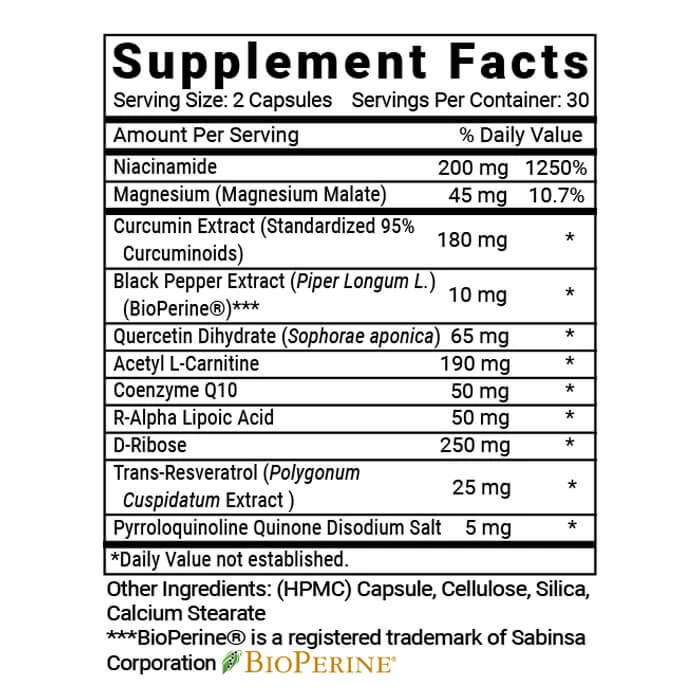
This is the panel we transcribed for Advanced Mitochondrial Formula, per Advanced Mitochondrial Formula's own panel, read September 3, 2026: the panel prints Serving Size: 2 Capsules and Servings Per Container: 30.
The bottle arithmetic: 60 capsules, 30 days, 50 mg of each active a day
Thirty servings at two capsules each is 60 capsules a bottle, two a day, 30 days exactly. That part of the arithmetic closes clean.
Coenzyme Q10 comes out to 50 mg a day from this product, under the 100 mg line the dividing instruction above targets. R-Alpha Lipoic Acid comes out to 50 mg a day too, on the meal source's opposite schedule.
The panel does the math on milligrams. It does not do the math on moments.
Panel figures per Advanced Mitochondrial Formula's own panel, read September 3, 2026. Bottle arithmetic (60 capsules, 30 days) is our own sum from the printed serving count.
The panel where the conflict is real, not hypothetical
The panel we reviewed asks for two capsules a day and carries CoQ10 and R-alpha lipoic acid on the same line-up, so the timing trade-off above is not hypothetical on that bottle.
Two tips before you fix a time for a combination capsule
The review prints the whole plate milligram by milligram, so you can see exactly which pairs you would actually be choosing between.
Before you fix a time, list which actives on a panel are fat-soluble and which carry a before-meal instruction of their own. The two categories do not always mix quietly.
A serving size of two capsules is a permission to split the serving across the day if that helps, not an instruction to swallow both at the same moment.
Eleven itemised actives, zero proprietary blend, 60 capsules for exactly 30 days, plus the three checkout totals and the guarantee, each dated.
Questions people also ask
Should I take CoQ10 in the morning or at night?
The source does not deal in clock time, it deals in meals. What it says is that absorption is best with fat in a meal, and that above 100 mg a day the dose is generally divided into two or three servings.
Does CoQ10 need to be taken with food?
It is fat-soluble and best absorbed with fat in a meal according to the Linus Pauling Institute; since less than 5% of what you swallow reaches the circulation, the meal is one of the few variables the person taking it controls.
What happens if I swallow it on an empty stomach?
One of the crossovers cited here dosed under fasting conditions and still measured absorption, so it is not futile. It simply is not the condition the reference source describes as best for absorption.
Can CoQ10 and alpha-lipoic acid go in the same capsule?
They can, and the label on our own bench does. The catch is that their reference instructions oppose each other: one asks for a meal with fat, the other asks for thirty minutes before a meal. In a single capsule, one of the two always gives way.
Does splitting a dose across the day actually help?
Above 100 mg a day, dividing into two or three servings is what the source describes. The same fact sheet separately notes gastrointestinal symptoms from around 200 mg a day. We report the two side by side; nothing we read links them as cause and effect.
How we built this page
Every source on this page and the date we read it
This page reads two fact sheets and three abstracts. It is not a lab test, and it is not medical advice.
- The fat-soluble, absorption and dose-splitting instructions for CoQ10 come from the Linus Pauling Institute, Micronutrient Information Center, "Coenzyme Q10," read September 4, 2026.
- The thirty-minutes-before-a-meal instruction for lipoic acid comes from the same institute's "Lipoic Acid" fact sheet, read September 4, 2026.
- The with-a-meal crossover trial is Zhang et al, Food & Function 2018, PMID 30302465, abstract read via Europe PMC September 4, 2026.
- The fasting crossover trial is Mei et al, Clinical Pharmacology in Drug Development 2026, PMID 41789786, a small pilot study of a cocrystal ubiquinol formulation, abstract read via Europe PMC September 4, 2026.
- The mouse study registered as a reminder the literature is not unanimous is Journal of Clinical Biochemistry and Nutrition 2023, PMID 36936872, read via Europe PMC September 4, 2026; it is animal evidence, never cited here as human evidence.
- The Coenzyme Q10 and R-Alpha Lipoic Acid milligram amounts and serving count are per Advanced Mitochondrial Formula's own Supplement Facts panel, read September 3, 2026.
- We did not test any product, and we did not estimate a timing plan the source material does not state.
- Nothing here is medical advice. A new supplement, or a change to how you take one, is a conversation with a doctor first, especially if you are pregnant, nursing or on medication.