The short answer: ubiquinol is CoQ10 in its reduced state, and a panel can print the compound without ever naming the state
Ubiquinol and ubiquinone are the same molecule, in different states of oxidation.
The state that has picked up extra electrons is called ubiquinol; the state that has given them up is ubiquinone; between the two sits a short-lived radical, the semiquinone. Of the nine results we read for this exact question, half are brand blogs that sell ubiquinol. The plainest fact of all rarely gets a line: your own bottle may never print which state is actually inside it.
Three oxidation states, one molecule: what the chemistry actually commits to
“Coenzyme Q10 can exist in three oxidation states: (i) the fully reduced ubiquinol form, CoQ10H2; (ii) the radical semiquinone intermediate, CoQ10H*; and (iii) the fully oxidized ubiquinone form, CoQ10.”
Linus Pauling Institute, Micronutrient Information Center, Coenzyme Q10, section Introduction, read September 4, 2026It does not say two ingredients. It says one molecule, three states. The body interconverts the states on its own, as part of ordinary metabolism, and supplementation just adds to whichever pool a given capsule happens to be in.
The three states one by one, and the citation
The Linus Pauling Institute's Micronutrient Information Center puts the chemistry in one sentence.
Read that sentence again and notice what it does not say.
Chemistry per the Linus Pauling Institute, Micronutrient Information Center, Coenzyme Q10, section Introduction, read September 4, 2026.
The trial people quote: ten older men, 200 mg a day, two weeks each way
Zhang and colleagues ran the trial in 2018, in the journal Food & Function: double-blind, randomized, a crossover design in ten older men. Each took 200 mg a day of one form for two weeks, with a main meal, then a two-week washout, then 200 mg a day of the other form for two more weeks.
The authors' own numbers: plasma ubiquinone up 1.7-fold and total CoQ10 up 1.5-fold (p < 0.05) on ubiquinol; the ubiquinone arm's rise was not significant
One trial anchors most of the ubiquinol absorbs better claims aimed at people past 50, and it is worth reading past its headline.
The authors put it this way:
“the ubiquinol supplement significantly increased plasma ubiquinone 1.7 fold from 0.2 to 0.6 μmol L-1 and total CoQ10 (the sum of 2 forms) 1.5 fold from 1.3 to 3.4 μmol L-1 (p < 0.05).”
The ubiquinone arm did not do the same: “The ubiquinone supplement insignificantly increases plasma ubiquinol, ubiquinone, and total CoQ10.”
Zhang Y, Liu J, Chen XQ, Oliver Chen CY. “Ubiquinol is superior to ubiquinone to enhance Coenzyme Q10 status in older men.” Food & Function 2018;9. PMID 30302465, abstract read via the Europe PMC API, September 4, 2026.
The blood number moved. The measured markers of function did not.
A plasma number went up in ten people over two weeks. Markers of antioxidant capacity, oxidative stress, and cellular energy output did not move in either arm, and two of the ten men did not follow the group pattern at all.
The three findings from the same abstract, quoted
The same abstract that reports the 1.5-fold rise also reports three findings that rarely travel alongside it.
- “Of 10 subjects, six were more responsive to the ubiquinol supplement and 2 were more so to the ubiquinone.” Two men did not follow the group pattern at all.
- “The supplementation of both CoQ10 forms did not alter the CoQ10 status in PBMC,” the white blood cells the authors also measured.
- “FRAP, total thiol, and MDA in plasma and ATP in PBMC were not changed during the intervention,” in either arm.
What this means for you: a plasma number went up in ten people over two weeks. Markers of antioxidant capacity, oxidative stress, and cellular energy output did not move in either arm.
The 2026 crossover behind the twice-the-absorption number, and the three words that scope it
Mei and colleagues tested a novel cocrystal ubiquinol formulation against a reference ubiquinone formulation in twelve healthy adults, fasting. It is the number most likely to travel as ubiquinol absorbs twice as well.
Three words carry the whole scope of that number: “novel cocrystal ubiquinol formulation.” One specific formulation beat one specific reference. The authors call their own work “this small pilot study,” not a verdict on ubiquinol as a category.
The authors' own sentence, the less precise fourth measure (3.43-fold, 90% CI 1.47 to 8.00), and the citation
The newest number in this comparison comes from a 2026 crossover trial.
“The geometric mean ratios (test/reference) for baseline-corrected peak plasma concentration (Cmax) and area under the curve from zero to last quantifiable time (AUC0-t) were 2.20 and 2.01, respectively, with 90% confidence intervals of 1.59-3.04 and 1.51-2.70.”
A fourth measure, the area under the curve to infinity, moved further and less precisely: 3.43-fold, 90% CI 1.47 to 8.00.
Mei X, Zhu B, Soni K, Kasaraneni K, Panchal N. “A Randomized, Double-Blind, Two-Treatment, Two-Period, Crossover Study Investigating the Systemic Bioavailability of a Novel Cocrystal Ubiquinol Formulation Compared with a Ubiquinone Formulation in Healthy Adults.” Clinical Pharmacology in Drug Development 2026;15. PMID 41789786, abstract read via the Europe PMC API, September 4, 2026.
The study that points the other way, and why the literature is not settled
Not every study lines up behind ubiquinol. A 2023 study in mice records that ubiquinol-10's greater bioavailability “has been reported... in some studies,” and in contrast that it “is not superior to that of ubiquinone-10 because ubiquinol-10 may be oxidized during digestion.” That finding comes from mice, not people. Two human crossovers favor ubiquinol, with real caveats attached to both; one mouse study argues the opposite mechanism. That is not a settled question. It is an open one with a current favorite.
The mouse study's two sentences, quoted in full, and the citation
A 2023 study in mice, in the Journal of Clinical Biochemistry and Nutrition, puts it plainly.
Its own abstract says: “The oral bioavailability of the reduced form of CoQ10, ubiquinol-10, has been reported to be greater than that of the oxidized form of CoQ10, ubiquinone-10, in some studies.”
Then the same sentence turns: “In contrast, it has also been highlighted that the oral bioavailability of ubiquinol-10 is not superior to that of ubiquinone-10 because ubiquinol-10 may be oxidized during digestion.”
We cite it only to record that the published literature disagrees with itself, never as evidence about human absorption.
Journal of Clinical Biochemistry and Nutrition 2023. PMID 36936872, abstract read via the Europe PMC API, September 4, 2026.
What the panels we have read do print, and what they usually stop at
The panels we have read name the ingredient and print a milligram amount. Naming the oxidation state is a separate choice, and it is one a panel can simply not make. "Coenzyme Q10 50 mg" and "Ubiquinol 50 mg" are both lines we have seen printed; only the second one has answered the question this page is about.
Pros and cons of paying more for the word ubiquinol, the fat-in-a-meal note from LPI, and three alternatives when the state is undeclared
The Linus Pauling Institute's own guidance shows why the state can matter at all.
“Coenzyme Q10 is fat-soluble and is best absorbed with fat in a meal,” it says. That note applies to CoQ10 in general, not to one state over the other.
LPI, Coenzyme Q10, section Supplements, read September 4, 2026.
Pros and cons of paying more for the word “ubiquinol”
What the declared form gets you
- A dose you can actually match to the two human trials cited here, instead of guessing.
- A plasma-level advantage that showed up in a real, if small, crossover trial.
- A fair question for customer support: which state, at which milligram amount, per serving?
What it still doesn't settle
- Whether that plasma advantage changes anything you would feel. The measured function markers did not move in the trial that found it.
- Whether the twice the absorption number applies to your capsule. It was measured on one cocrystal formulation, not on ubiquinol in general.
- Whether paying more for the declared form is worth it for you. That is a value judgment this page cannot make on your behalf.
When a label leaves the state undeclared, three honest alternatives exist.
- A product that states the form and the milligram amount together.
- A single-ingredient CoQ10 or ubiquinol capsule you can match to a trial.
- A conversation with a doctor or pharmacist who can read the panel with you.
None of those is a guaranteed better result. They are a label, and a person, you can actually check.
A thirty-second check on the bottle already in the cupboard
Three questions, in order: the word on the panel, the milligram number against 200 mg a day, and the with-food direction
Three questions, in this order, before any brand argument starts.
Find the word
Does the panel say Coenzyme Q10, ubiquinol, ubiquinone, or ubidecarenone?
If it only says “Coenzyme Q10,” the state has not been declared, and no amount of reading the rest of the panel will resolve it.
Find the milligram number
Note the dose next to whichever word is printed. Compare it to the trial doses on this page: 200 mg a day in the older-men crossover above.
Find the serving direction
CoQ10 “is fat-soluble and is best absorbed with fat in a meal,” per the Linus Pauling Institute. Check whether your own label says to take it with food.
Serving guidance per LPI, Coenzyme Q10, section Supplements, read September 4, 2026.
The panel that names the compound and stops
Advanced Mitochondrial Formula, from Advanced Bionutritionals, read September 3, 2026: its own Supplement Facts panel prints eleven named actives with a milligram amount each, and Coenzyme Q10 is one of them, at 50 mg.
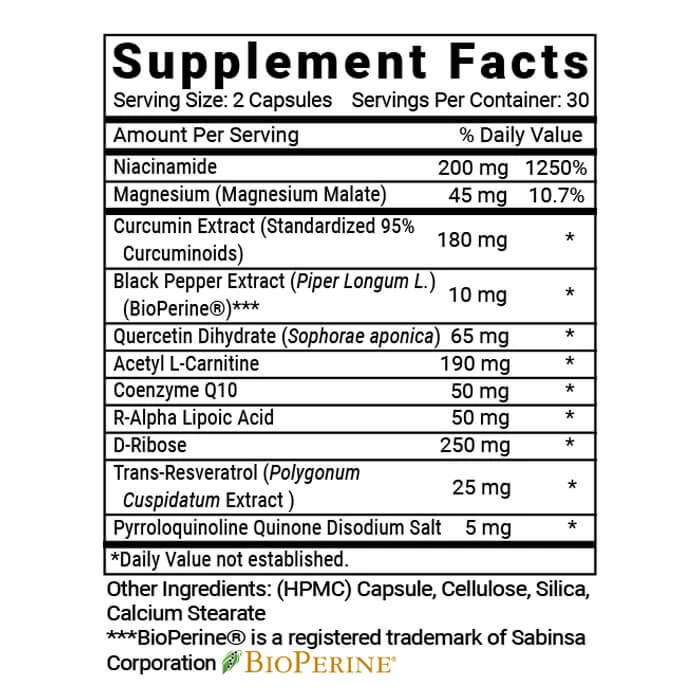
| Actives on the panel (per 2-capsule serving) | Amount | % DV |
|---|---|---|
| Coenzyme Q10 | 50 mg | * |
| R-Alpha Lipoic Acid | 50 mg | * |
| Pyrroloquinoline Quinone Disodium Salt | 5 mg | * |
The “Coenzyme Q10” line names the compound and prints the milligram amount, 50 mg. It does not print “ubiquinol,” “ubiquinone,” or “ubidecarenone” anywhere across all eleven lines. That is not an accusation. It is exactly what this panel does and does not commit to, and why the comparison this page has walked through cannot be settled from that one plate alone.
Panel transcribed from Advanced Bionutritionals' own product images, cross-verified across two asset paths, read September 3, 2026.
The label we read line by line
The bottle we reviewed prints “Coenzyme Q10 50 mg” and stops at that, so the redox question stays open on that particular plate, and the review transcribes all eleven lines exactly as printed so you can see what the panel does and does not commit to before you decide the form matters to you.
Two tips before you pay more for a declared form
Your own bottle may be in the same position: an undeclared state next to a printed milligram number.
The next step is reading the whole panel, not just one line of it.
Read the panel before the price. A declared form is a fact you can check; a marketing claim about absorption is not, until you have looked.
Compare the milligram number on your bottle to what the trials above actually used. The older-men crossover ran on 200 mg a day, before assuming more or less makes a difference for you.
Eleven label lines transcribed in full, the checkout totals we read twice, and the guarantee that actually governs.
Questions people also ask
Is ubiquinol the same thing as CoQ10?
Yes, it is the fully reduced form of the same molecule; ubiquinone is the fully oxidised form, and there is a semiquinone intermediate between them.
Does ubiquinol absorb better than ubiquinone?
In older men, an n=10 crossover at 200 mg a day saw plasma total CoQ10 rise 1.5-fold only in the ubiquinol arm; a 2026 crossover with n=12 under fasting conditions reported ratios of 2.20 for Cmax and 2.01 for AUC0-t, but its test arm was a specific cocrystal formulation. A mouse study records the opposite view. The honest answer is a qualified yes, with wide margins and for specific formulations.
How do I tell which form is in the bottle I already own?
By looking for the words on the panel. If it only says Coenzyme Q10 and a milligram figure, the form has not been declared, and no amount of reading the panel will resolve it.
Is ubiquinol worth the extra money after 50?
The one human trial cited here that used older men specifically favoured ubiquinol at the plasma level, and six of ten participants responded better to it. Two responded better to ubiquinone, and neither arm changed the measured markers of function. It is a blood-level advantage measured in ten people.
Did those ubiquinol trials measure anything besides blood levels?
Yes, and that is the point. The 2018 trial also measured FRAP, total thiol, plasma MDA and ATP in PBMC, and none of them changed during the intervention, in either arm.
How we built this page
Every source on this page and the date we read it
This is a literature-and-label page, not a clinical trial of our own.
- The chemistry claim is transcribed from the Linus Pauling Institute's Micronutrient Information Center, Coenzyme Q10, read September 4, 2026.
- The three named trials were confirmed against their PubMed records via the Europe PMC API on September 4, 2026. Each is linked by PMID above.
- The Advanced Mitochondrial Formula panel was read from the seller's own product images on September 3, 2026, cross-verified across two asset paths.
- We did not purchase or test any product for this page.
- This page carries no link on this page of its own; the review it links to further down does, and that is disclosed there.
- Nothing here is medical advice. A new supplement while pregnant, nursing, on medication, or managing a diagnosed condition is a conversation with a doctor first.