The short answer: 30 to 100 mg a day is the supplement band, and no Daily Value exists to check it against
Supplement doses of CoQ10 for adults run 30 to 100 mg a day.
That is the range the Linus Pauling Institute cites, and it is well above what an ordinary diet supplies.
The panels we have read print an asterisk and the note "Daily Value not established" beside CoQ10, because no Daily Value has been set for it.
A label that prints 50 mg, 100 mg or 200 mg is not answering to any government target; it is answering to the industry's own supplement range.
Linus Pauling Institute, Micronutrient Information Center, Coenzyme Q10 fact sheet, section Supplements: "Doses in supplements for adults range from 30 to 100 mg/day, which are considerably higher than typically estimated dietary coenzyme Q10 intakes." Read September 4, 2026.
Why CoQ10 has no RDA: your body makes it, so it is not a vitamin
Vitamins get an RDA because the body cannot make enough of them on its own.
CoQ10 does not qualify. Every cell already makes the molecule it needs.
"All animals, including humans, can synthesize ubiquinones, hence, coenzyme Q10 is not considered a vitamin."
Linus Pauling Institute, Coenzyme Q10 fact sheet, section Introduction, read September 4, 2026That one sentence is why no RDA and no Daily Value for CoQ10 show up on the panels we have read: the % DV column carries an asterisk instead.
A supplement dose is not filling a gap the way vitamin C or vitamin D fills one. It is adding to a supply the body already runs on its own.
Less than 5% of what you swallow reaches your blood
A milligram on the label is not a milligram in circulation.
What the label prints against what reaches the blood, the source line, and the 2,400 mg/day plateau
Linus Pauling Institute, Coenzyme Q10 fact sheet, section Supplements: "Less than 5% of orally administered coenzyme Q10 is thought to reach the circulation." Read September 4, 2026.
The same fact sheet notes that plasma CoQ10 levels off at very high intakes: "Plasma coenzyme Q10 appears to reach a plateau following supplementation with a dose of 2,400 mg/day." Past that point, a bigger number on the label buys less and less in the blood.
Where the three-digit numbers come from, and the point at which a dose gets split
Search CoQ10 online and three-digit numbers show up fast: 200 mg, 600 mg, 1,200 mg.
Why 200, 600 and 1,200 mg are research doses, and the 100 mg point where a dose gets split, in the source's words
Those are not supplement-shelf numbers. They are research doses.
Trials use them to test one specific question, at amounts well above the 30 to 100 mg supplement band.
The supplement-side rule that does apply at the top of that band is a practical one, about how a dose is taken, not how large it is.
Linus Pauling Institute, Coenzyme Q10 fact sheet, section Supplements: "Doses higher than 100 mg/day are generally divided into two or three doses throughout the day." Read September 4, 2026.
So a 50 mg or 100 mg dose is ordinarily taken once. Cross 100 mg a day and the same source describes splitting it, rather than swallowing it all at once.
The safety numbers behind the band: 1,200 mg a day, and the 200 mg where stomachs start complaining
A dosage band is only half the picture. The safety data the same fact sheet publishes is the other half.
"There have been no reports of significant adverse side effects of oral coenzyme Q10 supplementation at doses as high as 3,000 mg/day for up to eight months, 1,200 mg/day for up to 16 months, and 600 mg/day for up to 30 months."
Linus Pauling Institute, Coenzyme Q10 fact sheet, section Safety, read September 4, 2026The same fact sheet names 1,200 mg a day as the level its own risk-assessment method calls strongly supported.
"According to the observed safe level (OSL) risk assessment method, evidence of safety is strong with doses up to 1,200 mg/day of coenzyme Q10."
The discomfort that shows up first sits much lower than any of those numbers: "Some people have experienced gastrointestinal symptoms, such as nausea, diarrhea, appetite suppression, heartburn, and abdominal discomfort, especially with daily doses ≥200 mg."
So the ceiling on serious harm is high. The point where a stomach starts to notice is not.
Statins and warfarin: the two lines worth reading before the first capsule
Statins are the reason many people meet CoQ10 in the first place, and the same source that sets the dosage band addresses them directly.
"The use of cholesterol-lowering medications called statins can decrease circulating coenzyme Q10 concentrations. However, there is no evidence that this causes any adverse side effects in statin-treated patients."
Linus Pauling Institute, Coenzyme Q10 fact sheet, section Summary, read September 4, 2026That is information about a measured blood level, not a case for or against taking CoQ10 alongside a statin. Nothing here recommends starting, stopping or adjusting any medication.
The second line concerns a different drug: "Concomitant use of warfarin (Coumadin) and coenzyme Q10 supplements has been reported to decrease the anticoagulant effect of warfarin in a few cases." Anyone on warfarin has a real reason to raise CoQ10 with a doctor or pharmacist before starting it, not after.
None of these numbers say what dose works best
Every figure on this page describes a range, a threshold or a safety ceiling. None of them is a claim that a bigger dose does more.
- The 30 to 100 mg band describes what supplements typically contain, not a dose proven to outperform a smaller one.
- The 2,400 mg/day plateau describes blood levels, not any measured outcome in a person taking that much.
- The safety figures (600, 1,200, 3,000 mg/day) describe tolerability over months, not effectiveness at any of those amounts.
- No source here tested the finished capsule discussed later on this page; the trials behind these numbers tested the isolated ingredient, on its own schedule.
What this means for you: a milligram number tells you where a dose sits on a chart. It does not tell you what that dose will do for you personally.
A thirty-second check on any panel that lists CoQ10
Three questions, in order: the milligram number, the % DV column, and the statin or warfarin line
Three questions, in order, before any brand argument starts.
Find the milligram number
Is it inside 30 to 100 mg, or higher?
Inside the band, it is an ordinary supplement dose. Above it, expect the panel to split the serving.
Check the % Daily Value column
It should read an asterisk, not a percentage.
The panels we have read print an asterisk and the note "Daily Value not established" beside CoQ10, not a gap in the product.
Check what else is on the label
A statin or warfarin prescription is the reason this question matters at all.
Bring the exact milligram number to that conversation with a doctor or pharmacist, before the first capsule, not after.
What a printed milligram number gives you, and what it does not
Four things a printed milligram number gives you, four it does not, and two plain alternatives
This is our own read, from the fact sheet quoted above.
What it gives you
- A number you can place inside the 30 to 100 mg supplement band, or above it.
- A way to tell whether a dose crosses the 100 mg point where splitting is generally advised.
- A concrete figure to bring to a doctor or pharmacist if a statin or warfarin is already in the picture.
- Confirmation that the asterisk beside CoQ10 is normal, not a missing fact.
What it still does not give you
- Any evidence that the finished product was tested in people at that dose.
- A stated redox form; a panel that just says "Coenzyme Q10" has not said whether it is ubiquinone or ubiquinol.
- A reason to read a higher number as a better result.
- A personal answer to the statin or warfarin question, which stays a conversation for a doctor.
Some labels will not settle those last two questions. The honest alternatives are plain ones.
Pick a product that also states the redox form on its panel. Or pick a single-ingredient CoQ10 product, dosed to match one of the figures above, and check it against this same fact sheet.
The 50 mg line we already placed inside this band
We ran exactly this check on a bottle that prints Coenzyme Q10 50 mg on a panel of eleven itemised actives, and the review shows where that single line sits against the band above, alongside every other milligram on the same plate and the total the checkout actually charges.
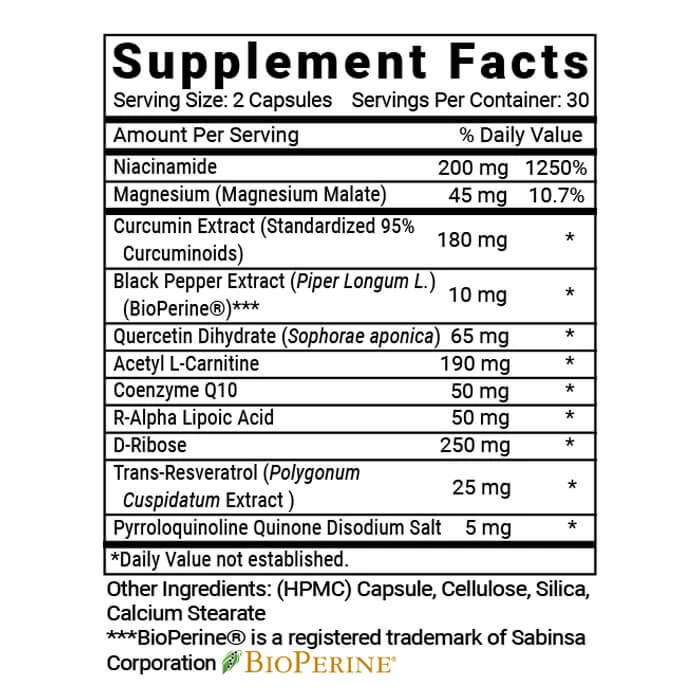
This is the full panel we transcribed on September 3, 2026 for our review of this product.
The Coenzyme Q10 line sits seventh of eleven, printed at 50 mg with an asterisk in the % DV column, as nine of the eleven lines are.
The 50 mg line as the panel prints it, where it falls against the band, and two label-reading tips
| Line from the panel (per 2-capsule serving) | Amount | % DV |
|---|---|---|
| Coenzyme Q10 | 50 mg | * |
Read the serving-size line before the amounts column. A number printed per capsule doubles the moment the instructions say two capsules.
An asterisk in the % DV column is what these panels print, not a verdict on the dose. Judge the milligram number against the band above instead.
Eleven itemised actives, zero proprietary blend, three real checkout totals and the guarantee, each with the date we read it.
Questions people also ask
How much CoQ10 should I take per day?
The supplement band is 30 to 100 mg a day per the Linus Pauling Institute; there is no RDA and no Daily Value, because the body synthesises the molecule. Three-digit numbers come from clinical trials, not from a general recommendation.
Is there a Daily Value for CoQ10 on a supplement label?
No. The panels we have read print an asterisk and the note "Daily Value not established" beside CoQ10, because no Daily Value has been set for it.
Can you take too much CoQ10?
The observed safe level method cited by the Linus Pauling Institute puts strong evidence of safety at up to 1,200 mg a day, and trials have gone to 3,000 mg a day for eight months. The discomfort that shows up first is gastrointestinal, from around 200 mg a day.
Does taking a statin change how much CoQ10 I need?
Statins do lower circulating CoQ10, but the same source states there is no evidence this causes any adverse side effect in statin-treated patients. That is information, not an indication.
Is 50 mg of CoQ10 a low dose?
It is inside the 30 to 100 mg supplement band, below its midpoint, and below the 100 mg a day point at which the source says doses are generally split. Where it lands on one real label is in the linked review.
How we built this page
Sources, the dates we read them, and what we did not do
This is a fact-sheet-reading page, not a clinical guide.
- Every quoted line comes from the Linus Pauling Institute's Micronutrient Information Center, Coenzyme Q10 fact sheet, read September 4, 2026.
- The label line and its % DV asterisk are transcribed from Advanced Mitochondrial Formula's own Supplement Facts panel, read September 3, 2026, for our review of that product.
- We did not test any product, and we did not estimate an effect for any dose named above; every number here describes a range, a threshold or a safety figure, never a result.
- The statin and warfarin lines are reported exactly as the source states them, as information, never as medical advice or a recommendation to start, stop or change any medication.
- Nothing on this page is medical advice. A new supplement while pregnant, nursing, under 18, on medication or managing a health condition is a conversation with a doctor or pharmacist first.