The short answer: 315 mg and 630 mg were the trial arms, and 203.7 mg is Europe's assessed ceiling
Three numbers cover almost every honest answer to this question, and none of them is a Daily Value.
315 mg and 630 mg a day are the two doses a 2024 crossover trial tested in healthy men.
203.7 mg a day is a different number. It is the maximum use level proposed for one specific, soy-derived form of the ingredient in food supplements, and assessed in a 2026 EFSA opinion.
And a label can print a GPC milligram figure that is not the alpha-GPC you actually receive. That only becomes clear once its own parenthesis is read.
Alpha-GPC a day, tested against placebo in 20 trained men, double-blind, crossover.
The higher arm in the same trial, same design, same 20 men.
The maximum use level for L-alpha-GPC from soy phospholipids in food supplements, as assessed in EFSA's NDA Panel opinion.
Each of those three figures is quoted in its own section below, next to the date we read it.
The line that changes everything: "glycerophosphocholine 250 mg (supplying 50% alpha-GPC)"
Here is the exact line, printed on a label we read for our Advanced Memory Formula review.
"Glycerophosphocholine (GPC) (supplying 50% alpha-GPC) from soy 250 mg"
Advanced Memory Formula's own Supplement Facts panel, a two-tablet serving, read September 3, 2026Read only the number before the parenthesis and you would write down 250 mg of alpha-GPC.
Read the whole line and the arithmetic changes: 250 mg of GPC, supplying 50% alpha-GPC, delivers 125 mg of alpha-GPC.
Set that 125 mg against the trial arms above. It is 40% of the 315 mg low dose, and 20% of the 630 mg high dose, from PMID 39683633.
Set it against EFSA's number instead. It sits below the 203.7 mg a day maximum use level in PMID 42131868, not above it.
Three comparisons, three different pictures. None of them was printed for you on the panel itself.
What the 2024 crossover in healthy men measured, and the two tests where it found nothing
The trial behind the 315 mg and 630 mg figures used 20 trained, healthy men. It was double-blind, placebo-controlled, and crossover in design.
Each man took three doses in turn, in a crossover sequence. A placebo, the low dose (315 mg, LD), and the high dose (630 mg, HD) of alpha-GPC.
It found a real, statistically significant result on one test.
"changes in Stroop total score were statistically greater after HD (13.0 +/- 8.2 vs. 5.2 +/- 9.0, p = 0.013, d = 0.61) and LD (10.8 +/- 7.7 vs. 5.2 +/- 9.0, p = 0.046, d = 0.48) administration."
Nutrients, 2024 · PMID 39683633The paper's own significant result is a Stroop score. Our source file records that result, and does not record a memory or recall outcome for this trial.
The same trial ran two other cognitive tests, and here the finding flips to null.
"No significant differences between groups were found for the Flanker and N-Back assessments."
Nutrients, 2024 · PMID 39683633The same paper reports both of those as null at either dose.
One test moved, in one narrow sample, on one day
This trial does not say alpha-GPC improves memory, general cognition, or brain health as you age.
- The sample was 20 trained, healthy men. It says nothing directly about women, untrained adults, or older adults.
- Every dose was a single, acute administration, not a supplementation period of weeks or months.
- Two of the three cognitive tests in the same trial, Flanker and N-Back, found no difference at either dose.
- No source in our file reports this trial testing memory or recall specifically.
What this means for you: 315 mg and 630 mg are real trial doses, on a real result, in a narrow acute study. They are not a general recommendation.
What EFSA actually assessed, and what "maximum use level" is and is not
The 203.7 mg figure comes from a different kind of document. It is a 2026 safety opinion from EFSA's Panel on Nutrition, Novel Foods and Food Allergens. That opinion evaluates L-alpha-glycerylphosphorylcholine (L-alpha-GPC) from soya phospholipids as a Novel Food.
EFSA's own words: the 203.7 mg/day level, the NOAEL, the safety conclusion, and what a maximum use level is not
"The NF is proposed to be used in food supplements at a maximum use level of 203.7 mg/day, corresponding to 82.5 mg/day of choline."
EFSA Journal, 2026 · PMID 42131868The same opinion reports a no observed adverse effect level derived from published studies, and a favorable conclusion.
"a no observed adverse effect level (NOAEL) of 1000 mg/kg bw per day for a 90-day study ... could be derived from published studies"
"the NF does not raise safety concerns under the proposed conditions of use."
EFSA Journal, 2026 · PMID 42131868A "maximum use level" is a proposed ceiling for one specific, named ingredient form, assessed by a regulator. It is not a Recommended Daily Allowance, and it is not a verdict on every alpha-GPC product on the market.
Nor does it evaluate the 315 mg and 630 mg doses from the trial above. Those numbers come from separate documents, testing separate questions, and neither one was written with the other in mind.
The other conversion on the same page: 203.7 mg of the ingredient, 82.5 mg of choline
203.7 mg of the ingredient is 82.5 mg of choline: EFSA's conversion, and why it is not the label's 50% line
EFSA's own framing makes this plain. The 203.7 mg/day maximum use level it assessed is stated as corresponding to 82.5 mg/day of choline.
That conversion, 203.7 mg of the ingredient to 82.5 mg of choline, comes from EFSA's own opinion. It is a different calculation from the label's "supplying 50% alpha-GPC" line above, on a different measure entirely: one converts to elemental choline, the other to elemental alpha-GPC. Do not treat the two percentages as interchangeable.
What both share is the same underlying point. The first number on a panel or in a headline is rarely the number your body actually receives, once the parenthesis is read.
Three names, one compound: alpha-GPC, choline alphoscerate, L-alpha-glycerylphosphorylcholine
The 2025 review's sentence naming all three (PMID 40036805), and what it means for reading a label
The label we read calls it alpha-GPC. EFSA's opinion calls it L-alpha-glycerylphosphorylcholine (L-alpha-GPC). A third name shows up in the research literature.
"l-alpha-Glycerylphosphorylcholine (GPC), also known as choline alphoscerate or alpha-glycerophosphorylcholine, serves as both a pharmaceutical product and a dietary supplement."
Nutrition Reviews, 2025 · PMID 40036805All three names, alpha-GPC, choline alphoscerate, and L-alpha-glycerylphosphorylcholine, describe the same compound. If a label, a study, or a search result uses a different one of the three, that alone is not a different ingredient.
Where it comes from, and why that matters if you avoid soy
EFSA's opinion is specifically an assessment of L-alpha-GPC "from soya phospholipids (lecithin)." It is not a blanket ruling on every possible manufacturing route for the compound.
The soy line on the label we read, what the trial and the opinion give you, and what they do not
On the one label we read for this cluster, that sourcing shows up directly. The GPC line is listed "from soy," alongside two other soy-derived actives on the same panel: phosphatidylserine complex, and lecithin. The panel prints CONTAINS SOY beneath the ingredient list, read September 3, 2026.
A different product could source its GPC differently. The only way to know is to read that product's own line, the same way we read this one.
What this trial and this opinion give you
- A published, placebo-controlled test at doses close to what some labels claim, not a mixed-ingredient formula.
- A regulator's own assessed ceiling to weigh a label's milligrams against, not just an online consensus number.
- A label parenthesis that lets you compute the delivered dose yourself, once you know to look for it.
What they still do not give you
- Evidence about memory or recall specifically. Our source file records one significant result, a Stroop score, and two null ones.
- A general-population dose. The trial's 20 men were healthy and trained, and the dosing was acute, not sustained.
- Proof that a higher milligram number works better. Two of three tests in the same trial found no difference at either dose.
Two honest alternatives, if the label's own math bothers you
Once you know a "supplying X%" line can cut a milligram figure in half, two ways to sidestep the arithmetic exist.
- A single-ingredient alpha-GPC product that states its own delivered alpha-GPC milligrams directly, with no separate compound and no percentage to convert.
- A formula whose printed dose already matches a published trial arm, 315 mg or 630 mg of alpha-GPC itself. The label then states the number the trial tested, not a precursor of it.
Either way, the two-second check is the same one we ran above: read the parenthesis before you write down the milligrams.
One label where we did the arithmetic
You now have the three numbers worth carrying to a label: 315 mg, 630 mg, and 203.7 mg.
One panel in our files prints the whole trap in three lines: 250 mg of glycerophosphocholine, the parenthesis that says it supplies 50% alpha-GPC, and a serving size of two tablets.
We read that panel in full, alongside the ten other actives on the same line, for our Advanced Memory Formula review.
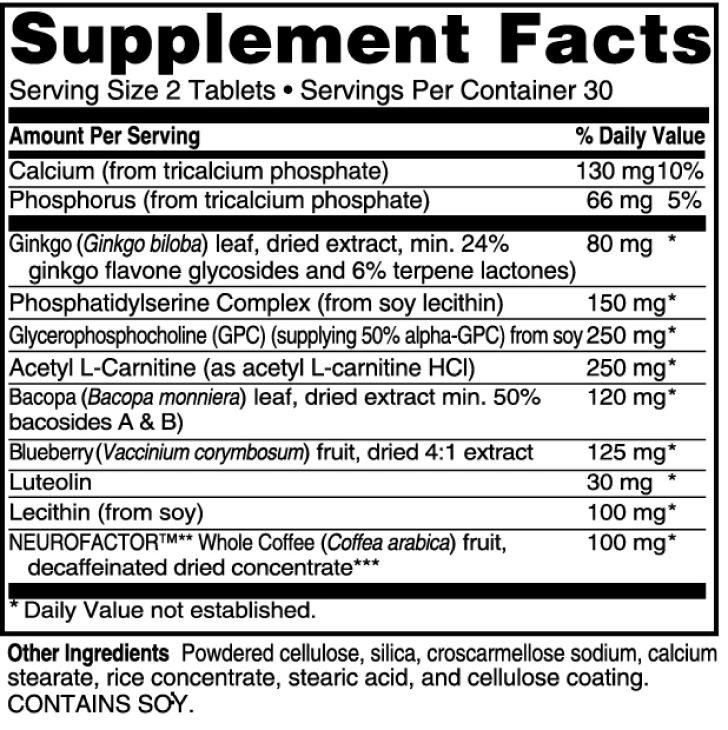
Advanced Memory Formula's own panel, read September 3, 2026.
The GPC line sits fifth of eleven itemized actives, none in a proprietary blend.
250 mg of GPC, at the printed 50%, is 125 mg of alpha-GPC per two-tablet serving.
Two tips: read the whole parenthesis, and check which compound the line actually names
Read the whole parenthesis before you write down the milligram number.
"Supplying 50%" or "supplying X% alpha-GPC" changes the delivered dose by exactly that percentage.
Check which compound is actually named on the line.
Glycerophosphocholine (GPC) and alpha-GPC are related, but a label can dose one and only convert to the other in a footnote.
The full 11-active label, the standardizations printed, and the arithmetic the panel leaves to you, dated.
Questions people also ask
What is a standard alpha-GPC dose in studies?
There is no single standard. The one crossover trial in our file tested two doses of alpha-GPC in healthy men: 315 mg and 630 mg (PMID 39683633). A separate document, from a food-safety regulator rather than a clinical trial, assesses a different and much lower number for everyday supplement use.
Is 250 mg of GPC the same as 250 mg of alpha-GPC?
No, not on the label we read for our Advanced Memory Formula review. That panel prints "Glycerophosphocholine (GPC) (supplying 50% alpha-GPC) from soy" at 250 mg, so 250 mg of GPC delivers 125 mg of alpha-GPC, by the label's own parenthesis, read September 3, 2026.
Has any regulator assessed an alpha-GPC intake level?
Yes. A 2026 opinion from EFSA's Panel on Nutrition, Novel Foods and Food Allergens assessed a proposed maximum use level of 203.7 mg a day for L-alpha-GPC in food supplements, corresponding to 82.5 mg a day of choline (PMID 42131868). That is an assessed ceiling for one specific ingredient form, not a recommended dose for everyone.
Is choline alphoscerate a different ingredient from alpha-GPC?
No. A 2025 review states it directly: "l-alpha-Glycerylphosphorylcholine (GPC), also known as choline alphoscerate or alpha-glycerophosphorylcholine, serves as both a pharmaceutical product and a dietary supplement" (PMID 40036805). Alpha-GPC, choline alphoscerate, and L-alpha-glycerylphosphorylcholine name the same compound.
Does alpha-GPC on a label mean the product contains soy?
Not automatically, but check the sourcing line next to it. EFSA's opinion covers L-alpha-GPC specifically "from soya phospholipids (lecithin)" (PMID 42131868), and on the one label we read for this cluster, the GPC line is sourced from soy and the panel prints CONTAINS SOY, read September 3, 2026. A different product could source it differently; read that product's own line.
How we built this page
Sources, PMIDs, the dates we read them, and which arithmetic is ours
This page reads sources. It is not a lab test, and it is not medical advice.
- The 315 mg and 630 mg trial doses and both cognitive-test results come from PMID 39683633, Nutrients, 2024, read September 4, 2026.
- The 203.7 mg maximum use level and the choline conversion come from PMID 42131868, EFSA Journal, 2026, read September 4, 2026.
- The three-name synonym quote comes from PMID 40036805, Nutrition Reviews, 2025, read September 4, 2026.
- The Supplement Facts panel, its GPC line, and the CONTAINS SOY declaration were read from Advanced Memory Formula's own product materials on September 3, 2026, for our Advanced Memory Formula review.
- The 125 mg and comparison-percentage arithmetic is ours, built only from the numbers printed in the sources above.
- A new supplement, at any dose named on this page, is worth a conversation with a doctor first, especially if you are pregnant, nursing, or on medication.