The short answer: 120 mg a day is the reference point, and the trial bands are 60 to under 240, then 240 and up
There is no single "correct" ginkgo dose.
What is published is a reference point and two bands.
The reference point: a 12-week trial gave adults 120 mg a day of standardized ginkgo extract, EGb 761. Its outcome was dizziness, not memory.
The bands: a 2026 network meta-analysis in healthy adults names "low-dose Ginkgo" as 60 to under 240 mg/day. It names "high-dose Ginkgo" as 240 mg/day and up.
An 80 mg label sits inside the low band, close to its floor, and at 67% of the 120 mg reference dose.
None of that is a recommendation to take any specific amount. It is what the two sources say, so a label's own number can be placed against it.
Dose bands per Phytomedicine 2026, PMID 41678913, read via Europe PMC, Sep 4, 2026. Reference dose per J Otolaryngol Head Neck Surg 2026, PMID 41487075, read Sep 3, 2026.
Why a ginkgo milligram is not a dose until you read the two percentages under it
Ginkgo leaf on its own is not what any trial tests.
What gets tested is a standardized extract: leaf, processed down, then held to a minimum percentage of two marker compound groups.
What the milligrams tell you (extract weight), what the two percentages tell you (concentration), and why a bare "80 mg" compares to nothing
Ginkgo (Ginkgo biloba) leaf, dried extract, min. 24% ginkgo flavone glycosides and 6% terpene lactones) 80 mg
Advanced Memory Formula's own label, read September 3, 2026A label that prints "Ginkgo biloba 80 mg" and stops there gives you a number that compares to nothing. Not to a trial. Not to another brand's 80 mg.
Panel quoted from Advanced Memory Formula's own Supplement Facts, read September 3, 2026.
Where 120 mg a day comes from: EGb 761, the extract the trials name
A 2026 trial in the Journal of Otolaryngology, Head and Neck Surgery gave 86 adults 120 mg a day of EGb 761, for 12 weeks.
Its outcome was dizziness, not memory or cognition, so it is not evidence that 120 mg a day does anything for recall.
What EGb 761 is, and why 120 mg/day is a reference point and not evidence for memory (PMID 41487075, n=86, 12 weeks)
EGb 761 is not a brand name in the marketing sense. It is a specific standardized ginkgo extract, and the one our own source file names as the daily-dose reference point for this ingredient.
What it does give: a real, published, daily milligram figure for one specific standardized extract. That is the sense in which we call it a reference point.
Trial detail per J Otolaryngol Head Neck Surg 2026, PMID 41487075, n=86, 12 weeks, read September 3, 2026. Cited here only as a dose reference, not as evidence for a memory outcome.
What a 29-trial network meta-analysis in healthy adults actually found, including where it found nothing
The most recent dose picture in our source file is a 2026 network meta-analysis. It compares ginkgo against bacopa (Brahmi) for cognitive function.
29 RCTs, n=2,107 (PMID 41678913), both results quoted verbatim: high-dose Brahmi beat both ginkgo bands and placebo on working memory; no differences on sustained attention, selective attention or processing speed
Systematic review and network meta-analysis, healthy adults, comparing Bacopa monnieri and Ginkgo biloba on cognitive function.
Verbatim: "High-dose Brahmi (≥600 mg/day) significantly improved working memory compared to low-dose Brahmi (300 to <600 mg/day), high-dose Ginkgo (≥240 mg/day), low-dose Ginkgo (60 to <240 mg/day), and placebo."
Verbatim: "No significant differences were observed in sustained attention, selective attention, or processing speed."
So the one domain where a dose band pulled ahead of the others was working memory. The winner was high-dose bacopa, not ginkgo at either band.
| Ginkgo band, per PMID 41678913 | Range | Where 80 mg sits |
|---|---|---|
| Low-dose Ginkgo | 60 to <240 mg/day | Inside, near the floor |
| High-dose Ginkgo | ≥240 mg/day | Not reached; 80 mg is one third of 240 |
Both quotations and the dose bands are verbatim from Phytomedicine 2026, PMID 41678913, read via Europe PMC, Sep 4, 2026.
What the research does not say: no ginkgo win over placebo on working memory in our file, no edge on attention or processing speed, no finished-product test, and no reason to read a higher milligram inside the same band as more
This is not a finished-product test, and it did not find a ginkgo win
PMID 41678913 tested ginkgo and bacopa as ingredients, at stated dose bands, in healthy adults. It did not test any multi-ingredient formula, including the one whose label this page quotes.
- The only working-memory result our source file records is high-dose Brahmi beating low-dose Brahmi, both ginkgo bands, and placebo. It records no result for a ginkgo band against placebo on that outcome.
- Ginkgo, at either dose, showed no significant edge over placebo on sustained attention, selective attention, or processing speed.
- A higher milligram number inside the low-dose band is not shown here to do more than a lower one. The band, not the exact milligram, is what the analysis compares.
- Nothing in this analysis or in PMID 41487075 was run on the specific product whose label we quote on this page.
What this means for you: the percentages under the milligram number tell you the extract is comparable. They do not tell you that dose produced a measured cognitive effect.
Serving size is the multiplier most people skip: per tablet or per two tablets
A milligram figure on a Supplement Facts panel is printed per serving, and a serving is not always one tablet.
Advanced Memory Formula's own panel states its serving as two tablets, and 30 servings per container.
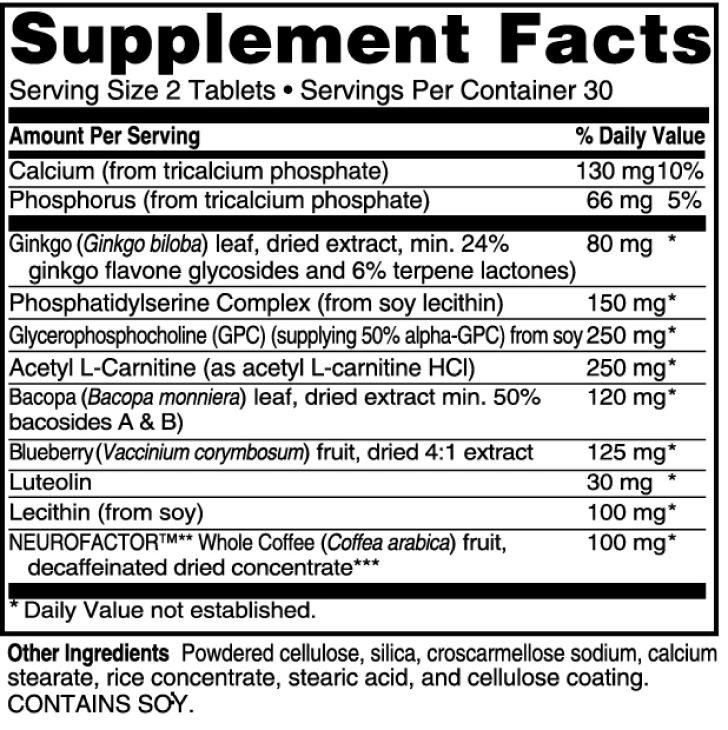
The math the panel supports: 30 servings × 2 tablets = 60 tablets, and at 2 tablets a day that is exactly 30 days per bottle.
So the 80 mg of ginkgo is printed per serving, meaning per two tablets together, not per single tablet.
A label that skips the serving size has not told you whether its milligram figure is per pill or per day. Neither has one that skips the tablet count.
Serving size, servings per container, and the ginkgo line are quoted from one source: Advanced Memory Formula's own Supplement Facts panel, read September 3, 2026.
One a day, or split: what the trials did
The low-dose and high-dose bands in PMID 41678913 are stated in mg/day. The 120 mg reference dose in PMID 41487075 is also stated as a daily figure, without our record specifying whether it was taken as one dose or split across the day.
Why the daily total is the number to compare, and what the two-tablet serving does and does not tell you about a split
Both numbers this page compares are written as a daily total, not a per-dose amount.
That is the number worth comparing either way: the daily total, not how many times it is swallowed.
The Supplement Facts panel we read does not itemize a split schedule. What it publishes is one combined serving, two tablets, with the day's ginkgo total, 80 mg, arriving inside that single serving.
So "once a day or split" matters less here than the daily mg total. That total is the question both the bands and the reference dose answer.
Dose framing per PMID 41678913 and PMID 41487075 as quoted above; serving structure per Advanced Memory Formula's own label, read September 3, 2026.
A two-line check before you pay for a ginkgo product
Two lines, read in this order, before any brand argument starts.
Find the milligram number
What's printed before the parenthesis: the weight of the dried extract in that serving, not raw leaf.
If there is no milligram figure, only a plant name, there is nothing yet to compare. Not to a trial, not to another label.
Find the two percentages under it
Ginkgo flavone glycosides and terpene lactones, each with its own minimum percentage. Both, printed together, are what turns a milligram figure into a comparable dose.
A milligram number with no percentages under it is just a plant name with a weight attached. Nothing more checkable than that.
Where this check comes from
Check derived from reading Advanced Memory Formula's own label, September 3, 2026, and the standardization language in PMID 41678913 and PMID 41487075.
What a checked label gives you, and what it still does not
This is our own read, from the label and trials named above.
What the two-line check gives you (a number you can place in a band, per tablet or per serving) and what it still does not (no evidence a finished product produced a cognitive effect, nothing about the other ten ingredients)
What the two-line check gives you
- A milligram number you can place inside a published band, when the percentages are printed too.
- A way to tell whether a figure is per tablet or per multi-tablet serving.
- A fair, specific question for a brand's support line: which percentage, which serving size?
- A way to catch a label that prints a plant name and a number with nothing standardizing either.
What it still does not give you
- Evidence that a specific finished product, taken as directed, produced a cognitive effect.
- A reason to read a higher milligram number, inside the same band, as a better result.
- Anything about the other ten ingredients that may sit on the same panel.
- A promise about how any one person will respond.
Three plain alternatives: a standalone EGb 761 extract near 120 mg/day, a formula that prints both percentages, or bacopa at its own bands
If ginkgo is the ingredient you actually want, the honest alternatives are plain ones.
A standalone ginkgo extract dosed near or at 120 mg/day of a standardized extract like EGb 761. A multi-ingredient formula that prints both the milligram figure and the standardization percentages, so the number is at least checkable. Or, if working memory specifically is the goal, weighing what the same analysis found for bacopa at its own dose bands.
None of those is a proven better outcome by itself. They are labels, and bands, you can actually check against a source.
Questions people also ask
How many milligrams of ginkgo biloba should I take a day?
There is no single universal number. A 29-trial network meta-analysis in healthy adults (Phytomedicine 2026, PMID 41678913) splits ginkgo into a low-dose band, 60 to under 240 mg/day, and a high-dose band, 240 mg/day and up. A separate 12-week trial (J Otolaryngol Head Neck Surg 2026, PMID 41487075) used 120 mg/day of the standardized extract EGb 761, though for a dizziness outcome, not memory. Check with a doctor before starting, especially on blood thinners.
What does "24% ginkgo flavone glycosides" mean on a label?
It is a standardization. The extract itself, not the whole leaf, is held to a minimum percentage of two marker compound groups: flavone glycosides and terpene lactones. That is what lets one label's milligram number be compared to another label, or to a trial dose, at all.
Is 80 mg of ginkgo biloba a low amount?
By the bands in PMID 41678913, 80 mg/day falls inside the low-dose band (60 to under 240 mg/day), close to its floor, and is about a third of the 240 mg/day high-dose threshold. Against the 120 mg/day reference point in PMID 41487075, 80 mg is 67% of that dose.
Should ginkgo be taken once a day or split into two?
Both the dose bands in PMID 41678913 and the reference dose in PMID 41487075 are written as a daily total in mg/day, not a per-dose amount. That daily total is the number worth comparing, however it is divided. A label that publishes only a combined serving, such as two tablets together, has not published a split schedule either way.
Do the trials say ginkgo or bacopa did more for working memory?
In the same 29-trial network meta-analysis (PMID 41678913), high-dose Brahmi (bacopa, 600 mg/day and up) significantly improved working memory compared with low-dose Brahmi, high-dose ginkgo, low-dose ginkgo, and placebo alike. The same analysis found no significant differences between any of the groups on sustained attention, selective attention, or processing speed.
How we built this page
This is a label-and-literature page, not a lab test.
Every number's source and read date, what we did not test or estimate, and the blood-thinner and doctor-first note
Every number on it comes from a document we read, on a date we print.
- The 80 mg ginkgo line, its two standardization percentages, the serving size, and the servings-per-container figure all come from one source: Advanced Memory Formula's own Supplement Facts panel, read September 3, 2026.
- The dose bands and both verbatim results are quoted from Phytomedicine 2026, PMID 41678913, read via Europe PMC on September 4, 2026.
- The 120 mg/day reference dose is quoted from J Otolaryngol Head Neck Surg 2026, PMID 41487075 (n=86, 12 weeks), read September 3, 2026. It is cited only for its dose, not its outcome.
- We did not test any product, and we did not estimate a milligram figure for a label that does not print one.
- Nothing here is medical advice. A new supplement while pregnant, nursing, on blood thinners, or on any medication is a conversation with your doctor first.
The label where we did the arithmetic
A milligram number that actually carries its own percentages, on a real checkout label, is not a hypothetical for us. It is one line inside a full review we built around the whole panel.
All 11 ingredients on that panel are itemized to the milligram, with no proprietary blend anywhere on it.
Read the panel before the price. A ginkgo line that prints both the milligram figure and the two percentages under it has already passed half of this page's check.
Do the serving-size math too. "Serving Size 2 Tablets" plus "Servings Per Container 30" is 60 tablets a bottle; at two tablets a day, that is 30 days, not 60.
All 11 ingredients, their doses, and the checkout totals we read, each with the date we read it.