The short answer: a 2025 crossover ran 200 mg and 1500 mg a day of the same 3% salidroside extract
Twenty-seven resistance-trained adults completed the trial. It was randomized, double-blind and crossover, with four conditions: a no-capsule control, a placebo, a low-dose rhodiola arm, and a high-dose rhodiola arm.
The low-dose arm took 200 mg a day. The high-dose arm took 1500 mg a day. Both came from the same extract, standardized to 3% salidroside. The trial's own methods translate that into salidroside. Roughly 6 mg a day on the low dose. Roughly 45 mg a day on the high dose.
Testing happened on day 7 of each condition, not after a single dose. Seven and a half times the milligrams, from the same standardized source.
Trial design and doses per PMID 41374026 (Nutrients 2025). Methods confirmed against the full-text record (PMC12693935) on September 4, 2026, for our Memocept file.
Why a rhodiola milligram means nothing without a percentage beside it
A milligram of rhodiola is a weight. A percentage is what fraction of that weight is the compound the label is actually claiming credit for.
What the milligram tells you, what the percentage tells you, and what one memory label prints
"Bacopa monnieri Whole Plant Extract 20% Bacosides A&B, Rhodiola (Rhodiola rosea) Root, Huperzia serrata Whole Herb Extract 1% Huperzine-A", inside a Proprietary Blend printed at 151 mg total.
Memocept's own Supplement Facts panel, transcribed September 3, 2026Bacopa: 20%. Huperzia: 1%. Rhodiola: nothing, and no milligram either, only the 151 mg the whole seven-ingredient blend shares. So this rhodiola line carries neither the number a trial uses nor the number that would make any number comparable.
Panel quoted from the seller's own product image, transcribed September 3, 2026 and filed in our Memocept recon the same day.
What each arm did, and the one test with no consistent effect
About 6 mg/day of salidroside, based on the trial's stated 3% standardization.
Improved Stroop Color-Word Test scores across every section, versus the no-capsule control.
About 45 mg/day of salidroside, from the same 3%-standardized extract.
Also improved Stroop scores across every section, versus the same control.
An anaerobic cycling sprint test, run at both doses.
In the authors' own words: "Wingate outcomes showed no consistent effects."
Stroop moved on both doses; Wingate showed no consistent effects on either. That is not a dose story. It is a standardization story.
Outcomes verbatim from PMID 41374026, confirmed against the full-text abstract on September 4, 2026.
What the 26-trial meta-analysis says about going above 600 mg a day
A separate 2025 systematic review pooled 26 randomized trials of rhodiola rosea in 668 healthy participants, averaging 33 days of use per study.
In the authors' own words: "Subgroup analyses indicated greater VO2max improvements at doses >600 mg/day."
It found nothing on another outcome, verbatim: "No significant effects were observed on inflammatory markers." The authors also added a caution, verbatim: "heterogeneity across studies warrants cautious interpretation."
This is an endurance-performance signal (VO2max) across pooled trials of mixed doses and durations. It is not a memory outcome, and it is not a test of this label's rhodiola line, which carries no milligram or percentage to check against any 600 mg threshold.
Findings per PMID 41080184 (Frontiers in Nutrition 2025), read September 4, 2026.
The limitation the trial authors printed themselves
The 200 mg and 1500 mg doses above are only comparable because both are stated to come from the same 3%-salidroside extract. That percentage, though, is a declared number, not a measured one.
The authors of the dose-response trial say so directly: "Independent analytical verification (e.g., HPLC) was not conducted."
- Neither arm's salidroside content was independently verified in a lab; both figures rest on the stated 3% standardization.
- The dose-response trial ran in 27 resistance-trained athletes, not a general supplement-buying population.
- The 26-trial meta-analysis measured endurance and VO2max, not memory, attention or any cognitive test.
- No source in our file tested a finished multi-ingredient formula, and none tested this label's undosed, unstandardized rhodiola line at all.
What this means for you: a percentage on a label is a maker's declared claim. It is not an independent lab result, in this trial or in general. It is still the number that makes a milligram meaningful, but it is not proof by itself.
Seven days, not one afternoon: the loading pattern both papers used
Neither of the sources behind this page tested a single dose taken once.
7 days per condition in the trial, 33 days on average in the meta-analysis, and what that rules out
Duration figures come from PMID 41374026 and PMID 41080184. Both were read September 4, 2026.
What a rhodiola line owes you before you pay for it
What a printed percentage buys you, what it still does not, and the plain alternatives (our own read)
What a printed percentage buys you
- A milligram you can actually line up against a trial arm, when a percentage sits beside it.
- A way to tell a 3% extract from a 5% one at the exact same milligram weight.
- A fair question for customer support: which standardization, and what percentage.
What it still does not give you
- Evidence that the finished, multi-ingredient product was tested as a whole.
- A reason to assume a higher milligram number performs better than a lower one.
- Independent lab verification of the printed percentage itself; the trial authors did not run one either.
- Any claim about memory beyond a Stroop score, measured in trained athletes.
If a rhodiola line prints no percentage at all, the honest alternatives are plain ones. Pick a single-ingredient rhodiola product that states both the milligram and the salidroside percentage. Pick a finished formula whose rhodiola amount matches one trial's whole daily dose. Or judge the rest of a proprietary blend on ingredients you can actually count, and set the rhodiola line aside.
None of those is a proven better result by itself. They are labels you can actually check.
Questions people also ask
How much rhodiola rosea did the dose-response trial give per day?
200 mg a day in the low-dose arm, or 1500 mg a day in the high-dose arm. Both came from the same extract, standardized to 3% salidroside. Twenty-seven resistance-trained adults took it for seven days (PMID 41374026).
What does "3% salidroside" on a rhodiola label tell you?
It states how concentrated the extract is in salidroside, one of rhodiola's marker compounds. Without a percentage next to it, a milligram of rhodiola root or extract cannot be compared to any trial dose. Two products can print the same milligram number at very different strengths.
Is a higher rhodiola dose better than a lower one?
Not by our reading. In the same crossover, both the 200 mg arm and the 1500 mg arm improved Stroop scores against control. The trial reports no consistent effects on the 30-second Wingate test. A meta-analysis of 26 trials found a subgroup benefit for endurance above 600 mg a day. That is a different outcome, in a different population (PMID 41080184).
How many days did people take rhodiola before it was tested?
Seven days in the dose-response crossover (PMID 41374026). The 26-trial meta-analysis behind the 600 mg subgroup finding averaged 33 days of use across its included studies (PMID 41080184).
Why do some rhodiola labels print no standardization at all?
We do not know a given maker's reason; we can only report what is on the panel. On the label we transcribed, bacopa carries "20% Bacosides A&B." Huperzia carries "1% Huperzine-A." The rhodiola line reads only "Rhodiola (Rhodiola rosea) Root," with no percentage and no milligram. All seven actives share one 151 mg blend total.
How we built this page
This is a label-and-literature page, not a lab test of any product. Every number on it comes from a document we read, on a date we print.
- We did not test any product, and we did not estimate a percentage or a milligram for a label that does not print one.
- Nothing here is medical advice. A new supplement while you are pregnant, nursing or on medication is a conversation with your doctor first.
Sources and dates: PMID 41374026, PMID 41080184, the label, and two sibling pages
- The 200 mg, 1500 mg, 3% salidroside, seven-day and Wingate/Stroop figures come from PMID 41374026 (Nutrients 2025). Methods and abstract confirmed September 4, 2026.
- These figures come from PMID 41080184 (Frontiers in Nutrition 2025), read September 4, 2026. They cover the >600 mg/day subgroup finding, the 26 trials, the 668 participants, and the 33-day average duration.
- The label line quoted above was transcribed from the seller's own Supplement Facts panel on September 3, 2026. It includes the bacopa and huperzia percentages, and the absence of one for rhodiola.
- Two sibling pages on this bench read labels the same way. L-tyrosine dosage covers a studied scale of grams, not milligrams. Ginkgo biloba dosage covers a different label's percentage line, doing the same comparability work.
One label where the percentage is simply absent
One memory panel we transcribed prints a standardization percentage for two of its botanicals. It leaves rhodiola bare, on a blend line whose whole printed weight is 151 mg. Three vitamins on that panel carry their own amount and percentage; seven more ingredients share the one blend total.
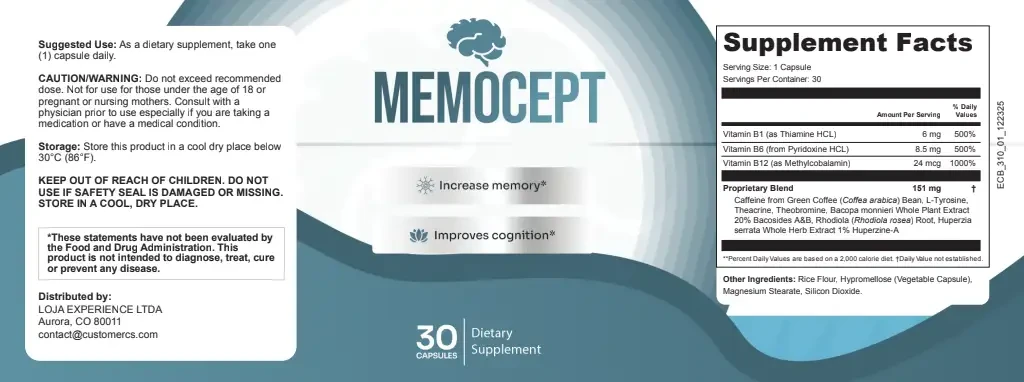
The panel we transcribed on September 3, 2026. Two botanicals carry a percentage. Rhodiola does not.
Ask for the percentage before you ask for the milligram. A rhodiola line with no percentage beside it cannot be mapped to either arm of the trial above, whatever the total blend weight says.
Compare two botanicals on the same label before you judge the category. If bacopa and huperzia both carry a percentage and rhodiola does not, that gap is printed evidence, not a guess.
Full Supplement Facts panel, all seven blend actives named, the checkout prices we read September 3, 2026, and the refund terms, empty bottles included.