The short answer: 2.0 g in the working-memory study people cite, and a condition attached to it
L-tyrosine dosage in the working-memory study on our file was 2.0 grams, given once to healthy adults.
The study, published in Cognitive, Affective & Behavioral Neuroscience in 2020, put it plainly: "2.0 g of dopamine's precursor L-tyrosine was administered to healthy young adults (N = 45) in a double-blind, placebo-controlled, within-subjects study."
Two grams is 2,000 milligrams. That is the scale the literature on this ingredient is written in.
Most focus, nootropic or energy blends write L-tyrosine in milligrams instead. Usually it sits inside one combined total, shared with several other actives.
That mismatch of units is the whole subject of this page.
Dose and study design per PMID 32133585 (Cognitive, Affective & Behavioral Neuroscience, 2020). Read via Europe PMC on September 4, 2026 for our Memocept file.
The condition the review put in its own conclusion, and why it is the whole answer
A 2015 review in the Journal of Psychiatric Research looked across the tyrosine-supplementation literature. It wrote its own conclusion with a condition built right into the same sentence.
"We conclude that TYR is an effective enhancer of cognition, but only when neurotransmitter function is intact and DA and/or NE is temporarily depleted."
Jongkees et al., Journal of Psychiatric Research, 2015, PMID 26424423Read that sentence in two halves. The first half is the part that gets quoted: tyrosine can enhance cognition.
The second half rarely travels with it. It says this works only when dopamine or noradrenaline is already running low, from stress or a demanding task.
The same review adds where that condition tends to show up: "TYR does seem to effectively enhance cognitive performance, particularly in short-term stressful and/or cognitively demanding situations."
And it states its own limit directly: "The potential of using TYR supplementation to treat clinical disorders seems limited."
A label cannot print a neurotransmitter test. What it can do is not ship the first half of that sentence without the second.
Both quotations verbatim and complete to their scoping clause, per PMID 26424423, read via Europe PMC on September 4, 2026.
The result nobody prints on a bottle: it helped the low scorers and hurt the high scorers
Go back to the 2020 working-memory study and read past the headline dose.
The effect it found was not one arrow pointing up for everyone who took 2.0 g.
"L-tyrosine had a selective, baseline-dependent effect only on gate opening ... low-performing subjects improved, whereas high-performing subjects were impaired on L-tyrosine."
PMID 32133585, Cognitive, Affective & Behavioral Neuroscience, 2020That is the opposite of the usual focus-label story. There, more of the ingredient is framed as more of the benefit.
Here, the same 2.0 g dose moved two groups in opposite directions. Which way it moved depended on where each person's working memory already sat.
A single bottle cannot know which group a buyer is in. And our record of this study names one dose only, 2.0 g. So we cannot say whether less would have been gentler on the high scorers.
What these two papers do not establish
- Neither paper tested a finished multi-ingredient blend. Both are about L-tyrosine on its own.
- Our file records a stated dose for only one of them: 2.0 g, in the 2020 within-subjects study. The 2015 paper is a review, and our record of it carries no dose at all.
- Nothing in either paper sets a minimum milligram floor for a blend to "count" as effective.
- Neither paper supports reading a bigger printed number, by itself, as a better result for a given person.
What this means for you: these are ingredient-level findings about a single compound at a stated dose. They are not a verdict on any finished product.
Both quotations per PMID 32133585, read via Europe PMC on September 4, 2026.
Grams against a blend total: the ten-second test for whether a label can even reach the studied scale
Before you read a single ingredient name, ask a faster question. Does the printed total even leave room for the studied dose?
One memory-blend label we read answers that question on its own.
| Where the number comes from | Amount | Note |
|---|---|---|
| Working-memory study dose | 2.0 g (2,000 mg) | L-tyrosine alone, single session, PMID 32133585 |
| One blend's entire printed total | 151 mg | Shared across seven named actives, per the brand's own label, read September 3, 2026 |
The panel we read prints one Proprietary Blend line at 151 mg. It carries seven named actives: caffeine from green coffee bean, L-tyrosine, theacrine, theobromine, a standardised bacopa extract, rhodiola root and a standardised huperzine-A extract.
No individual milligram is given for any of the seven. So no single active inside that line can exceed 151 mg.
Picture the impossible case: L-tyrosine is the entire blend, and the other six names contribute nothing. Even then, 151 mg is still less than one-thirteenth of the 2,000 mg used in the study.
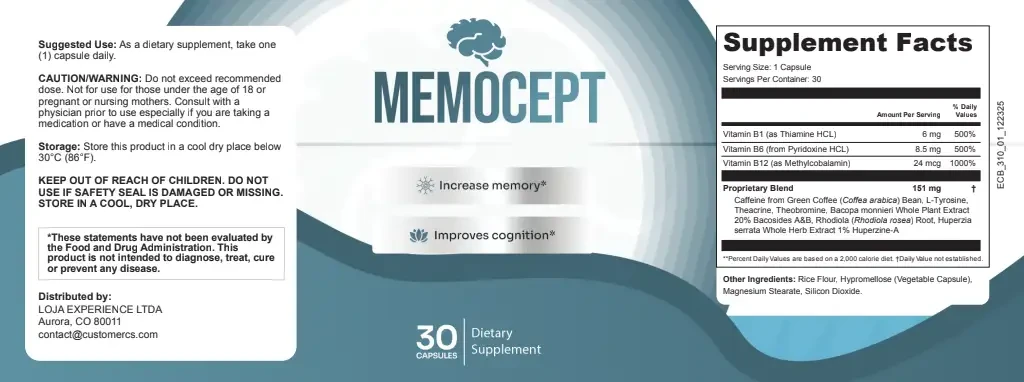
This is the blend line at the center of the arithmetic above: one combined weight, seven names, no split given for any of them.
The ten-second test does not need the rest of the label. Total blend weight against studied dose, in the same unit, is enough to see the gap.
Blend composition and total quoted from the brand's own label, read September 3, 2026, filed in our Memocept recon. Study dose per PMID 32133585.
Being named first in a blend is a position, not a dose
The order rule (21 CFR 101.36(c)(2)), where L-tyrosine sits on the label we read, and the page that explains the rule
On a Supplement Facts panel, ingredients inside a blend are printed in descending order by weight. That is a labeling rule, 21 CFR 101.36(c)(2), not a dose disclosure.
On the label above, L-tyrosine is not even first. It is second, right after caffeine from green coffee bean, inside that same 151 mg line.
Second place tells you tyrosine outweighs the five names after it. It tells you nothing about whether it is 5 mg or 75 mg of the total.
We wrote the full order-rule explanation on its own page: what a proprietary blend is, and what its order rule actually means. It covers what the rule does, and does not, let a maker claim.
This page's angle is narrower: the unit. Gram-scale studies against a milligram-scale line, no matter where any one name sits on it.
The window both papers point to: short, demanding, stressful tasks, not a daily habit
The 2015 review's "short-term stressful" line, the within-subjects design, what this evidence supports, and what it does not
Our file does not record either paper testing tyrosine as an every-morning habit.
The 2020 working-memory study used a within-subjects design: the same 45 people were tested under both tyrosine and placebo, at 2.0 g per tyrosine condition.
The 2015 review points at the same window. It found benefits showing up "particularly in short-term stressful and/or cognitively demanding situations." The link is a temporary dip in dopamine or noradrenaline, the kind a demanding task itself can cause.
That is a specific, short, high-demand scenario. It is not the same claim as "take this every day for sustained focus," which is how a focus-blend label usually frames its ingredients.
What this evidence supports
- A single 2.0 g dose of L-tyrosine alone, studied in one demanding cognitive task.
- A plausible mechanism tied to dopamine and noradrenaline depletion under stress.
- A published number you can compare a label's own printed dose against, when one is given.
What it does not support
- Daily, cumulative use at any dose, gram-scale or milligram-scale.
- A finished multi-ingredient blend, tested as a product, at any total weight.
- The idea that everyone responds the same way, given the baseline-dependent result above.
Study design per PMID 32133585. Review framing per PMID 26424423, both read via Europe PMC on September 4, 2026.
Two lines to check before you pay for a tyrosine product
Step one, find the unit and do the arithmetic; step two, find its position, then ignore it
In this order, before any brand argument starts.
Find the unit and do the arithmetic
Is L-tyrosine's amount printed alone, in grams or milligrams? Or is it sealed inside a combined blend total?
If it is a blend total, that total is the ceiling for every name inside it, tyrosine included. Compare that ceiling to 2,000 mg, the studied dose, in the same unit.
Find its position, then ignore it
Note where L-tyrosine sits in the ingredient list, first, second, wherever. Under 21 CFR 101.36(c)(2), that is a weight ranking, not a milligram figure.
Position alone cannot tell you whether the blend can reach a studied dose. Only the total weight, against the study's unit, can.
One blend where the arithmetic runs out
One memory panel in our files names L-tyrosine second inside a blend whose entire printed weight is 151 mg, shared with six other actives. That is the point where this arithmetic stops being theoretical.
What to do with a bottle like that, and two tips on totals and units
If you are holding a bottle like that, the objective is simple. Find the blend's total printed weight, and hold it against the gram-scale dose above, before you read another word of marketing copy.
Doing that first tells you, in ten seconds, whether the product can even reach the scale the tyrosine literature was built on. And it applies to every other name sharing that same total.
Write down the blend's one printed total before you read the ingredient names. That single number is the ceiling every name inside it has to share.
Convert everything to the same unit before comparing. A study printed in grams and a label printed in milligrams look closer than they are until you put both in milligrams.
The full label, the 151mg blend line, the checkout prices, and the refund terms we read, including the three different ways the seller's own documents start the 60-day clock.
Questions people also ask
What dose of L-tyrosine did the working-memory studies use?
2.0 g of L-tyrosine, given to 45 healthy young adults in a double-blind, placebo-controlled, within-subjects study (Cognitive, Affective & Behavioral Neuroscience, 2020, PMID 32133585).
Does L-tyrosine help everyone the same way?
No. The same trial found a baseline-dependent, opposite effect: low-performing subjects improved, while high-performing subjects were impaired on L-tyrosine (PMID 32133585).
Can a milligram-scale blend deliver a studied amount of L-tyrosine?
Not if the blend's entire printed weight is smaller than the studied dose. One label we read prints a 151mg Proprietary Blend shared across seven actives. Even in the impossible case that tyrosine were the whole blend, that is less than one-thirteenth of the 2.0 g used in PMID 32133585 (per the brand's own label, read September 3, 2026).
When did the papers have people take tyrosine?
In short, single-session, cognitively demanding or stressful tasks, not as a daily habit. A 2015 review (Journal of Psychiatric Research, PMID 26424423) concludes tyrosine helps particularly in short-term stressful and/or cognitively demanding situations. It adds one condition: only when neurotransmitter function is intact, and dopamine or noradrenaline is temporarily depleted.
If L-tyrosine is listed near the top of a blend, is that enough to go on?
No. Ingredient order on a Supplement Facts panel reflects descending weight, under 21 CFR 101.36(c)(2). That is not a dose. It says nothing about how many of the blend's milligrams that one active actually gets.
How we built this page
Sources, PMIDs, the dates we read them, and what we did not do
This is a unit-comparison page, not a lab test.
Every number on it comes from a document we read, on a date we print.
- The 2.0 g dose, the study design and the baseline-dependent result are quoted from PMID 32133585, read via Europe PMC on September 4, 2026.
- The "but only when" conclusion and its supporting sentences are quoted from PMID 26424423, read via Europe PMC on September 4, 2026.
- The 151 mg blend total, its seven names and their printed order come from the brand's own label. Read September 3, 2026, and filed in our Memocept recon.
- We did not test any product. We did not estimate a milligram figure for any ingredient a label does not itemise.
- Nothing here is medical advice. A new supplement while pregnant, nursing or on medication is a conversation with your doctor first.