The short answer, in one sentence a 2026 review already wrote
"Overall, supplementation has not shown consistent benefits in populations without overt clinical or biochemical B12 deficiency, with no clear improvements in fatigue, mood, cognition, or cardiovascular outcomes."
Nutrients, 2026 · PMID 42197057Memory is not named on its own; it sits inside "cognition," one of the four outcomes that sentence covers. The population is specific too: people without overt clinical or biochemical deficiency, which most people reading a memory-supplement label have never had checked.
Read via Europe PMC, September 4, 2026.
The full sentence, with the clause that scopes it
The review adds one clause right after that sentence, the part a headline would drop:
"Benefits, when reported, appear confined to selected subgroups (e.g., hyperhomocysteinemia or low-normal B12 status)."
Nutrients, 2026 · PMID 42197057Together, the two sentences do not say "B12 does nothing for memory." They say B12 has not shown a consistent benefit in people whose status was already fine, and where a benefit did turn up, it was in people who were not in that group.
Read via Europe PMC, September 4, 2026.
Where the review says low status is uncommon, and where it is not
"deficiency appears uncommon in general populations of high-income countries (~2%), but substantially more frequent in settings with limited access to animal-source foods or B12-fortified products (up to 69%)."
Nutrients, 2026 · PMID 42197057Around 2% in most high-income settings is the group the top-line finding, no consistent benefit, applies to. Up to 69% where animal-source foods or B12-fortified products are hard to get is a different population, and the one where reported benefits cluster. The review does not say which group you are in; only your own diet, health history and, where relevant, a doctor's read on your labs can.
The studied regimens do not compare to each other
"range from 0.02 to 1 mg/day orally and from 1 to 5 mg/week intramuscularly"
Nutrients, 2026 · PMID 42197057Our own arithmetic on that range, not the review's: 0.02 mg is 20 mcg, 1 mg is 1,000 mcg, beside a 24 mcg label line
That is the same order of magnitude as a 24 mcg B12 line on a label we reviewed elsewhere. We read that label from the vendor's own materials, September 3, 2026.
About 42 times larger than that same 24 mcg label line. Both are ends of the one oral range the review prints, not two separate studied doses.
Fifty times separates the floor of that oral range from its ceiling, and the intramuscular regimens are a different route again. No single "the studied dose" exists to hold any one label up against.
What a 1000% Daily Value line actually is: arithmetic on a small reference amount
A percentage on any Supplement Facts label is just an amount divided by a reference, times 100. The label itself hands us both numbers.
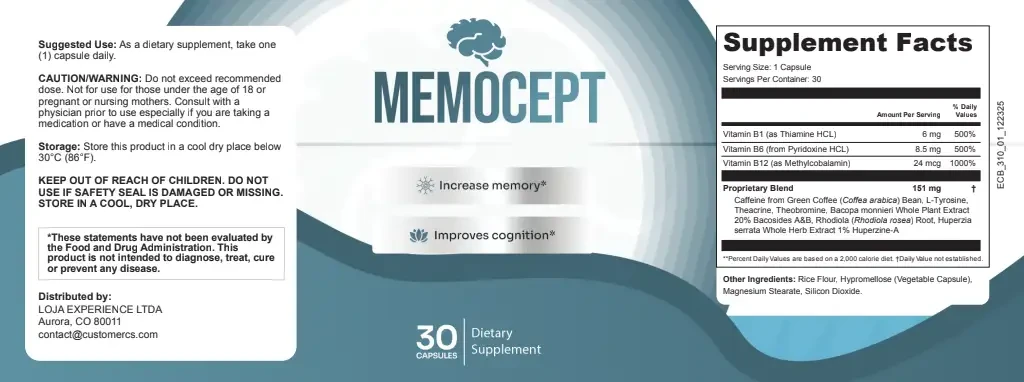
Memocept's own panel prints 24 mcg of B12 next to 1000%, read from the vendor's own materials September 3, 2026. Work the arithmetic backward: 24 mcg divided by 10 is 2.4 mcg. That small figure is the reference the label is measuring against.
That is the entire calculation. It is not a claim that ten times a normal need was studied for memory. A 1000% line and a "0.02 to 1 mg/day" study range are two different measuring sticks: one is arithmetic against a tiny label reference, the other is what researchers actually gave people, and the lowest oral dose tested already sits near that same 24 mcg figure.
B12 is one of the few brain-shelf ingredients that carries a Daily Value at all
We read this off a real label while building our Memocept review, from the vendor's own product materials, September 3, 2026. Its Supplement Facts panel itemizes three vitamins with a milligram figure and a percentage each: Vitamin B1 at 6 mg (500%), Vitamin B6 at 8.5 mg (500%), and Vitamin B12 at 24 mcg (1000%).
The seven actives behind one 151 mg total, the dagger symbol, and the rule behind it (21 CFR 101.36)
Seven other actives share the rest of the panel. They are caffeine from green coffee bean, L-tyrosine, theacrine, theobromine, a bacopa extract, a rhodiola root, and a huperzia serrata extract. They share one printed total, 151 mg. A single dagger symbol, reading "Daily Value not established," sits next to that shared line.
That is not a gap in one label. Under 21 CFR 101.36(b)(3)(iv), an ingredient with no established Daily Value gets the symbol and the footnote instead of a percentage. Most plant extracts and amino acids sit in that group.
So on a page like that, B12's percentage is the one number built on a shared, standardized yardstick.
Why the panel is worth reading even when the vitamin lines look generous
"Twelve products were selected from the 650 products being marketed for brain health."
"Eight (67%) had at least one ingredient listed on the Supplement Facts label not detected through analysis."
J Altern Complement Med, 2020 · PMID 32119795This study did not test the label above, or any product named on this page. It is category context, not an accusation aimed at one brand.
A well-itemized vitamin line and an unverified blend line can sit on the same piece of paper.
Read via Europe PMC, September 4, 2026. The product named in the section above was not one of the 12 products this study analyzed.
Two honest checks before you buy a B12-for-memory product
Check 1, your own status. Check 2, the percentage math. And two plain options if you would rather not guess
Do these two things before the percentage does the deciding for you
- Check 1
Ask about your own status first, not the bottle. Do you already eat animal-source foods regularly, with no absorption issue? Then the review's own finding says you likely fall in the group where the review found no consistent benefit for cognition.
- Check 2
Read the percentage math before the marketing copy. A 1000% line means ten times a 2.4 mcg reference, nothing more. It says nothing about your own status, or whether that dose was tested for memory at all.
Would rather not guess at either check? Two plain options exist. A doctor-ordered blood test settles the status question directly. A standalone B12 supplement prints its own microgram amount outside any blend.
One panel where B12 is fully counted and the rest of the bottle is not
One memory panel in our files prints B12 exactly this way: 24 mcg, 1000% of the Daily Value. Then it puts seven more actives behind one shared 151 mg total.
Look for the dagger symbol next to an ingredient name.
It is the label telling you, in writing, that no Daily Value exists for that ingredient. It is not the maker skipping a step.
Count every name inside a shared blend line before comparing it to any studied dose.
Seven names sharing 151 mg means no single one can exceed that ceiling, no matter how the marketing around it reads.
The full label panel, the blend total, and the guarantee terms, each dated September 3, 2026.
Questions people also ask
Does taking extra vitamin B12 improve memory?
Not consistently, if your B12 status is already normal. A 2026 review in Nutrients (PMID 42197057) found that supplementation has not shown consistent benefits in people without clinical or biochemical B12 deficiency, with no clear improvement in cognition. Reported benefits were confined to subgroups such as low-normal B12 status.
What does 1000% of the Daily Value of B12 actually mean?
It means the label's own two numbers imply a small reference amount. Memocept's panel prints 24 mcg of B12 at 1000%, so working backward, 24 mcg divided by 10 gives a 2.4 mcg reference. It is arithmetic against that small number, not evidence the dose was tested at a memory-relevant level.
Which people are most likely to have low B12 status?
The same 2026 review puts deficiency at about 2% in general populations of high-income countries. In settings with limited access to animal-source foods or B12-fortified products, it runs far higher, up to 69%.
Should I ask for a B12 blood test?
The review points to guidance from major health authorities against routine testing in people with no symptoms and no risk factors. A test makes more sense if you have symptoms or a known risk factor. That is a conversation for your doctor, not a default step.
Is a larger B12 number on a supplement label a better product?
No. A bigger percentage is still arithmetic against the same small 2.4 mcg reference. It tells you the label cleared that reference by a wide margin. It does not tell you the dose was studied for memory, or that it will do anything for someone whose B12 status is already adequate.
How we built this page
This is a source-reading page. It is not a lab test, and it is not medical advice.
- Nothing on this page describes vitamin B12 as treating, curing, or preventing any disease, memory loss included.
- A new supplement is worth a conversation with a doctor first, at any dose named here. This matters most if you are pregnant, nursing, or on medication.
Sources and dates: PMID 42197057, PMID 32119795, the Memocept label, and which arithmetic is ours
- The main finding, its scoping clause, and the prevalence and dose ranges are from PMID 42197057, Nutrients, 2026. Read via Europe PMC, September 4, 2026.
- The category context on brain-health products is from PMID 32119795, Journal of Alternative and Complementary Medicine, 2020. Read via Europe PMC, September 4, 2026. It names no product on this page.
- The 2.4 mcg reference behind the 1000% figure is our own arithmetic on Memocept's own label (24 mcg divided by 10), not a separately sourced number.
- The Memocept label figures were read from the vendor's own product materials on September 3, 2026, for our Memocept review.
- The arithmetic comparing label figures to studied ranges is ours, built from the numbers above, and is not itself a study finding.