The short answer: 8 weeks, 12 weeks, one year, and 72 weeks
Four numbers cover almost every trial that has actually been run.
Eight weeks is when the one recent trial with a positive result first separated from placebo.
Twelve weeks was that same trial's full length.
One year is how long a 225-man trial ran, and it never separated from placebo at all.
Seventy-two weeks is how long a dose-escalation trial ran, at up to three times the standard amount, and it landed slightly worse than placebo.
The four clocks as cards, each with its trial size, dose and PMID (32884683, 16467543, 21954478)
The one recent trial with a positive result. The IPSS difference against placebo reached significance at this point.
320 mg a day, 40 analyzed men, 20 per group. A small, placebo-controlled study in healthy Japanese men.
225 men, 320 mg a day. The AUASI difference against placebo was 0.04 point.
369 men escalated to 960 mg a day. The extract group improved less than placebo did.
The one recent trial with a positive signal, and the week it appeared
Ishii I et al. ran a randomized, double-blind, placebo-controlled study of saw palmetto fruit extract in Japanese men, published in Food Science & Nutrition in 2020.
Forty-four men were randomized. Forty were analyzed, twenty per group.
The dose was 320 mg a day, for 12 weeks.
The IPSS score dropped in the saw palmetto group. That drop did not become statistically significant against placebo until week 8 of the 12-week run.
The trial's own conclusion, quoted, and the two caveats next to it: 40 analyzed men, and a healthy Japanese population (PMID 32884683)
One trial on file reported a real difference from placebo, and it is the most recent one.
"The consumption of saw palmetto fruit extract capsule for 12 weeks relieved subjective symptoms related to urination, which suggests improvement of the issue in healthy Japanese men."
Ishii et al., Food Science & Nutrition, 2020 · PMID 32884683Two details belong right next to that quote.
Forty analyzed men is a small trial. And "healthy Japanese men" is a specific population, not a stand-in for everyone reading this page.
Ishii I et al., Food Science & Nutrition, 2020. PMID 32884683, read September 3, 2026.
The one-year trial that never separated from placebo
The dose most pages repeat, 320 mg a day, traces to a different trial: a full year, 225 men. For the dose question on its own, see how much saw palmetto per day.
The dose was 320 mg a day, split as 160 mg twice a day, for a full year.
The result: an average difference of 0.04 point on the AUA Symptom Index, with a confidence interval that crossed zero on both sides (95% CI, -0.93 to 1.01).
Bent 2006 in the New England Journal of Medicine, quoted: no improvement in symptoms or objective measures, and no difference in urinary flow (PMID 16467543)
Bent S et al. ran a randomized, double-blind trial of saw palmetto extract, published in the New England Journal of Medicine in 2006.
Maximum urinary flow did not differ between groups either.
"In this study, saw palmetto did not improve symptoms or objective measures of benign prostatic hyperplasia."
Bent et al., New England Journal of Medicine, 2006 · PMID 16467543A full year is far longer than the 12-week trial above. More time did not become more effect.
Bent S et al., New England Journal of Medicine, 2006. PMID 16467543, read September 3, 2026.
Seventy-two weeks, three times the dose, still no separation
Barry MJ et al. ran the CAMUS trial, published in JAMA in 2011: 369 men, 72 weeks, with the dose escalating from 320 mg a day up to 960 mg a day.
The AUA Symptom Index fell 2.20 points in the saw palmetto group and 2.99 points in the placebo group. Placebo moved more.
Barry 2011 in JAMA, quoted: increasing doses did not reduce symptoms more than placebo; the longest and highest-dose run on file (PMID 21954478)
"Increasing doses of a saw palmetto fruit extract did not reduce lower urinary tract symptoms more than placebo."
Barry et al., JAMA, 2011 · PMID 21954478This is the longest run on file, and the highest dose on file. Neither variable produced a bigger effect than placebo.
Barry MJ et al., JAMA, 2011. PMID 21954478, read September 3, 2026.
None of these four trials set a timeline for one person
- Week 8 is a group-average finding from a 40-person trial, not a promise that any one reader will notice a change by that week.
- No trial on file found that more time produced a bigger effect. The one-year trial and the 72-week, triple-dose trial each landed at, or worse than, placebo.
- The one positive signal comes from a small, specific population. Nothing in this file tests whether the same week-8 result repeats in a different group of men.
- None of these four trials tested a finished multi-ingredient formula. They tested saw palmetto on its own, against placebo, and no study in our file tested the product this page links to.
What this means for you: these are real numbers from real trials. None of them is a personal countdown clock.
What the "4 to 12 weeks" you read everywhere is measuring
Tacklind J et al. pooled 32 trials and 5,666 men in a Cochrane systematic review, published in 2012.
Those 32 trials ran anywhere from 4 weeks to 72 weeks. Pooled across all of them, the difference on the AUA scale was 0.25 point (95% CI, -0.58 to 1.07).
Cochrane 2012, quoted: double and triple doses did not improve flow or prostate size; and why "4 to 12 weeks" is the front end of a 4-to-72-week range with the tail cut off (PMID 23235581)
A lot of pages compress this whole question into a single window, something like four to twelve weeks.
"Serenoa repens, at double and triple doses, did not improve urinary flow measures or prostate size in men with lower urinary tract symptoms consistent with BPH."
Tacklind et al., Cochrane Database of Systematic Reviews, 2012 · PMID 23235581So the "4 to 12 weeks" shorthand looks like the front end of that 4-to-72-week range, with the tail cut off, the tail being exactly where three of our four trials above sit, and exactly where none of them separated from placebo.
Length of run is not what separates the results in this file. What was actually tested does.
Tacklind J et al., Cochrane Database of Systematic Reviews, 2012. PMID 23235581, read September 3, 2026.
A bottle is a clock: servings per container against the calendar
Per Protoflow's own label, read September 3, 2026, the panel prints "Servings Per Container: 30" and "Suggested Use: As a dietary supplement, adults take two capsules daily with water."
Thirty servings, one serving a day, is thirty days. One bottle is a thirty-day clock.
The one positive trial above ran 12 weeks, 84 days. At 30 days a bottle, that is three bottles, with a few days to spare.
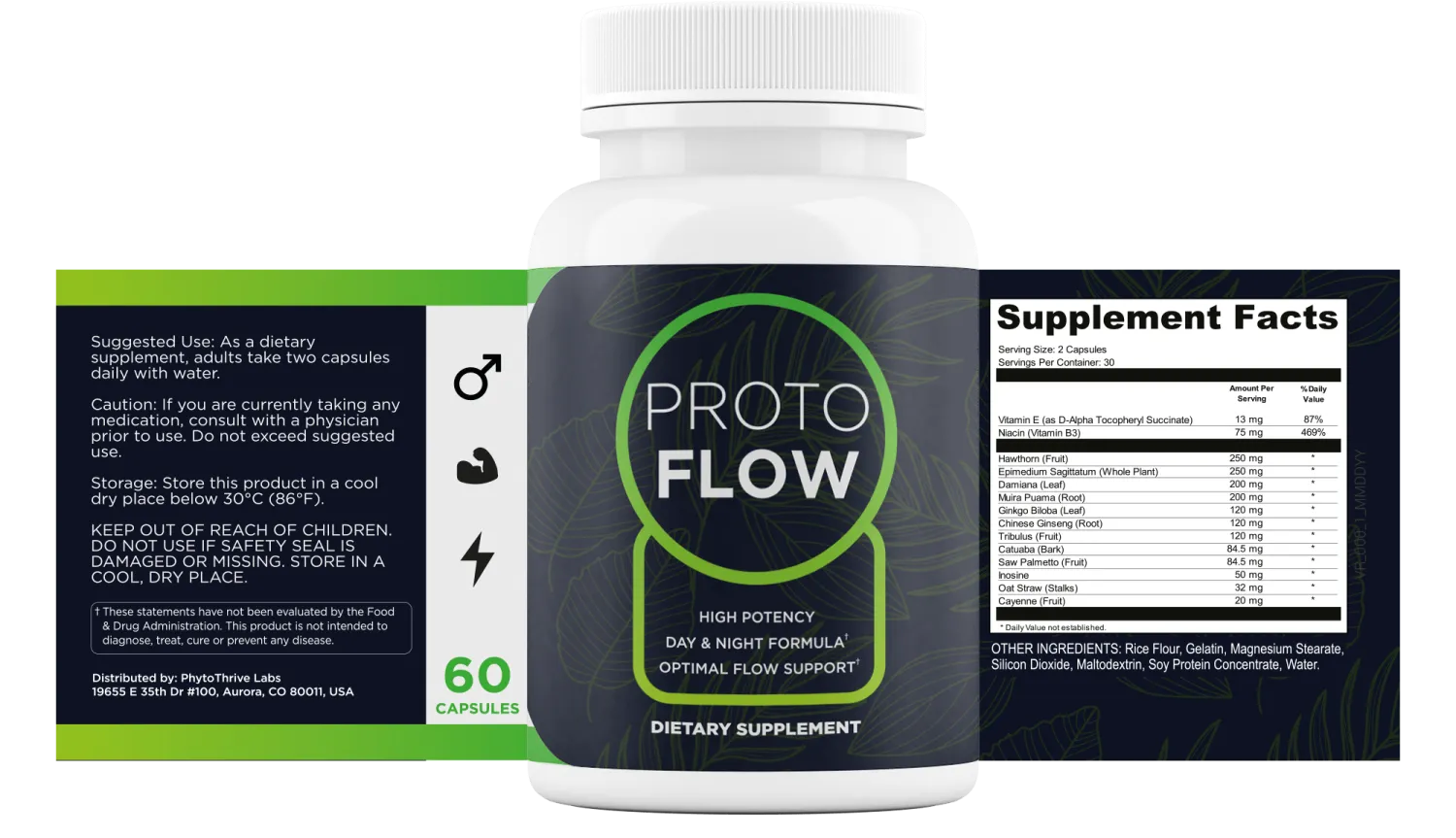
Protoflow's own label, read September 3, 2026.
Servings Per Container: 30. Suggested Use: two capsules a day.
Thirty servings at one serving a day is thirty days per bottle, by our own arithmetic, not a number printed on the panel.
The three pack sizes on the vendor's order form (2, 3 and 6 bottles: $167.95, $177.00, $294.00, read Sep 3, 2026) against the 12-week and 72-week clocks
The vendor's own order form, read the same day, sells three pack sizes.
| Pack | Days at 2 capsules/day | Covers | Order-form total |
|---|---|---|---|
| 2 bottles | 60 days | Short of the 12-week (84-day) trial above | $167.95 |
| 3 bottles | 90 days | Covers the 12-week trial, with days to spare | $177.00 |
| 6 bottles | 180 days | Past 12 weeks; still short of the 72-week trial (about 17 bottles) | $294.00 |
Days-per-pack and the 17-bottle figure are our own arithmetic (30 servings per container, 2 capsules a day). Pack totals: vendor order form, read September 3, 2026. Nothing here is a claim that a pack size produces a result.
Before you start counting weeks, write down the dose
Per Protoflow's own label, read September 3, 2026, one line reads "Saw Palmetto (Fruit) 84.5 mg" per two-capsule serving.
84.5 mg is 26.4% of the 320 mg a day used in all four trials above.
The "Fruit" line against the extract the trials tested, what writing the dose down gives you, and what it still does not
One more detail is worth naming. The label's line says "Fruit." The trials above tested an extract, and two of them (Barry 2011 and Ishii 2020) call it a saw palmetto fruit extract. Whether the ingredient on this panel is the same preparation those trials used is not something a calendar can settle.
What writing down the dose gives you
- A number you can put next to 320 mg, the amount common to every trial in this file.
- A way to know, before day one, whether a bottle even carries that dose.
- A stopping point: the week-8 marker from the one positive trial, instead of an open-ended wait.
What it still does not give you
- Proof that a fruit-labeled ingredient behaves like the extract the trials tested.
- Any guarantee that reaching 320 mg a day reproduces a result seen in 40 people.
- A reason to expect a longer wait to work better. The two longest trials on file never separated from placebo at all.
Three alternatives when the panel dose is smaller than the trial dose, and where the 26.4% figure comes from
When the dose on the panel is smaller than the trial dose, three honest alternatives exist.
A single-ingredient product whose own line states 320 mg a day of an extract, the dose used in all four trials above.
A different formula that names its own milligrams for saw palmetto, rather than folding it into a blend.
Or a conversation with a doctor about what a realistic timeline looks like before you start counting anything.
Label figures: Protoflow's own label, read September 3, 2026. The 26.4% figure is our own arithmetic against the 320 mg/day dose common to the four trials cited on this page.
A three-step check before you start counting
Find the milligram number
Is saw palmetto on its own line, with its own dose? Or only named inside a blend total?
Compare it to 320 mg a day
That is the dose common to every trial cited on this page, positive or not.
Start the calendar
Servings per container divided by the daily serving is how many days one bottle actually buys you.
One label where we did the arithmetic
A clock only means something if you can name what is on it.
We ran exactly this check on a bottle that names saw palmetto by the milligram, alongside thirteen other dosed actives on the same panel.
Servings per container divided by the daily serving is the number of days one bottle buys you.
That is the honest unit of a trial run, not the pack size on the checkout page.
Write the start date and the dose on the bottle itself.
A dose you cannot state later is a run you cannot judge later.
The panel, the 30 servings per bottle, and what each pack size actually charges at checkout, each dated.
Questions people also ask
When did saw palmetto separate from placebo in the trials?
In the only recent trial with a positive signal, at week 8. Ishii 2020 (PMID 32884683) ran 320 mg a day for 12 weeks in 40 analyzed men and the IPSS difference reached significance at the eight-week point.
Is four weeks long enough to judge saw palmetto?
The trials that reported a signal did not see one that early, and the trials that ran far longer never reported one at all. Cochrane 2012 (PMID 23235581) pooled runs of 4 to 72 weeks to a 0.25 point difference.
Do longer trials show a bigger effect?
No. The one-year trial (PMID 16467543) landed at 0.04 point and the 72-week trial (PMID 21954478) landed slightly in favour of placebo.
How many bottles is a twelve-week run?
On a panel with 30 servings per container and a two-capsule daily serving, one bottle is 30 days, so twelve weeks is three bottles.
Does a higher dose work faster?
The only trial that escalated the dose, to three times the standard, reported no improvement in symptoms beyond placebo across 72 weeks.
How we built this page
This is a source-reading page. It is not a lab test, and it is not medical advice.
Every source with the date we read it, which figures are our own arithmetic, and the doctor-first note
- The week-8 finding and its trial details come from PMID 32884683, read September 3, 2026.
- The one-year trial and its result come from PMID 16467543, read September 3, 2026.
- The 72-week, dose-escalation trial comes from PMID 21954478, read September 3, 2026.
- The pooled, 32-trial range comes from PMID 23235581, read September 3, 2026.
- Protoflow's label panel and Suggested Use line were read from the vendor's own materials on September 3, 2026, for our Protoflow review.
- The three order-form totals were read from the vendor's own checkout the same day, for the same review.
- Any per-day, per-bottle, or percentage-of-320-mg figure on this page is our own arithmetic on the numbers above, not a number any single source printed as such.
- Starting or stopping any supplement, at any dose named on this page, is worth a conversation with a doctor first, especially if you are pregnant, nursing, or on medication.