The short answer: 320 mg a day is a trial dose, not a recommendation
320 milligrams a day is the number behind almost every saw palmetto product on the market.
It is not a government recommendation and it carries no FDA Daily Value. It is the dose two of the largest randomized trials in our file used, and a systematic review pooling 32 trials and 5,666 men found no meaningful difference from placebo at that dose or higher.
Used in the two largest randomized trials in our file on saw palmetto for urinary symptoms, one for a year, one escalated over 72 weeks.
Mean difference on the AUA symptom scale versus placebo (95% CI -0.58 to 1.07), across 5,666 men.
Saw Palmetto (Fruit), per two-capsule serving, on Protoflow's own published panel. About 26.4% of the trial dose above.
Vendor's own label, read Sep 3, 2026
Where the 320 mg comes from: one year, 225 men, and a difference of 0.04 point
The number traces to a single well-known trial, often called STEP: 225 men, randomized between saw palmetto extract and a matching placebo. The dose was 320 mg a day, split as 160 mg twice daily, for one full year.
After a year, the difference between the saw palmetto group and the placebo group on the AUA Symptom Index was 0.04 point.
Bent 2006, quoted: no improvement in symptoms or objective measures, no difference in urinary flow either (PMID 16467543)
Symptoms were scored on the American Urological Association Symptom Index (AUASI), the validated self-report score both trials used.
There was no difference in maximum urinary flow rate either.
"In this study, saw palmetto did not improve symptoms or objective measures of benign prostatic hyperplasia."
Bent S et al., New England Journal of Medicine, 2006 · PMID 16467543320 mg a day is a real number from a real, well-designed trial.
It is also the dose that trial's own authors say did not work, at least not on the two measures they set out to test.
Bent S et al., "Saw palmetto for benign prostatic hyperplasia," New England Journal of Medicine, 2006. PMID 16467543, read September 3, 2026.
What happened when the dose was tripled
One trial tested exactly that, known as CAMUS.
369 men took a saw palmetto extract for 72 weeks. The dose started at 320 mg a day. It rose in steps, all the way to 960 mg a day, three times the first trial's dose.
The AUASI score fell 2.20 points in the saw palmetto group.
It fell 2.99 points in the placebo group.
The placebo group improved slightly more than the group taking triple the standard dose.
Barry 2011, quoted: increasing doses did not reduce symptoms more than placebo (PMID 21954478)
"Increasing doses of a saw palmetto fruit extract did not reduce lower urinary tract symptoms more than placebo."
Barry MJ et al., JAMA, 2011 · PMID 21954478So the honest answer to "should I take more?" already has a trial behind it, and the trial's answer is no.
Barry MJ et al., "Effect of increasing doses of saw palmetto extract on lower urinary tract symptoms," JAMA, 2011. PMID 21954478, read September 3, 2026.
Thirty-two trials and 5,666 men, pooled
The Cochrane Collaboration pooled 32 randomized trials of Serenoa repens (saw palmetto's botanical name), covering 5,666 men, with treatment lengths from 4 to 72 weeks.
The pooled mean difference on the AUA symptom scale was 0.25 point, with a 95% confidence interval of -0.58 to 1.07. That interval crosses zero, so the pooled result cannot rule out no effect at all.
Tacklind 2012, quoted: double and triple doses did not improve flow measures or prostate size (PMID 23235581)
A single trial, however large, can still be an outlier. That is what a systematic review is for.
"Serenoa repens, at double and triple doses, did not improve urinary flow measures or prostate size in men with lower urinary tract symptoms consistent with BPH."
Tacklind J et al., Cochrane Database of Systematic Reviews, 2012 · PMID 23235581Tacklind J et al., "Serenoa repens for benign prostatic hyperplasia," Cochrane Database of Systematic Reviews, 2012. PMID 23235581, read September 3, 2026.
Neither the standard dose nor a tripled one is a proven fix
Three separate readings on saw palmetto for urinary symptoms, one trial, one dose-escalation trial, and one 32-trial pool, land in roughly the same place.
- No source in our file shows 320 mg a day outperforming placebo on a validated symptom scale.
- The one trial that tried a higher dose (960 mg a day) did not find that "more" helped either.
- None of these trials tested a multi-ingredient formula. They tested saw palmetto extract, on its own, against placebo.
What this means for you: 320 mg is a real, well-studied number. It is not, on the evidence we read, a number proven to change symptoms.
"Fruit" is a plant part, not a concentration, and the panel does not always say which
Protoflow's published label lists saw palmetto by name and by milligram: "Saw Palmetto (Fruit), 84.5 mg" per two-capsule serving. 84.5 mg is about 26.4% of the 320 mg used in every trial above.
The word "Fruit" matters as much as the number.
Why "Fruit" is not "extract": what Bent 2006 and Barry 2011 actually gave, and what the panel does not have to say
We read a published prostate-formula label, from Protoflow, that lists saw palmetto by name and by milligram, which already puts it ahead of many blends that hide the number entirely.
Every trial cited on this page tested an extract, a concentrated, processed form: Bent 2006 gave 160 mg of saw palmetto extract twice a day, and Barry 2011 calls the preparation it tested a saw palmetto fruit extract.
A line that reads "Fruit" names a plant part, not a concentration. The panel does not say whether it is the same preparation the trials used, and it does not have to.
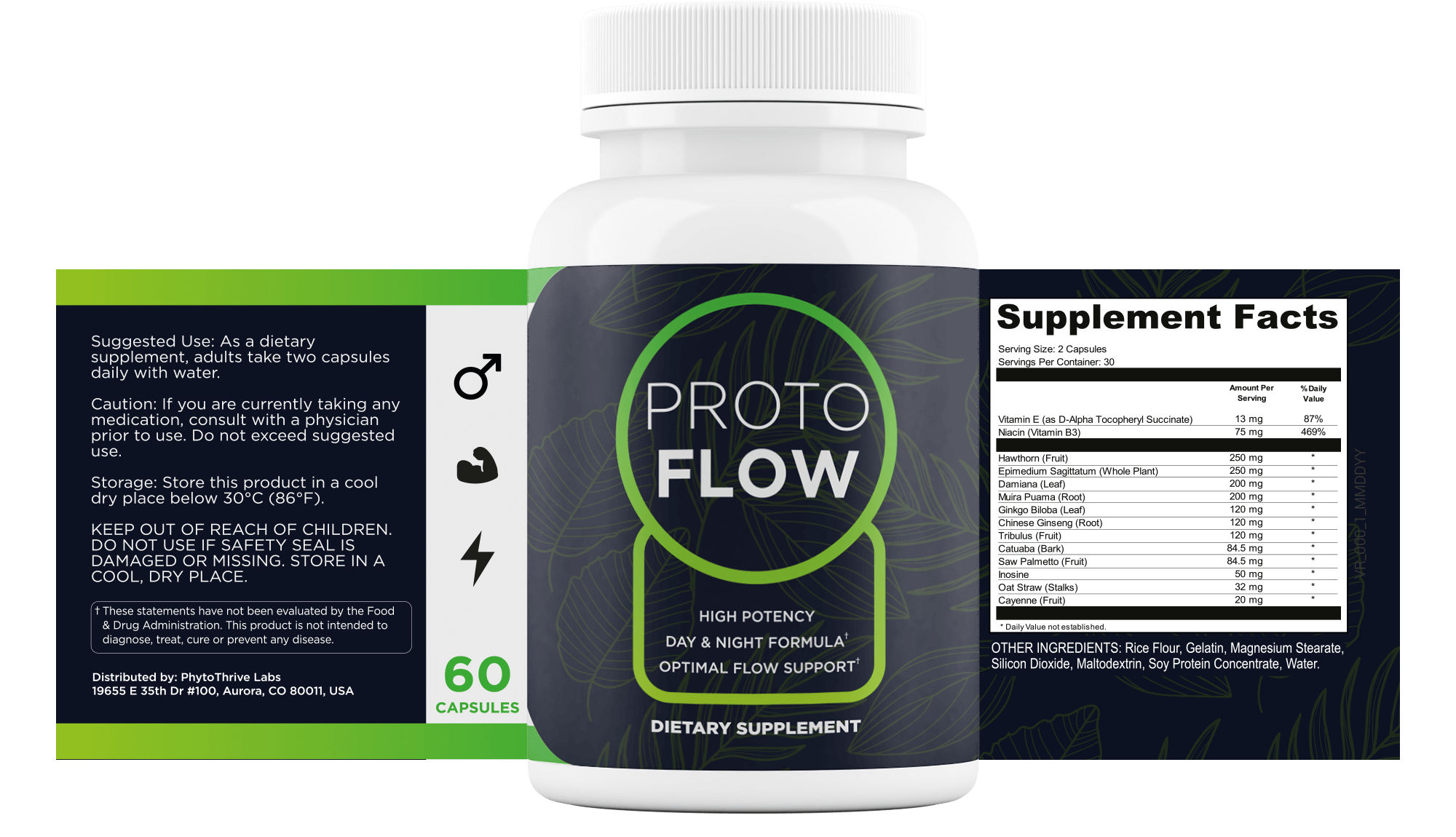
Protoflow's own label panel, read September 3, 2026.
Saw Palmetto (Fruit) is one of 14 dosed actives on the panel, at 84.5 mg per two-capsule serving.
No blend total hides this number: every line on this panel carries its own milligram figure. The word "Fruit," and the 84.5 mg amount, are what they are.
Saw palmetto has no Daily Value, so the line carries an asterisk instead
Instead of a percentage, the "% Daily Value" column shows an asterisk pointing to a footnote. That is not a maker skipping a step. It is a federal labeling rule, applied because no Daily Value exists for saw palmetto.
The rule quoted (21 CFR 101.36), how Protoflow's own panel follows it, and the same asterisk on boron
"Other dietary ingredients shall bear a symbol (e.g., an asterisk) in the column under the heading of '% Daily Value' that refers to the same symbol placed at the bottom of the nutrition label and followed by the statement 'Daily Value not established.'"
21 CFR 101.36(b)(3)(iv), via govinfo.govProtoflow's own panel follows the rule exactly: the Saw Palmetto (Fruit) line carries an asterisk, and the footnote at the bottom of the panel reads "* Daily Value not established," read from the label September 3, 2026.
Saw palmetto is not the only ingredient on the bench that carries this asterisk instead of a percentage; boron does too, and for the same reason: see how much boron per day.
So when a saw palmetto line shows no percentage, that is the labeling rule working as written, not a hint about quality either way.
The serving size decides every number above it
Protoflow's own panel sets Serving Size at 2 Capsules, with 30 servings per container, and its Suggested Use line matches: "adults take two capsules daily with water," read from the label September 3, 2026.
Why the serving size line comes first: a panel written per capsule next to a two-capsule instruction doubles every number on it
Every milligram figure on a Supplement Facts panel is an "amount per serving," and the serving is defined by the maker, not by you.
That consistency matters, because it is not guaranteed on every label.
Picture a panel written per single capsule, sitting next to separate instructions to take two. That doubles every milligram figure printed above it, saw palmetto included.
Reading the serving size line first, before any amount, is the only way to know which number you are actually looking at.
A thirty-second check before you buy, and what we think of the ingredient itself
Find the word
Does the line say "extract," or does it say "Fruit" or "berry powder"? Every trial on this page tested an extract, not a plain plant-part line.
Find the number
Compare the milligram figure to 320. Protoflow's own line, for reference, reads 84.5 mg.
Find the serving
Check the panel's serving size against the suggested use on the same label. One capsule and two capsules are not the same number.
What saw palmetto has going for it (32 trials, 5,666 men of published data) and what the same reading does not support (no meaningful difference from placebo at 320 or 960 mg a day)
What saw palmetto has going for it
- Thirty-two randomized trials and 5,666 men tested against placebo, which is more published data than most botanical ingredients carry on this bench.
- When a label prints a real milligram figure, it is at least comparable to a published trial dose, unlike an ingredient with no dosed literature at all.
What the same reading does not support
- The two largest individual trials in our file, and the pooled review of all 32, found no meaningful difference from placebo at 320 mg a day.
- Tripling the dose to 960 mg a day did not close that gap either.
- A "Fruit" line, like Protoflow's 84.5 mg, is a different input than the extract every cited trial used, on top of being about a quarter of that trial dose.
Three alternatives if the number on a bottle does not satisfy you
If the number on a bottle does not satisfy you, three honest alternatives exist.
A single-ingredient product that states 320 mg a day of an extract, the dose the trials above used. It still does not match a proven benefit, per those same trials.
A multi-ingredient formula that doses every active on its own line, the way Protoflow's panel does. Each ingredient's amount, saw palmetto included, can then be checked against its own published dose.
Or a conversation with a doctor about the underlying symptom itself. The best-controlled evidence here found saw palmetto did not outperform placebo, at any dose tested.
One label where we did the arithmetic
You now have a number worth carrying to a label: 320 mg, and the two words that decide whether a panel is handing it to you.
We ran that check on a prostate formula whose entire panel is published and dosed, fourteen actives with a milligram on every line, and whose saw palmetto line reads 84.5 mg per two-capsule serving.
Read the serving size line before the amounts column.
A panel written per two capsules, read as if it were per capsule, halves every number on it.
Check whether the line says "extract" or "Fruit."
The 320 mg in every trial above was an extract. A fruit powder line is a different input, whatever the milligram figure next to it.
The full panel, the 84.5 mg line, and the arithmetic against 320 mg, each dated.
Questions people also ask
Is 320 mg of saw palmetto a day the right amount?
It is the amount the trials used, not an amount anyone recommends. Bent 2006 (PMID 16467543) ran 320 mg a day for a year in 225 men and found a 0.04 point difference on the AUASI against placebo.
Does taking more saw palmetto do more?
The one trial that tested that escalated to 960 mg a day for 72 weeks (Barry 2011, PMID 21954478) and the placebo group moved slightly more, -2.99 points against -2.20.
Why is there no percent Daily Value next to saw palmetto?
Because no Daily Value has been established for it, so the panel prints an asterisk and the footnote "Daily Value not established" instead. The milligram figure is the only number the line gives you.
Is berry powder the same as saw palmetto extract on a label?
No. The trials above tested an extract; Barry 2011 calls it a saw palmetto fruit extract. A line that reads "Fruit" names a plant part and the panel does not have to tell you how the two compare.
Should saw palmetto be taken with food?
Nothing we read today fixes a time of day. What the trials do fix is a split: the 320 mg in PMID 16467543 was given as 160 mg twice daily.
How we built this page
This is a source-reading page. It is not a lab test, and it is not medical advice.
Every source with the date we read it, and the doctor-first note
- The STEP trial dose and its result come from PMID 16467543, read September 3, 2026.
- The dose-escalation trial and its result come from PMID 21954478, read September 3, 2026.
- The 32-trial pooled review comes from PMID 23235581, read September 3, 2026.
- The Daily Value rule is quoted from 21 CFR 101.36, read via govinfo.gov on September 3, 2026.
- Protoflow's label panel, including the 84.5 mg Saw Palmetto (Fruit) line, the serving size, and the asterisk footnote, was read from the vendor's own published label on September 3, 2026, for our Protoflow review.
- A new supplement, at any dose named on this page, is worth a conversation with a doctor first, especially if you are on medication.