The short answer: no RDA exists, a 1 to 13 mg safe range does, and the ceiling is 20 mg
Four numbers answer this question honestly. None of them is a government-set recommendation.
The Food and Nutrition Board looked at boron and found nothing solid enough to set an RDA, an AI, or an EAR.
In place of a recommendation, the World Health Organization describes an acceptable safe range: 1 to 13 mg a day for adults.
Above that range sits a hard ceiling: 20 mg a day, the same figure for men, women, pregnancy, and lactation.
A normal diet already supplies 0.87 to 1.35 mg a day, median, comfortably inside the WHO range on its own.
No RDA also means no Daily Value on a label. An asterisk stands in its place, and we get to that further down.
The Food and Nutrition Board found the data insufficient to derive any of the three.
Institute of Medicine, 2001
An acceptable safe range of boron intake for adults, by the World Health Organization's own estimate.
The Tolerable Upper Intake Level, row "19+ years", the same for men, women, pregnancy, and lactation.
What US survey data shows adults already get from food, before any supplement.
All four figures come from NIH's Office of Dietary Supplements fact sheet on boron, read and cited section by section below, September 3, 2026.
The sentence the Food and Nutrition Board actually wrote
Most nutrients with a recommendation trace back to one committee: the Food and Nutrition Board, part of the Institute of Medicine.
For boron, that committee looked at the evidence in 2001, and stopped.
"The FNB found the existing data insufficient to derive an RDA, AI, or EAR for boron."
Institute of Medicine, 2001, via NIH ODS Boron: Fact Sheet for Health Professionals, read September 3, 2026What declining all three means, and why it was not a safety verdict
That is three separate kinds of recommendation, declined at once.
No Recommended Dietary Allowance. No Adequate Intake. No Estimated Average Requirement.
The reason was not that boron looked unsafe. It was that the human data did not clear the bar the committee sets before it will name any number.
So there is no percentage to check a dose against, and no shortcut answer to "how much boron per day." Four other numbers fill that gap instead, one section at a time.
What a normal diet already supplies
Before any supplement, food already supplies boron. The federal fact sheet puts a number on that, not a list of foods.
The fact sheet's 0.87 to 1.35 mg/day line, and what a 5 mg dose is next to it
"Median dietary boron intakes range from 0.87 to 1.35 mg/day in adults."
NIH ODS Boron: Fact Sheet for Health Professionals (NHANES III 1988-1994, CSFII 1994-1996), read September 3, 2026That range matters for one reason. It turns any supplement dose into a multiple of what a plate already gives you, not a number floating on its own.
A 5 mg supplement dose, next to a 0.87 to 1.35 mg diet, is roughly four times what an average adult already eats in a day. The two source figures are NIH's own; the "roughly four times" comparison is our arithmetic, not theirs.
The 20 mg ceiling, and who it applies to
One boundary exists on the high side: 20 mg a day.
It comes from the same kind of Tolerable Upper Intake Level table used for zinc, vitamin D, and dozens of other nutrients.
Tolerable Upper Intake Level, row "19+ years": 20 mg a day, listed the same for men, women, pregnancy, and lactation.
NIH ODS Boron: Fact Sheet for Health Professionals, UL table, read September 3, 2026No group gets a different ceiling. Nothing in the fact sheet suggests that getting closer to 20 mg does anything useful.
A ceiling is a stop sign, not a target. The WHO's own 1 to 13 mg safe range already sits well under it, with room to spare.
The testosterone question, and the one human supplementation trial we could read
Boron shows up online mostly for one reason: testosterone.
We looked for a human trial that tested boron supplementation, on its own, in men. One came up.
Green NR and Ferrando AA gave 19 male bodybuilders 2.5 mg of boron a day for seven weeks, then measured plasma boron and hormone levels against a placebo group.
"Boron supplementation affects these variables not at all."
Green NR & Ferrando AA, Environmental Health Perspectives, 1994, PMID 7889885, read September 3, 2026Both groups gained testosterone over the seven weeks, in roughly equal amounts. The trial's own conclusion is that the boron did not account for it.
One small trial in one narrow group is not a verdict on boron
Nineteen men already lifting weights, over seven weeks, is a specific study, not a population.
- It does not say boron raises testosterone in a general population. The one trial we found reported no isolated effect.
- It does not say boron lowers testosterone either. The measured change appeared equally in the boron and the placebo groups.
- It says nothing about prostate size, urinary comfort, or any disease outcome. The trial measured hormones in bodybuilders, not prostate health.
- No source in our file claims a bigger boron dose works better than a smaller one, for anyone.
What this means for you: 5 mg is inside every public boundary we could read. What no source in our file gives you is a reason to expect a result from it.
No Daily Value means an asterisk, and an asterisk means you bring the ruler
Open almost any boron label and look for the percentage column.
Where a nutrient has an RDA, that column shows a number. Where it doesn't, federal rule requires something else.
The federal rule's own words (21 CFR 101.36), why the asterisk is not a maker skipping a step, and the zinc contrast
"Other dietary ingredients shall bear a symbol (e.g., an asterisk) in the column under the heading of '% Daily Value' that refers to the same symbol placed at the bottom of the nutrition label and followed by the statement 'Daily Value not established.'"
21 CFR 101.36(b)(3)(iv), via govinfo.gov, read September 3, 2026That asterisk is not a maker skipping a step. It is the rule working as written, because no Daily Value exists for boron to print.
It also means the label owes you exactly one thing: the milligram figure. The WHO range, the ceiling, and the diet comparison all have to come from outside the panel, which is what the rest of this page is for.
Zinc on the same ProstaVive panel does have a Daily Value, which raises a different reading question; see how much zinc per day for men.
Where a 5 mg line sits against all four numbers
One real label gives a concrete example. Read against the public figures above, a 5 mg boron line lands at four points at once.
| Marker | Public number | Where a 5 mg line falls |
|---|---|---|
| WHO safe range | 1-13 mg/day | Inside the range |
| Upper limit (UL) | 20 mg/day | 15 mg of headroom below it |
| Diet, median | 0.87-1.35 mg/day | Roughly 4x a normal day's food |
| The one human trial we read | 2.5 mg/day, 7 weeks | Double that dose |
Public figures: NIH ODS Boron fact sheet and PMID 7889885, both read September 3, 2026. The label figure and every comparison in the third column are per ProstaVive's own label, read September 3, 2026; the arithmetic is ours.
What that arithmetic gives you, what it does not, and three honest alternatives
What that arithmetic gives you
- A concrete point of comparison against four public numbers, not a guess.
- Confirmation the dose sits inside the WHO safe range, well under the ceiling.
- A number you can hold up against the only human trial we found, not just a claim on a page.
What it still doesn't give you
- Proof the finished product changes testosterone, or anything else, in people.
- Any signal that a bigger number works better. The one trial we read used under half this dose.
- Independent lab verification of what's in the scoop. The arithmetic is ours, from the label's own printed figure.
Three honest alternatives exist when a boron number matters to you.
A single-ingredient boron product that states its own milligrams, on its own line, outside any blend.
A multivitamin or mineral formula that lists boron by name with a real, individual dose.
Or food itself, where the number is never hidden behind an asterisk in the first place.
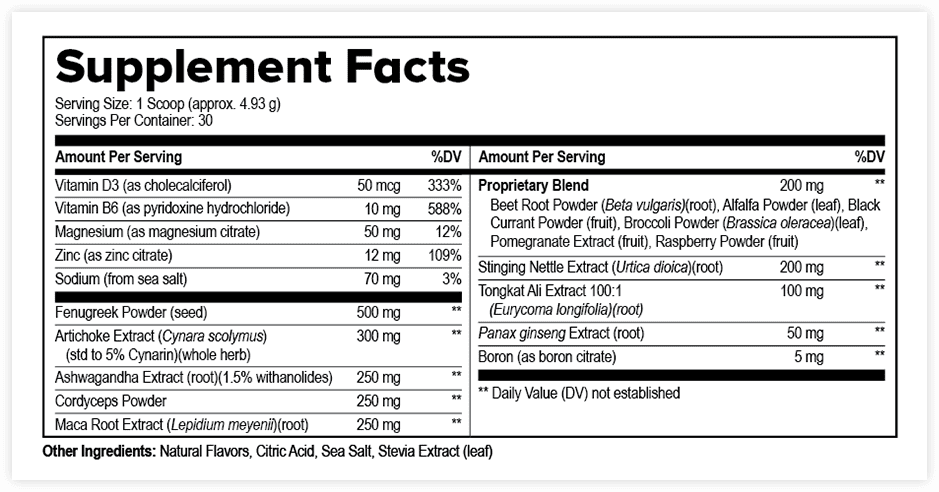
ProstaVive's own panel, read September 3, 2026.
Boron sits on its own line: "Boron (as boron citrate), 5 mg, **".
The footnote below the table reads "** Daily Value (DV) not established."
A two-line check before you read a boron number as good or bad
Step one, find the milligrams; step two, hold them against the four numbers
Find the milligrams
Is boron on its own line, with its own figure, or only named inside a blend with a combined weight?
Hold it against the four numbers
Inside the WHO's 1-13 mg range? Below the 20 mg ceiling? A multiple of the 0.87-1.35 mg diet median? That's the whole check.
One label where we did the arithmetic
Four public numbers and one line on a panel.
The label that prompted this page prints boron at 5 mg with a double asterisk, because there is no Daily Value to print, and the review sets the whole panel out with the arithmetic beside every line.
Two tips: the asterisk means no Daily Value, and compare to the trial dose, not the box
When a line carries an asterisk instead of a percentage, no Daily Value has been established.
The milligram figure is the only information the panel owes you. The ceiling has to come from you.
Compare the milligrams to the dose a trial actually used, not to the largest number on the front of the box.
This panel's 5 mg is double the 2.5 mg of the only human boron supplementation trial we could read.
Fifteen lines, one of them a 200 mg proprietary blend, the 2,105 mg that reconcile with the front of the tub, and the 180-day return clock, each dated.
Questions people also ask
Is there a recommended daily amount of boron?
No. The Food and Nutrition Board found the existing data insufficient to derive an RDA, an AI or an EAR for boron, so no government-set daily amount exists to aim at.
What is the safe upper limit for boron?
The Tolerable Upper Intake Level is 20 mg a day for everyone 19 and over, and the World Health Organization separately describes 1 to 13 mg a day as an acceptable safe range for adults.
Does boron raise testosterone?
The one human supplementation trial we could read, 19 male bodybuilders on 2.5 mg a day for seven weeks (PMID 7889885), reported that the hormonal changes appeared equally in the boron and the placebo groups, and concluded that boron supplementation "affects these variables not at all".
How much boron does food give me?
Median dietary intake in adults runs 0.87 to 1.35 mg a day in the US survey data the fact sheet cites.
Why does a boron line have an asterisk instead of a percentage?
Because no Daily Value has been established, so the panel prints the footnote "Daily Value not established" and gives you the milligrams alone. The ceiling and the safe range have to be brought in from outside the label.
How we built this page
Sources, PMIDs, the dates we read them, and what we did not do
This is a source-reading page. It is not a lab test, and it is not medical advice.
- The no-RDA finding, the WHO safe range, the UL, and the diet median all come from NIH's Office of Dietary Supplements, Boron: Fact Sheet for Health Professionals, read September 3, 2026.
- The testosterone trial is Green NR & Ferrando AA, Environmental Health Perspectives, 1994, PMID 7889885, read September 3, 2026.
- The Daily Value asterisk rule is quoted from 21 CFR 101.36(b)(3)(iv), read via govinfo.gov on September 3, 2026.
- ProstaVive's label panel was read from the seller's own product image on September 3, 2026, for our ProstaVive review.
- A new supplement, at any dose named on this page, is worth a conversation with a doctor first, especially if you are pregnant, nursing, or on medication.