The short answer: 11 mg a day for men 19 and over, with a 40 mg ceiling
Two numbers settle almost every honest question about zinc dosing.
Eleven milligrams a day is the Recommended Dietary Allowance for men age 19 and up.
Forty milligrams a day is the Tolerable Upper Intake Level, the ceiling for adults.
Both come from the same source: the NIH Office of Dietary Supplements' own Zinc fact sheet for health professionals.
A percentage on a Supplement Facts panel is measured against a different, smaller reference than that 40 mg ceiling, which is the part that trips people up. We work through that gap below, on a real label.
Women of the same age: 8 mg. Pregnancy: 11 mg. Lactation: 12 mg.
NIH ODS Zinc fact sheet, read Sep 3, 2026
A daily total from every source, not a per-product allowance.
Same fact sheet, same table
One scoop of a published prostate-support powder we read.
Per the seller's own label, read Sep 3, 2026
Fact sheet figures per NIH Office of Dietary Supplements, Zinc: Fact Sheet for Health Professionals, read September 3, 2026. Label figure per the seller's own panel, read the same day and cited in full below.
Where both numbers come from, and who set them
The RDA table by group, and the fact sheet's own ceiling sentence, with the link
Both figures sit in the same government document, not two different ones.
The NIH Office of Dietary Supplements publishes a Zinc fact sheet for health professionals, and it carries a Recommended Dietary Allowance table by age and sex.
| Group, 19 years and up | RDA |
|---|---|
| Men | 11 mg/day |
| Women | 8 mg/day |
| Pregnancy | 11 mg/day |
| Lactation | 12 mg/day |
The same fact sheet also sets the ceiling, in its own words.
"The Tolerable Upper Intake Level for zinc is 40 mg for adults, and it ranges from 4 to 34 mg for infants, children, and adolescents, depending on age."
NIH Office of Dietary Supplements, Zinc Fact Sheet for Health Professionals, read Sep 3, 2026One RDA table, one ceiling line, one document. Neither number is brand language.
NIH Office of Dietary Supplements, Zinc: Fact Sheet for Health Professionals, ods.od.nih.gov/factsheets/Zinc-HealthProfessional, read September 3, 2026.
What sits above the ceiling: the 50 mg copper line
Forty milligrams is not an arbitrary round number. It sits just below a described effect.
"Doses of 50 mg of zinc or more over a period of weeks can inhibit copper absorption, reduce immune function, and lower high-density lipoprotein cholesterol levels; however, it is unlikely that a person would obtain this much zinc from food alone."
NIH ODS Zinc Fact Sheet, read Sep 3, 2026That sentence is what gives the 40 mg ceiling practical meaning.
It is not an abstract line on a chart. It is the distance to a named effect, at 50 mg and up, sustained over weeks.
The same fact sheet adds that high zinc intakes can also cause nausea, dizziness, headaches, gastric distress, vomiting, and loss of appetite.
The fact sheet is a nutrient reference, not a verdict on any one product
Nothing in the NIH Office of Dietary Supplements' Zinc fact sheet names a brand, tests a finished multi-ingredient product, or scores a formula.
- It sets an RDA and a ceiling for the mineral zinc. It does not evaluate the other ingredients on any label that happens to contain zinc.
- It does not say a 12 mg dose works better, or worse, than a 20 mg or a 30 mg dose for any particular person.
- It carries no line about prostate size, urinary symptoms, or any specific health outcome, and this page does not add one.
What this means for you: the numbers on this page describe the mineral, not any product's results.
Zinc does have a Daily Value, so the panel hands you a percentage
Why zinc prints a percentage where other lines print an asterisk, and why that percentage is a different ruler
Some nutrients on a Supplement Facts panel carry no percentage at all, only an asterisk and a footnote reading "Daily Value not established."
Zinc is not one of them. A Daily Value for zinc is set, so every panel that lists it also prints a percent figure next to the milligrams.
That percentage is useful. It is also a different ruler than the 40 mg ceiling, and mixing the two up is the easiest mistake on this page to make.
The next section is that mix-up, worked through on one real label.
A percentage over 100 is not the same as being over the limit
Here is the label line at the center of this page, transcribed from the seller's own Supplement Facts panel.
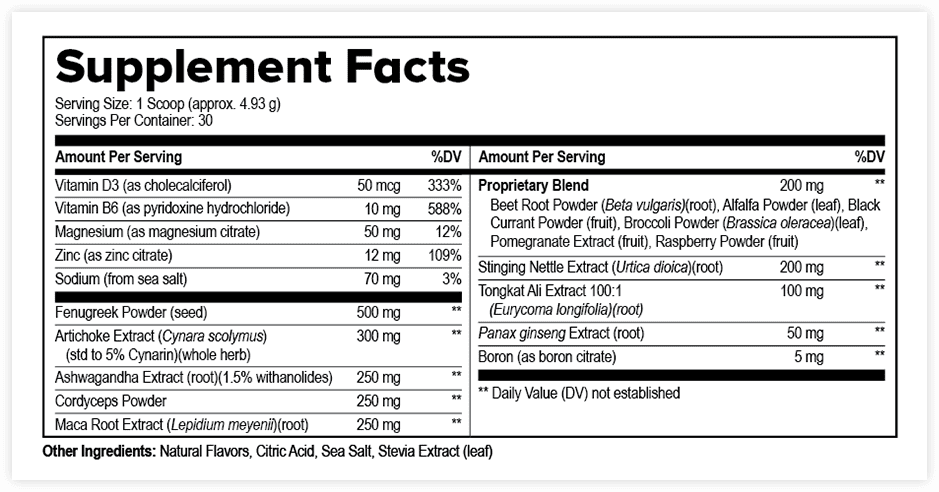
The full panel, read from the seller's own product page on September 3, 2026.
Serving Size: 1 Scoop (approx. 4.93 g). Servings Per Container: 30.
Row four reads "Zinc (as zinc citrate), 12 mg, 109%."
Twelve milligrams is 1 mg above the 11 mg RDA for a man, and 28 mg below the 40 mg ceiling.
The 109% figure looks alarming next to that math, and it should not.
The same panel shows why a percentage alone can never answer a ceiling question on its own.
| Same panel, same serving | Amount | % Daily Value |
|---|---|---|
| Vitamin D3 (as cholecalciferol) | 50 mcg | 333% |
| Vitamin B6 (as pyridoxine hydrochloride) | 10 mg | 588% |
| Zinc (as zinc citrate) | 12 mg | 109% |
Vitamin B6 on the same line reads 588% Daily Value. Vitamin D3 reads 333%. Both percentages are far larger than zinc's 109%, on ingredients that carry their own separate ceilings entirely.
The niacin parallel, what the percentage gives you, what it does not, and the panel source
A triple-digit Daily Value looks alarming until you know which ruler it is measured against; niacin on the Protoflow panel shows the same pattern, at 469%. See how much niacin is too much.
A percentage tells you where a dose sits against its own Daily Value. It does not, by itself, tell you where that same dose sits against a Tolerable Upper Intake Level measured in milligrams.
What the percentage gives you
- A quick way to see whether a serving supplies most, or only a fraction, of a nutrient's Daily Value.
- A number the maker has committed to in print, on the panel in your hand.
- A way to compare two zinc products against the same reference.
What it still does not give you
- A reading against the 40 mg Tolerable Upper Intake Level, which uses milligrams, not percent.
- Any information about the other 14 ingredients sharing the same panel.
- Evidence that the finished product changes prostate size, urinary symptoms, or any other outcome.
Panel quoted from the seller's own product page for ProstaVive, read September 3, 2026. RDA and Upper Intake Level per NIH Office of Dietary Supplements, read the same day.
The ceiling is a daily total, so the shelf counts, not the bottle
The 40 mg figure is a daily total across everything a person takes and eats, not an allowance per product.
That distinction matters most for anyone taking more than one thing at once.
Three steps to add up a shelf, and three alternatives when one line sits close to 40 mg
Find the milligrams
Look past the percentage for the actual mg figure on each zinc-containing label.
Add the shelf up
A multivitamin, a zinc lozenge, and a powder can each carry their own zinc line. Add them before comparing to 40 mg.
Count the plate too
The 40 mg ceiling is a daily total from all sources, food included, not just what comes from a capsule or scoop.
When a single product's own zinc line already sits close to 40 mg, three generic alternatives are worth naming.
A single-ingredient zinc product that states its own milligrams on its own line, so nothing else on the shelf hides inside it.
A formula, like the one on this page, where zinc is one line among several and the total still leaves headroom under 40 mg.
Or a food-first approach, remembering the fact sheet's own note that food alone is unlikely to reach the 50 mg level, so eating well is not a way around counting the supplements.
What the same fact sheet says about medicines
The Zinc fact sheet does not stop at intake numbers. It also lists interactions worth knowing before adding a zinc-containing product to an existing medicine.
- Quinolone and tetracycline antibiotics: zinc can reduce how much of these drugs the body absorbs.
- Penicillamine, used for conditions such as rheumatoid arthritis: zinc can interfere with this medicine too.
- Diuretics: the fact sheet notes that "some diuretics can decrease serum zinc concentrations by increasing zinc excretion in urine," the opposite direction, a loss rather than a block.
None of that is a reason to avoid zinc on its own. It is a reason to mention any zinc-containing supplement to a doctor or pharmacist alongside a current medication list.
Interactions per NIH Office of Dietary Supplements, Zinc: Fact Sheet for Health Professionals, read September 3, 2026.
One label where we did the arithmetic
Two numbers, 11 and 40, and one column to hold them against.
We ran that comparison on a prostate powder whose entire panel is published, fifteen lines, each with a milligram figure, one of them a 200 mg proprietary blend, and whose zinc line reads 12 mg at 109% Daily Value.
The full review walks every one of those fifteen lines, plus the checkout totals and the refund window, each with the date we read it.
Two tips: read the serving size, and add every zinc source before comparing to 40 mg
Read the serving size first. This panel is written per scoop of about 4.93 g, so half a scoop halves the zinc and two scoops double it.
Add every zinc source on the shelf together before comparing to 40 mg. The ceiling is a daily total across everything you take, not a per-product allowance.
The full fifteen-line panel, one of them a 200 mg proprietary blend, the 2,105 mg that add up, and what each pack charges at checkout, each dated.
Questions people also ask
What is the recommended zinc intake for a man?
The NIH Office of Dietary Supplements lists 11 mg a day for males 19 and over, against 8 mg for women of the same age.
Is 40 mg of zinc a day safe?
Forty milligrams is the Tolerable Upper Intake Level for adults, meaning the top of the range rather than a target, and the fact sheet notes that food alone is unlikely to reach the 50 mg level above it.
What happens if I take 50 mg of zinc for weeks?
The fact sheet is specific: doses of 50 mg or more over a period of weeks can inhibit copper absorption, reduce immune function, and lower HDL cholesterol, and it notes food alone is unlikely to reach that amount.
Does 109% Daily Value mean I am over the limit?
No. The percentage is measured against the Daily Value, not against the 40 mg ceiling. A 12 mg line at 109% sits 28 mg below the ceiling on its own.
Do I need to count the zinc in my food too?
Yes. Forty milligrams is the Tolerable Upper Intake Level for adults, the top of the range rather than a target, and the fact sheet notes that food alone is unlikely to reach the 50 mg level above it, so a supplement adds to the plate rather than replacing it.
How we built this page
Sources, the dates we read them, and what we did not do
This is a source-reading page. It is not a lab test, and it is not medical advice.
- The RDA table, the 40 mg ceiling, the 50 mg copper line, and the medicine interactions all come from NIH Office of Dietary Supplements, Zinc: Fact Sheet for Health Professionals, read September 3, 2026.
- The Supplement Facts panel, including the zinc, Vitamin B6, and Vitamin D3 lines, was read from ProstaVive's own product page on September 3, 2026, for our ProstaVive review.
- We did not test any product, and we did not estimate a total daily zinc intake for any individual reader.
- Nothing here is medical advice. A new supplement while you are on medication, pregnant, or nursing is a conversation with a doctor or pharmacist first.