The short answer: on the seven trials we read, NMN dosage runs in four trial bands, from 250 mg up to 2,000 mg a day
There is no single "correct" NMN dose, and no trial has tested every number on the market.
The lowest repeated-dose band, 250 mg/day, raised NAD+ in the two trials that measured it: in peripheral blood mononuclear cells after 10 weeks (PMID 33888596) and in whole blood after 12 weeks (PMID 35927255). A three-arm trial then tested 300, 600 and 900 mg/day against each other and against placebo over 60 days (PMID 36482258). A four-week safety trial gave 1,250 mg/day to 31 healthy adults and reported no severe adverse events (PMID 36002548). The highest dose in the NMN trials we read, 2,000 mg/day (1,000 mg twice daily), was given for 14 days in one trial (PMID 35182418) and 28 days in another (PMID 36740954). None of these trials ran longer than 24 weeks, which is not a recommendation, just what these trials, read directly, actually say.
Where the full source list lives
What is actually published is a set of dose bands, each tied to a specific trial, duration and outcome.
Trial identifiers are given throughout; see "How we built this page" near the bottom for the full source list, each read in September 2026.
The dose-response table the SERP does not show you
Dose band by trial: participants, duration, blood NAD+ and functional outcome for all six arms (Yoshino 2021, Igarashi 2022, Akasaka 2023, Yi 2023)
Most NMN content repeats "250 to 900 mg is the studied range" and stops there. The trials behind that range measured different things, over different lengths of time, in different people. Reading them side by side is the point of this page.
| Dose band | Trial | Duration | Blood NAD+ | Functional outcome tested |
|---|---|---|---|---|
| 250 mg/day | Yoshino 2021, PMID 33888596; n=25 postmenopausal women with prediabetes, overweight or obese | 10 weeks | PBMC NAD+ up after NMN, unchanged after placebo | Muscle insulin sensitivity up after NMN, unchanged after placebo; handgrip strength not affected |
| 250 mg/day | Igarashi 2022, PMID 35927255; n=42 randomized (20 completed), healthy men 65+ | 12 weeks | Whole-blood NAD+ significantly up | Nominally significant gains in gait speed and left grip; right grip not significant |
| 250 mg/day | Akasaka 2023, PMID 36443648; n=14 men 65+ with diabetes, reduced grip or walking speed | 24 weeks | Not reported in the abstract | No difference from placebo in grip strength or walking speed |
| 300 mg/day | Yi et al. 2023 (epub Dec 2022), PMID 36482258; n=80 healthy adults 40 to 65, arm 1 of 3 | 60 days | Up vs placebo; lower than the 600 mg arm | 6-min walk up vs placebo; shorter than the 600 mg arm |
| 600 mg/day | Same trial, PMID 36482258, arm 2 | 60 days | Significantly higher than the 300 mg arm | 6-min walk significantly longer than the 300 mg arm |
| 900 mg/day | Same trial, PMID 36482258, arm 3 | 60 days | Not statistically different from 600 mg | 6-min walk up vs placebo; not statistically different from 600 mg |
Doses, durations and outcomes are drawn from the trials as cited, each with its own PubMed identifier. "Not reported in the abstract" means the abstract we read does not include that measurement, not that the trial found nothing.
The lowest dose that raised blood NAD+, and the trial where the same dose did nothing functional
250 mg a day is the floor of the repeated-dosing range, and a 12-week and a 24-week trial give two different pictures of what it does.
Together, the honest conclusion is narrower than "250 mg works": the NAD+ rise showed up in both of the trials that measured it. The functional gain, gait or grip, was nominally significant in healthy older men over 12 weeks, did not appear in older men with diabetes over 24 weeks, and did not appear in handgrip strength in the 10-week women's trial. Age and baseline health, not the milligram number, look like what separated the groups.
The win (healthy men 65+, 12 weeks), the miss (men 65+ with diabetes, 24 weeks), the 10-week women's trial, and the citations
250 mg/day for 12 weeks significantly raised whole-blood NAD+. Gait speed (P = 0.033) and left grip strength (P = 0.019) showed what the authors call nominally significant improvements, which they say should be validated in larger studies; right grip strength did not reach significance.
PMID 35927255, 42 randomized, 20 completed, healthy men 65 and older
Same 250 mg/day dose, but for 24 weeks in men 65 and older with diabetes and reduced grip strength (under 26 kg) or walking speed (under 1.0 m/s) at baseline. The changes in grip strength and walking speed showed no difference between the NMN and placebo groups.
PMID 36443648, n=14, mean age 81
A third 250 mg/day trial, 10 weeks in postmenopausal women with prediabetes who were overweight or obese (PMID 33888596, n=25), found muscle insulin sensitivity increased after NMN and did not change after placebo; its handgrip strength measurement was not affected by 10 weeks of either NMN or placebo, and it did not measure gait speed.
All three trials are cited above with PubMed identifiers. None tested a finished multi-ingredient product; each dosed NMN alone.
Is more better? What 300, 600 and 900 mg showed, and where the gain stopped climbing
The pattern worth remembering is not "900 beats 600 beats 300". Both NAD+ and walking distance rose significantly from the 300 mg arm to the 600 mg arm, and neither measure was statistically different between the 600 mg and 900 mg arms. The authors' own conclusion: clinical efficacy expressed by blood NAD concentration and physical performance "reaches highest at a dose of 600 mg daily oral intake".
That is one 60-day trial in healthy 40-to-65-year-olds, not a universal ceiling, but it is the closest thing to a real dose-response curve this page can point to, and it does not support the assumption that a bigger number keeps buying a bigger result in a straight line.
Arm by arm: what 300, 600 and 900 mg/day each did to blood NAD+ and the 6-minute walk, and the citation
One trial answers this directly, because it is the only one in our source list that put three doses in the same design, against the same placebo, over the same 60 days.
Doses, durations and both outcome patterns per Yi et al., GeroScience 2023 (epub Dec 2022), PMID 36482258, n=80, healthy adults 40 to 65, 20 per arm.
Label math: what 500 mg and 1,000 mg a day actually cost, and where each falls in the bands above
A Supplement Facts panel we read prints a plain, single-ingredient NMN capsule: 500 mg of NMN per capsule, one capsule per serving, 60 capsules a bottle, suggested use of 1 to 2 capsules a day.
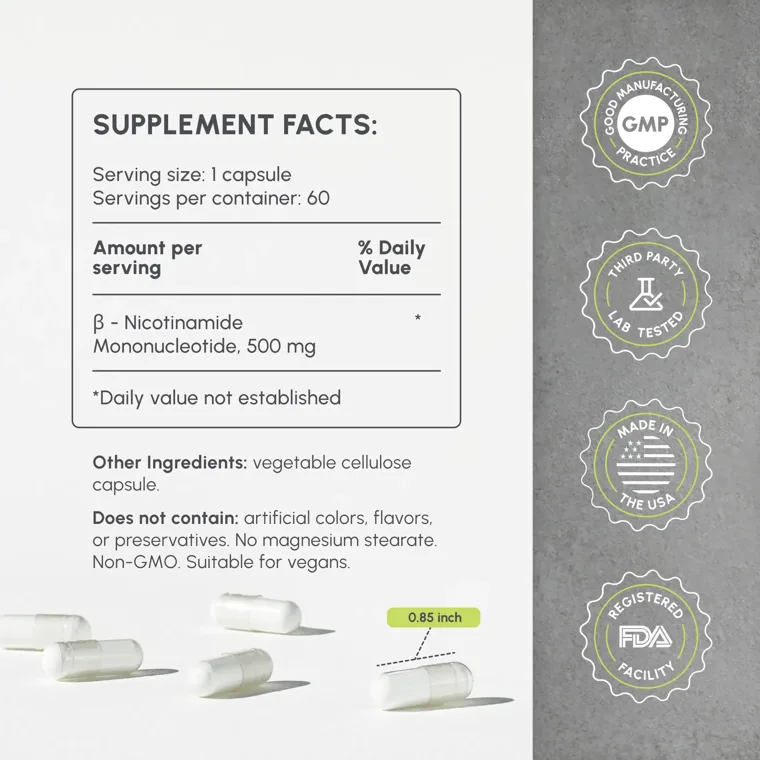
At 1 capsule a day, that is 500 mg/day, a bottle lasts 60 days, and at $64.99 a bottle that works out to about $32.50 a month.
At 2 capsules a day, that is 1,000 mg/day, a bottle lasts 30 days, so the same $64.99 bottle becomes about $64.99 a month.
Where 500 mg and 1,000 mg sit against the trial bands, and where the label and price were read
Both fall inside the territory the trials above cover: 500 mg sits above the 250 mg band and between the 300 mg and 600 mg arms of the three-arm trial; 1,000 mg once a day was itself an arm of a 14-day trial, and is half of the 2,000 mg/day given for 28 days in the highest-dose trial we read. Neither 500 mg nor 1,000 mg is an untested guess.
Label figures (500 mg per capsule, 60 capsules, 1 to 2 capsules suggested) and the $64.99 one-bottle price are read from one product's own Shopify listing and Supplement Facts panel, checked September 2026. The monthly-cost math is ours, applied to those published numbers.
A starting protocol, built from the trial durations above, not a guess
Four steps: weeks 1 to 4 at 500 mg, reassess at weeks 8 to 12, step up only with a reason, and when to stop
If the trials are the only real map of what has been tested, the sanest way to start is to follow their timing, not skip to their top dose.
Weeks 1 to 4: one capsule, 500 mg/day
500 mg sits above the 250 mg dose that raised whole-blood NAD+ over 12 weeks and between the 300 mg and 600 mg arms of the three-dose trial. None of the trials cited here attributed an adverse event to NMN; where counted, rates were similar to placebo. Write down anything new anyway.
Weeks 8 to 12: reassess
This window matches the trials that reported a result (60 days for the three-arm trial, 12 weeks for gait and grip, 10 weeks for insulin sensitivity). Measure whatever you started this to change, the same way at week 0 and again here, not a felt impression alone.
Step up only if there is a reason to
Two capsules, 1,000 mg/day, matches the once-daily arm of a 14-day trial and is half of the 2,000 mg/day given for 28 days: not shown to outperform 500 mg, just still inside tested territory.
When to stop
No change at the checkpoint above, or any new symptom that does not settle, are both reasonable stops. No trial cited here ran past 24 weeks, so there is no published guidance past that window.
Protocol built from the durations and outcomes of the trials cited throughout this page. This is a suggested framework for tracking your own response, not a dosage recommendation, and is not medical advice.
Doses beyond the NMN trials we read, and what a 2 gram-a-day habit would actually cost
The longest higher-dose trial we read gave 1,250 mg a day for four weeks. 2,000 mg a day exists in the published record as a 14-day pharmacokinetic study and a 28-day physiologic study, not as a sustained protocol. Above 2,000 mg a day, none of the NMN trials we read go.
What "highest dose in the NMN trials we read" does and does not mean, the 2 g/day cost math, and the citations
What "highest dose in the NMN trials we read" does and does not mean
- The 1,250 mg/day trial ran four weeks in 31 healthy adults aged 20 to 65 and reported no severe adverse events (PMID 36002548). The 250 mg trials below it ran 10 to 24 weeks and the 300 to 900 mg trial ran 60 days. None of the trials on this page ran a year or longer.
- The 2,000 mg/day figure (Pencina et al., PMID 35182418, PMID 36740954) was given for 14 and 28 days respectively, in overweight or obese adults, with adverse events reported as similar across groups. None of the NMN trials we read tests 2,000 mg a day for longer than that, and none tests any NMN dose above 2,000 mg a day. A dose or duration beyond what a trial used is not shown to do more, or less, than one inside the tested bands. It is simply unmeasured.
The cost math: $64.99 a bottle divided by 60 capsules is about $1.08 per 500 mg capsule, so a 2,000 mg/day habit is four capsules a day, twice the top of that label's own suggested use of 1 to 2 capsules a day, about $4.33 a day, or roughly $130 a month, for a dose only ever given for 14 to 28 days in the NMN trials we read.
1,250 mg/day safety figures per Fukamizu et al., Sci Rep 2022, PMID 36002548; 2,000 mg/day figures per Pencina et al., PMID 35182418 (14 days) and PMID 36740954 (28 days). The $1.08 per capsule and the 2 g/day cost calculation are our arithmetic on the $64.99, 60-capsule listing read in September 2026.
Questions people also ask
How much NMN should I take per day for the first month?
A common starting point is one 500 mg capsule a day for the first four weeks. 500 mg sits above the 250 mg dose that raised whole-blood NAD+ in a 12-week trial in healthy men 65 and older (npj Aging 2022, PMID 35927255) and between the 300 mg and 600 mg arms of a three-arm, 60-day dose-response trial (GeroScience 2023, epub Dec 2022, PMID 36482258). Reassess at 8 to 12 weeks, the window in which those two trials reported their results, and talk to a doctor before starting if you take medication or have a health condition.
Is 500 mg of NMN enough to raise NAD+?
By the trial evidence, yes. A 250 mg daily dose significantly increased whole-blood NAD+ over 12 weeks in healthy men 65 and older (npj Aging 2022, PMID 35927255), and a separate three-arm trial found that 300, 600 and 900 mg per day all raised blood NAD+ compared with placebo at day 30 and day 60 (GeroScience 2023, epub Dec 2022, PMID 36482258). 500 mg sits above both of those lower doses and below the 600 mg arm, so it is inside tested territory, not below it.
Is 1,000 mg of NMN too much?
1,000 mg once a day was one arm of a 14-day trial in 32 overweight or obese adults aged 55 to 80, which reported that adverse-event frequency was similar across groups (PMID 35182418). The highest daily dose in the NMN trials we read is 2,000 mg, given as 1,000 mg twice daily, for 14 days in that trial and for 28 days in a second trial of 30 overweight or obese adults 45 and older, where adverse events were again similar between groups (PMID 36740954). Those are tolerability findings over two to four weeks, not evidence that 1,000 mg does more than 500 mg, and neither trial ran longer than 28 days.
Does NMN dosage depend on age or weight?
The published trials cited on this page did not scale the dose to body weight; each gave every participant in an arm the same flat milligram amount per day. Age and baseline health look more consequential than weight in the results: at 250 mg a day, healthy men 65 and older showed nominally significant improvements in gait speed and left-hand grip over 12 weeks (PMID 35927255), while men 65 and older with diabetes and reduced grip strength or walking speed at baseline showed no difference from placebo in grip strength or walking speed over 24 weeks (Geriatr Gerontol Int 2023, PMID 36443648).
How we built this page
All seven trials with their PubMed identifiers, the label and price source, and what we deliberately left off
This is a literature-and-label page, not a lab test or a clinical protocol. Every dose, duration and outcome above comes from a named, indexed trial, read against its PubMed record and, where open access, its full text, or from one product label we read directly.
- 250 mg/day, 10 weeks, insulin sensitivity and PBMC NAD+: Yoshino et al., Science 2021, PMID 33888596.
- 250 mg/day, 12 weeks, whole-blood NAD+ and physical function: Igarashi et al., npj Aging 2022, PMID 35927255.
- 250 mg/day, 24 weeks, no functional improvement in an impaired population: Akasaka et al., Geriatr Gerontol Int 2023, PMID 36443648.
- 300/600/900 mg/day, 60 days, three-arm dose response: Yi et al., GeroScience 2023 (epub Dec 2022), PMID 36482258.
- 1,000 mg once or twice daily, 14 days, 32 overweight or obese adults 55 to 80: Pencina et al., J Gerontol A 2023, PMID 35182418.
- 1,000 mg twice daily, 28 days, 30 overweight or obese adults 45 and older: Pencina et al., J Clin Endocrinol Metab 2023, PMID 36740954.
- 1,250 mg/day, 4-week safety trial, 31 healthy adults 20 to 65: Fukamizu et al., Sci Rep 2022, PMID 36002548.
- Label figures (500 mg per capsule, serving size, servings per container, suggested use) and the $64.99 one-bottle price come from one product's own Shopify listing and Supplement Facts panel, checked September 2026. The $1.08 per capsule is our division of that price by 60.
- Single-dose pharmacokinetic arms below 250 mg (100 mg in Irie et al. 2020, PMID 31685720) and the short 8-day 1,200 mg/day pharmacokinetic arm of the 2026 blood-and-brain study (PMID 41858901) are covered on our best time to take NMN page and are not daily-dosing bands, so they are not listed here.
- We did not run any dose ourselves, and we did not estimate a milligram figure for any trial that does not report one. Animal doses and any animal-to-human conversion are deliberately left off this page.
- Nothing here is medical advice. Anyone pregnant, nursing, on blood thinners, or on any medication should talk to a doctor before starting NMN at any dose.
The capsule where the label math actually checks out
Once you know one 500 mg capsule already sits inside the studied band, the practical question stops being "how much" and becomes "which 500 mg capsule was actually measured at 500 mg".
The checkout label we ran this against, and two tips before comparing on price
We ran that exact question against a real checkout label: a single-ingredient NMN capsule claiming 500 mg per serving, with two public lab certificates behind the number.
Check whether a brand publishes an independent lab certificate for its milligram claim before comparing on price. A 500 mg label with no certificate behind it is a claim, not a measurement.
Run the same per-capsule and per-month math on any bottle you consider. Serving size and capsule count decide your real dose more than the front-of-label number alone.
The lab sheet that shows what 500 mg on this particular label actually measured, with the date we read it.